
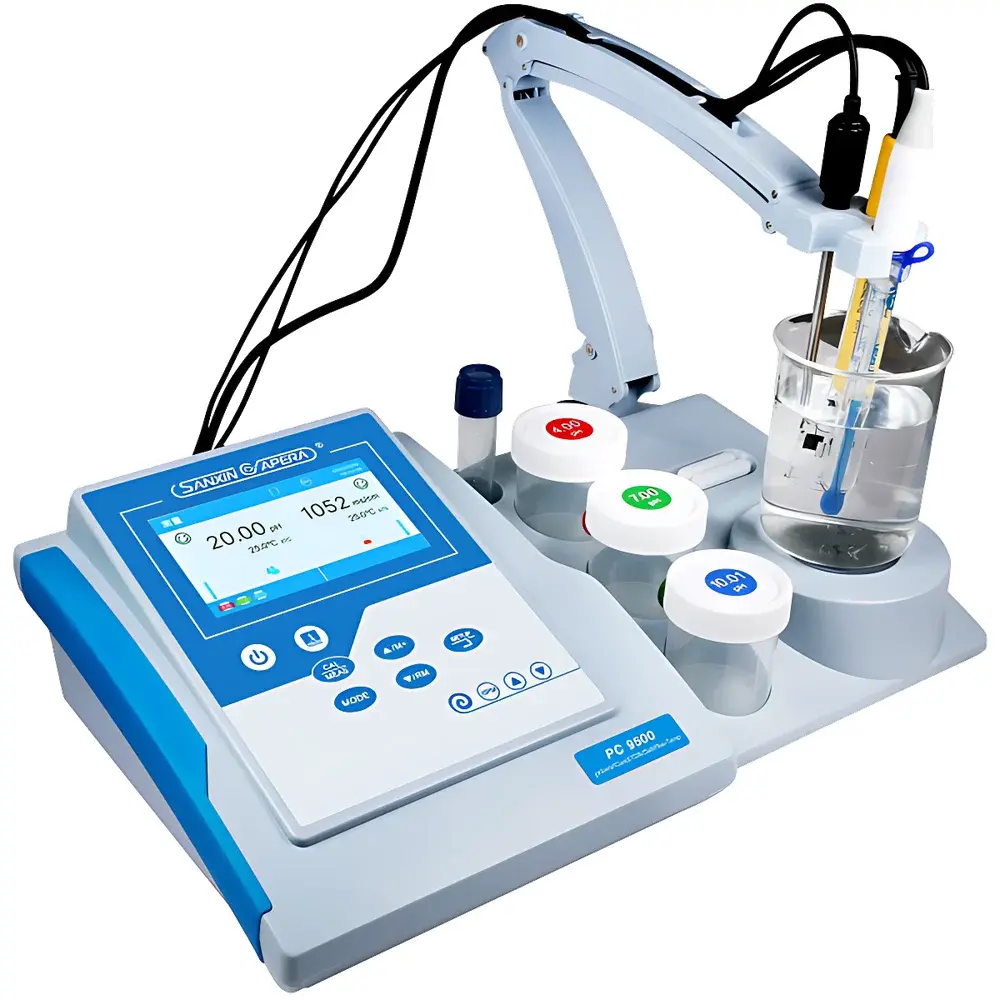
SANXIN PC9500 Benchtop pH/Conductivity Multi-Parameter Water Quality Analyzer
| Brand | SANXIN |
|---|---|
| Origin | Shanghai, China |
| Manufacturer Type | OEM Manufacturer |
| Product Category | Domestic |
| Model | PC9500 |
| Instrument Type | Laboratory Water Quality Analyzer |
| Detection Principle | Electrochemical Method |
| Measured Parameters | pH, mV, Conductivity, TDS, Salinity, Resistivity, Temperature |
| Measurement Ranges | pH: −2.000–20.000 |
| mV | ±2000.0 |
| Conductivity | 0.00 μS/cm–2000 mS/cm |
| TDS | 0.00 mg/L–1000 g/L |
| Salinity | 0.00–100 ppt |
| Resistivity | 0.00 Ω·cm–100 MΩ·cm |
Overview
The SANXIN PC9500 Benchtop pH/Conductivity Multi-Parameter Water Quality Analyzer is a high-precision electrochemical laboratory instrument engineered for rigorous analytical environments in environmental monitoring, academic research, regulatory compliance testing, and quality control laboratories. It implements dual-channel simultaneous measurement of pH and conductivity using standardized potentiometric and conductimetric principles—compliant with ISO 7888 (conductivity), ISO 10523 (pH of water), and ASTM D1125 (electrical conductivity of water). The analyzer features a robust architecture with integrated temperature compensation across all parameters, supporting both automatic and manual thermal correction per IUPAC-recommended algorithms. Designed to meet GLP/GMP data integrity requirements, the PC9500 delivers traceable, auditable measurements with full metadata capture—including electrode ID, operator code, sample ID, calibration history, and timestamped event logs.
Key Features
- Dual-channel real-time measurement of pH and conductivity—eliminating sequential measurement delays and cross-parameter drift.
- TFT color display with intuitive multilingual graphical interface (English, German, Spanish, Chinese) and context-sensitive on-screen guidance.
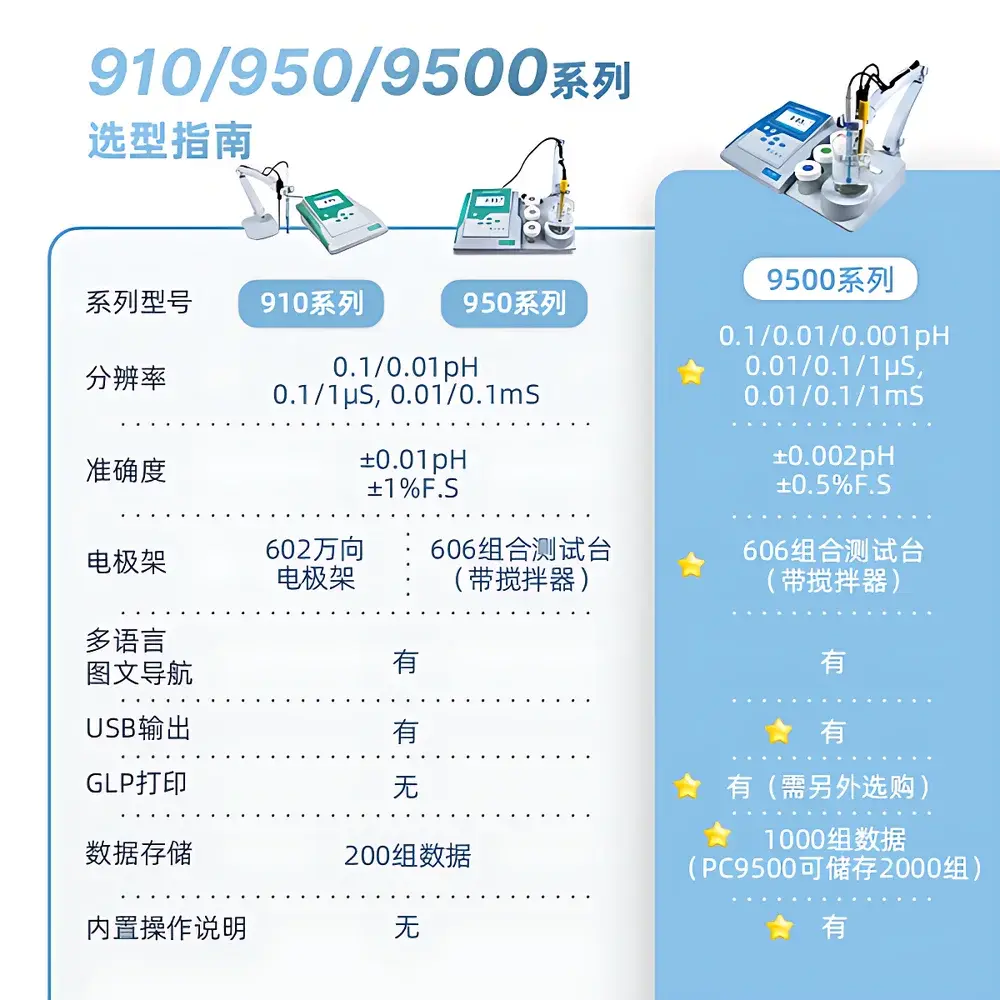
- High-accuracy pH measurement: ±0.002 pH ±1 digit, with 0.001-pH resolution and 1–5-point auto-calibration featuring buffer recognition (USA, NIST, CH, or user-defined standards).
- Precision conductivity measurement: ±0.5% FS ±1 digit, 0.01 μS/cm minimum resolution, and selectable cell constants (0.1 / 1.0 / 10 cm⁻¹) for optimal range matching.
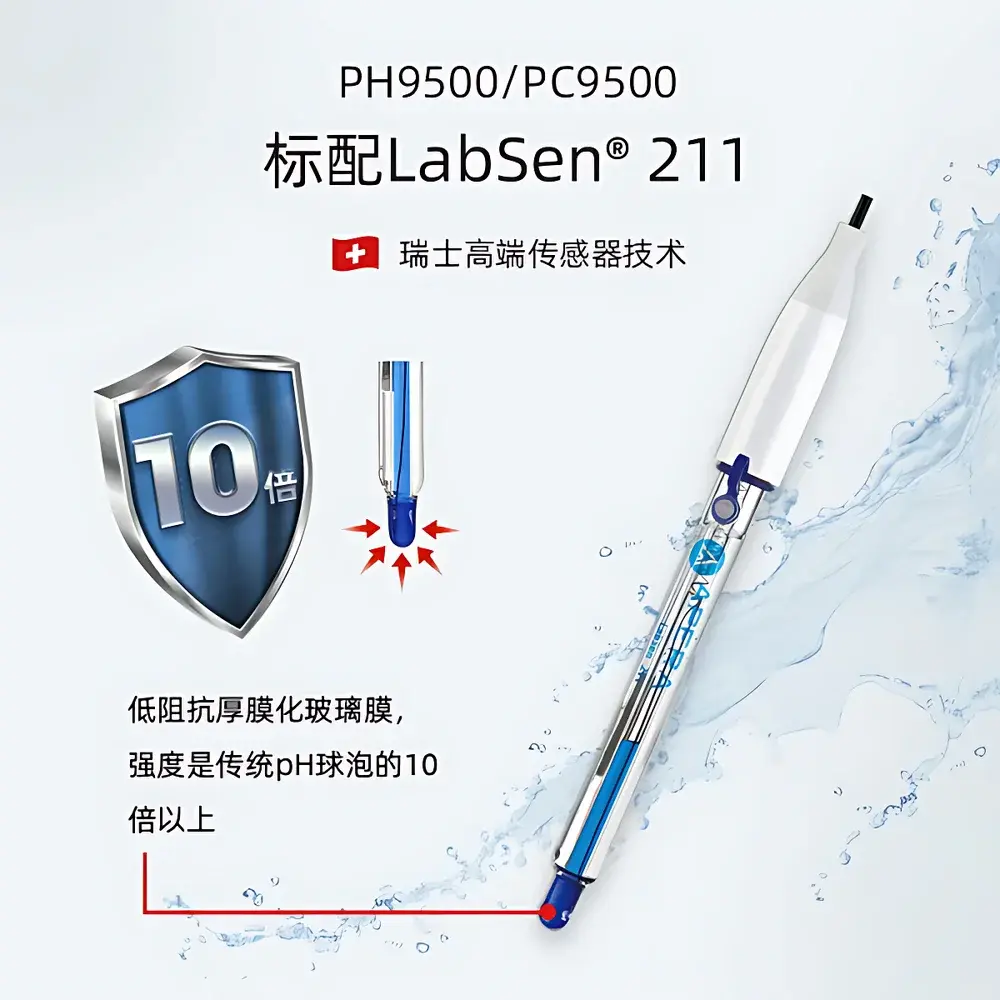
- Integrated LabSen®211 rechargeable glass pH electrode: ultra-low impedance, thick-film glass membrane (10× mechanical strength vs. conventional electrodes), gel-filled reference system eliminating bubble formation during inversion.
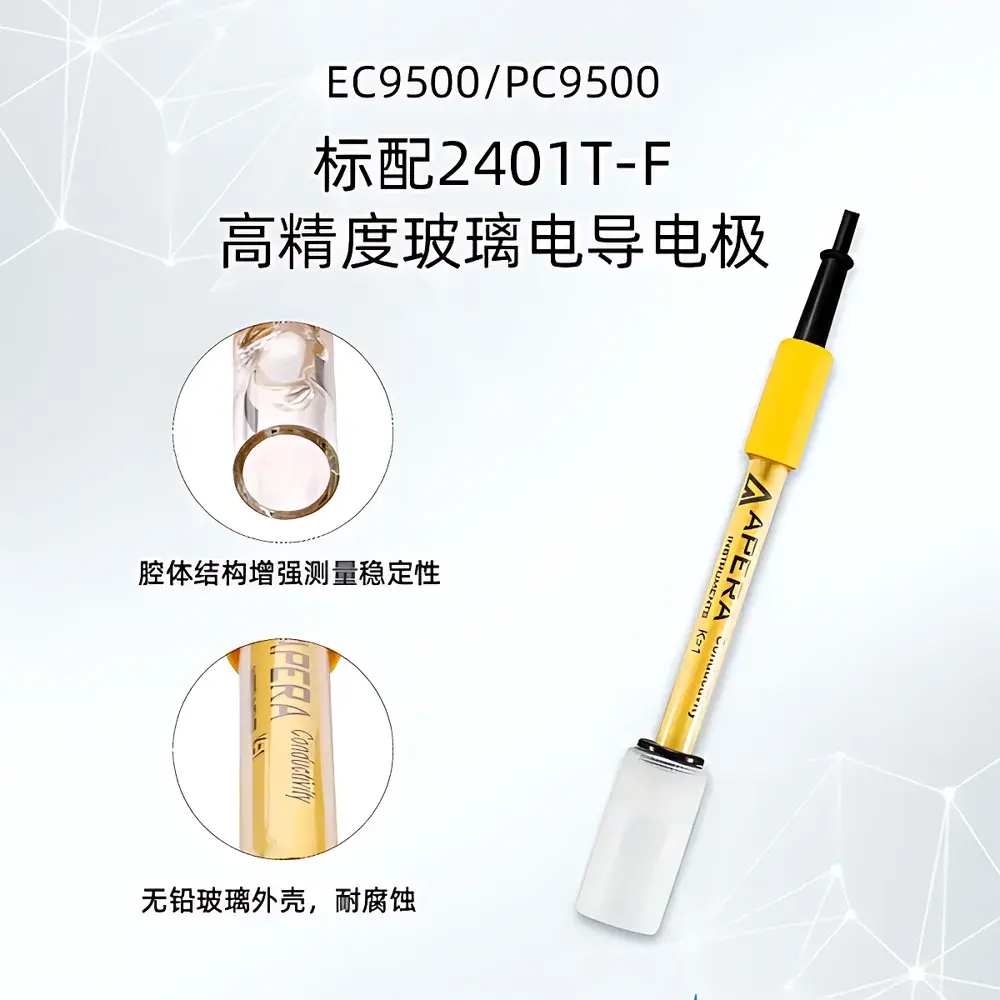
- 2401T-F high-stability conductivity cell (K = 1.0 cm⁻¹): platinum black plating, corrosion-resistant lead-free glass body, built-in thermistor for simultaneous temperature sensing and automatic compensation.
- Intelligent 606 multi-function test stand: motorized stirrer with infinitely variable speed control and memory recall; universal electrode holder with secure accessory docking and solution bottle storage.
- Comprehensive data management: 2000 GLP-compliant measurement records with editable fields (operator ID, company name, electrode serial number), password-protected calibration settings, and USB export to CSV or Excel-compatible formats.
Sample Compatibility & Compliance
The PC9500 is validated for use with aqueous matrices including drinking water, wastewater, surface water, seawater, industrial process streams, and laboratory reagent solutions. Its measurement algorithms conform to internationally accepted conversion models: linear TDS scaling (0.40–1.00 factor), PSS-78 seawater salinity calculation, and NaCl-based salinity referencing. All electrical safety and EMC performance comply with IEC 61010-1:2010 (Safety Requirements for Electrical Equipment for Measurement, Control, and Laboratory Use) and EN 61326-1:2013 (EMC for Laboratory Equipment). The device supports audit-ready operation under FDA 21 CFR Part 11 when paired with validated third-party LIMS or ELN systems via USB-hosted data transfer.
Software & Data Management
Data acquisition and reporting are fully GLP-aligned: each stored record includes date/time stamp, measured values, raw sensor outputs, calibration coefficients, temperature at measurement, and user-defined identifiers. USB connectivity enables direct transfer to Windows/macOS systems without proprietary drivers. Optional USB-connected dot-matrix printers generate hard-copy reports containing full measurement metadata—formatted to satisfy internal QA documentation or external accreditation audits (e.g., ISO/IEC 17025). The “i” button provides embedded contextual help—displaying operational diagrams, calibration workflows, error code explanations, and maintenance protocols directly on-device—reducing reliance on printed manuals and minimizing training overhead.
Applications
- Environmental laboratories performing EPA Method 120.1 (pH), 120.2 (conductivity), and ASTM D5391 (conductivity of purified water).
- Pharmaceutical QC labs verifying USP water conductivity specifications across Purified Water and Water for Injection batches.
- Academic teaching labs conducting titration validation, buffer characterization, and electrolyte solution behavior studies.
- Municipal water treatment facilities monitoring intake, filtration effluent, and distribution system stability.
- Marine biology research stations measuring estuarine salinity gradients and conductivity-temperature-depth (CTD) profiling support.
- Industrial hygiene programs assessing cooling tower water chemistry and corrosion potential indicators.
FAQ
Does the PC9500 support FDA 21 CFR Part 11 compliance?
Yes—when used with validated external software (e.g., certified LIMS or ELN platforms), its password-protected calibration controls, electronic signature fields, and immutable audit trails meet core ALCOA+ data integrity criteria.
Can the LabSen®211 pH electrode be used for low-ionic-strength samples?
Yes—the electrode’s stable Ag/AgCl reference system and low-resistance glass membrane ensure reliable response down to deionized water (≥1 µS/cm), with optional refillable KCl bridge for extended low-conductivity applications.
Is automatic temperature compensation available for all parameters?
Yes—each parameter (pH, conductivity, TDS, salinity, resistivity) applies independent, user-selectable temperature compensation curves based on standard reference tables or custom coefficients.
What file format is generated during USB data export?
CSV (comma-separated values) files compatible with Microsoft Excel, GraphPad Prism, and most LIMS platforms—containing column headers, units, timestamps, and metadata tags.
How many calibration points can be stored per parameter?
Up to five for pH (with full buffer identification and slope/asymmetry diagnostics) and up to four for conductivity/TDS/salinity/resistivity—with automatic retention of historical calibration certificates per session.







