
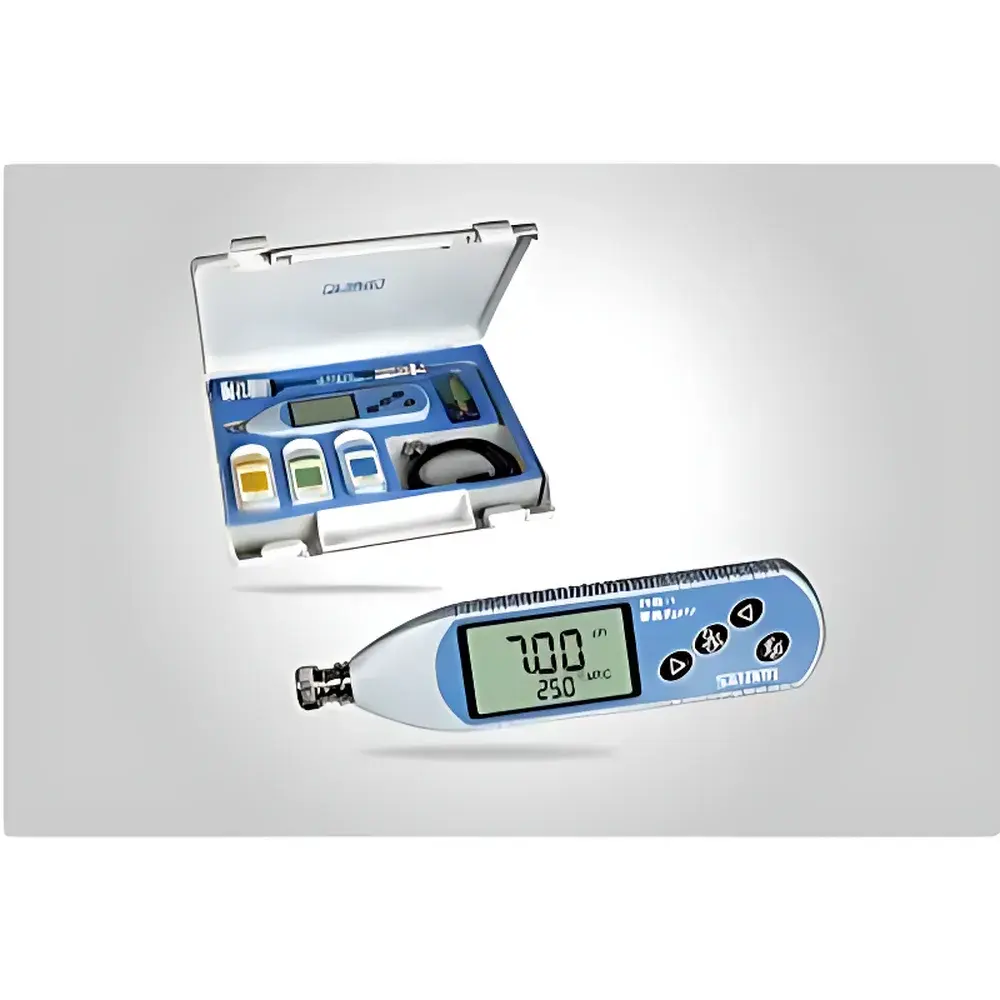
SANXIN PHB-1 Portable pH Meter
| Brand | SANXIN |
|---|---|
| Origin | Shanghai, China |
| Manufacturer Type | Manufacturer |
| Model | PHB-1 |
| Measurement Range | pH 0.00–14.00 |
| Resolution | 0.01 pH |
| Accuracy | ±0.01 pH ±1 digit |
| Input Impedance | ≥1 × 10¹² Ω |
| Temperature Compensation | 0–80 °C (manual) |
| Power Supply | 1 × 9 V alkaline battery (6F22) |
| Dimensions & Weight | 168 × 43 × 26 mm |
| Operating Environment | 5–35 °C |
Overview
The SANXIN PHB-1 Portable pH Meter is a compact, field-deployable electrochemical instrument engineered for high-accuracy measurement of hydrogen ion activity (pH) and oxidation-reduction potential (ORP) in aqueous solutions. Based on potentiometric principles, the device measures the voltage difference between a glass pH sensing electrode and a stable reference electrode—typically Ag/AgCl—against a known buffer standard. This voltage is converted to pH using the Nernst equation (−59.16 mV/pH unit at 25 °C), with built-in temperature compensation ensuring thermodynamic consistency across measurements. Designed for rugged portability without compromising metrological integrity, the PHB-1 meets the operational requirements of environmental monitoring, industrial process verification, academic fieldwork, and water quality assessment where laboratory-grade precision must be maintained outside controlled settings.
Key Features
- Triple-point automatic calibration using dual-slope algorithm—supports up to five pre-programmed standard buffer points (pH 4.01, 6.86, 7.00, 9.18, 10.01)—enabling traceable accuracy and real-time electrode performance diagnostics.
- On-screen display of electrode slope (%), offset (mV), and asymmetry potential—critical indicators for assessing electrode health and identifying drift or contamination prior to measurement.
- Large backlit LCD panel simultaneously shows pH value, manually entered temperature (°C/°F toggleable), battery status, and calibration progress—optimized for readability under variable ambient lighting conditions.
- Integrated auto-power-off function (15-minute timeout) and low-battery warning—extends battery life and prevents inadvertent data loss during extended field use.
- High-input-impedance circuitry (≥1 × 10¹² Ω) minimizes loading error when measuring high-resistance samples such as deionized water, soil extracts, or low-conductivity effluents.
- Compact form factor (168 × 43 × 26 mm) and lightweight design (170 g) with included protective carrying case and long-life buffer vials—facilitates transport, storage, and rapid deployment in remote or mobile laboratories.
Sample Compatibility & Compliance
The PHB-1 is validated for use with standard combination pH electrodes (BNC connector) and compatible ORP probes meeting IEC 60746-1 and ISO 7888 specifications. It supports routine analysis of potable water, wastewater, surface runoff, aquaculture media, and industrial rinse solutions. While not certified for GMP or GLP-regulated environments out-of-the-box, its calibration traceability, documented accuracy specifications, and manual temperature compensation align with foundational requirements of ASTM D1293 (Standard Test Method for pH of Water) and EPA Method 150.1. Users performing regulated testing are advised to implement supplementary documentation—including calibration logs, electrode maintenance records, and uncertainty budgets—as required by ISO/IEC 17025 or local regulatory frameworks.
Software & Data Management
The PHB-1 operates as a standalone instrument with no onboard data logging or PC connectivity. All measurements are displayed in real time and must be recorded manually. However, its calibration protocol conforms to internationally recognized electrochemical best practices: slope acceptance criteria (>95% and <105%), offset limits (±30 mV for new electrodes), and mandatory two-point verification before critical measurements. For laboratories requiring audit trails, integration into electronic lab notebooks (ELNs) or LIMS systems can be achieved via manual entry of calibration parameters (slope, offset, date/time, operator ID) and measured values—supporting compliance with FDA 21 CFR Part 11 when paired with appropriate procedural controls.
Applications
- Field-based environmental monitoring: pH and ORP profiling of rivers, lakes, wetlands, and groundwater wells per USGS NWIS protocols.
- Process control in municipal water treatment plants—verifying coagulation, disinfection, and corrosion inhibition stages.
- Quality assurance in food and beverage production—monitoring brine solutions, fermentation broths, and cleaning-in-place (CIP) rinse efficacy.
- Academic teaching labs: Demonstrating electrode theory, buffer chemistry, and Nernstian behavior with hands-on, portable instrumentation.
- Industrial maintenance: Diagnosing cooling tower chemistry, boiler feedwater conditioning, and electroplating bath stability.
FAQ
What types of pH electrodes are compatible with the PHB-1?
The meter accepts standard BNC-connecting combination pH electrodes with integrated reference junctions. Electrodes must be calibrated prior to use and maintained according to manufacturer guidelines.
Does the PHB-1 support automatic temperature compensation (ATC)?
No—it features manual temperature input only. Users must measure sample temperature separately (e.g., with a calibrated thermometer) and enter it before reading pH or ORP.
Can the built-in buffer standards be customized?
Yes—the device stores five programmable calibration points; users may overwrite factory defaults with custom pH values corresponding to their certified reference materials.
Is the instrument suitable for measuring low-conductivity samples like ultrapure water?
It can be used, but readings may exhibit increased instability due to high electrical resistance. Use of a low-resistance electrode and strict adherence to ISO 3696 Grade 1 water handling protocols is recommended.
How often should calibration be performed?
Calibration is required before each measurement session and repeated whenever electrode slope deviates by >5% from nominal or offset exceeds ±30 mV—per ASTM D1293 Annex A1 guidance.
Related Products






