
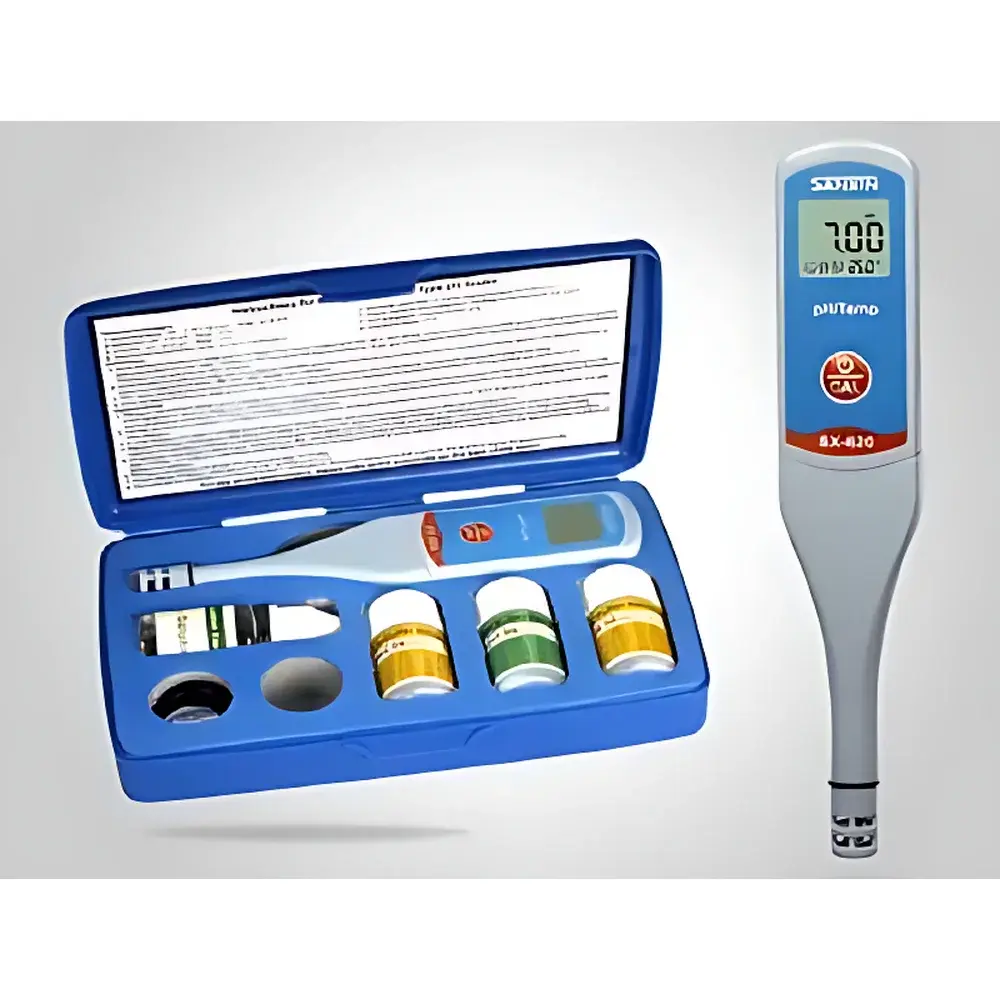
SANXIN SX620 Pocket-Style Waterproof pH Meter
| Brand | SANXIN |
|---|---|
| Origin | Shanghai, China |
| Manufacturer Type | Direct Manufacturer |
| Product Category | Domestic (China) |
| Model | SX620 |
| Instrument Type | Pocket-Style pH Meter |
| Parameter Type | Single-Parameter (pH only) |
| Measurement Range | -1.00 to 15.00 pH |
| Resolution | 0.01 pH |
| Accuracy | ±0.01 pH |
| Temperature Compensation Range | 0.0 to 60.0 °C (Automatic) |
| Calibration Points | 1–3 point (pH 4.00 / 7.00 / 10.01) |
| Power Supply | Two CR2032 lithium coin cells (≥100 h continuous operation) |
| Dimensions | 148 × 29 × 14 mm |
| Weight | 43 g |
| IP Rating | IP57 |
| Electrode Diameter | 10 mm |
| Calibration Solution Included | China-standard buffer set (pH 4.00, 7.00, 10.01) |
Overview
The SANXIN SX620 is a compact, single-parameter pocket-style pH meter engineered for field-deployable and routine laboratory pH measurements with high reproducibility and operational robustness. Based on potentiometric measurement principles using a glass electrode and integrated reference system, the SX620 detects hydrogen ion activity in aqueous solutions and converts the resulting electromotive force (EMF) into a calibrated pH reading. Its design prioritizes portability without compromising metrological integrity—meeting essential requirements for quality control in water treatment, food & beverage production, aquaculture, educational labs, and environmental monitoring. The instrument operates within an extended pH range of −1.00 to 15.00, accommodating highly acidic or alkaline samples such as industrial cleaning agents, electroplating baths, and caustic soda solutions—beyond the scope of conventional 0–14 pH meters. Temperature compensation is fully automatic across 0.0–60.0 °C, minimizing thermal drift errors during ambient or process-condition measurements.
Key Features
- Ultra-compact form factor (148 × 29 × 14 mm; 43 g), optimized for one-handed operation and storage in lab coat pockets or field kits.
- IP57-rated enclosure ensures dust resistance and immersion protection up to 1 m for 30 minutes—validated per IEC 60529—enabling reliable use in humid, splash-prone, or outdoor environments.
- Intuitive single-button interface simplifies calibration, measurement, and mode selection—reducing operator training time and minimizing procedural error.
- Smart diagnostics including low-battery indication, electrode status alert, and auto-power-off after 10 minutes of inactivity extend service life and conserve battery resources.
- Replaceable combination pH electrode (10 mm diameter) supports long-term maintenance and cost-effective recalibration without full instrument replacement.
- Dual CR2032 lithium batteries provide ≥100 hours of continuous operation under typical usage conditions—ideal for extended field surveys or shift-based QC workflows.
Sample Compatibility & Compliance
The SX620 is validated for use with aqueous and mildly buffered solutions across diverse sample matrices, including drinking water, wastewater effluents, hydroponic nutrient solutions, brewery wort, dairy products, and chemical process streams. It complies with fundamental performance criteria outlined in ISO 7888:2019 (Water quality — Determination of pH) and ASTM D1293-22 (Standard Test Methods for pH of Water). While not certified for GLP/GMP-regulated environments requiring full audit trails, its calibration traceability to NIST-traceable Chinese national standard buffers (pH 4.00, 7.00, 10.01) supports documented quality assurance protocols in non-critical applications. Electrode compatibility excludes non-aqueous, viscous, or protein-rich media unless pre-diluted or filtered per standard method guidance.
Software & Data Management
The SX620 operates as a standalone analog-digital hybrid instrument with no onboard data logging or USB/Bluetooth connectivity. All measurements are displayed in real time on a high-contrast LCD screen with dual-parameter readout (pH and temperature). Calibration history is retained in volatile memory until power cycle but lacks timestamping or export capability. Users must manually record results in laboratory notebooks or external LIMS systems. For regulatory compliance in FDA 21 CFR Part 11–governed settings, external validation documentation—including calibration logs, electrode verification reports, and environmental condition records—is required to establish measurement traceability and instrument suitability.
Applications
- Routine pH verification in municipal water distribution networks and wastewater treatment plants.
- In-process monitoring of fermentation tanks, pasteurization cycles, and cleaning-in-place (CIP) rinse stages in food manufacturing.
- Field-based assessment of soil leachates, pond water, and irrigation sources in agricultural extension services.
- Classroom experiments and undergraduate chemistry labs requiring rugged, intuitive instrumentation.
- Quick-check verification of buffer stock solutions and calibration standards prior to use with benchtop pH analyzers.
- On-site troubleshooting of aquarium systems, hydroponic reservoirs, and swimming pool maintenance programs.
FAQ
What calibration buffers are compatible with the SX620?
The SX620 supports 1–3 point calibration using China-standard pH 4.00, 7.00, and 10.01 buffer solutions. These match common international references and ensure alignment with ISO/ASTM-compliant procedures.
Can the SX620 measure pH in non-aqueous solvents?
No. The instrument is designed exclusively for aqueous solutions. Measurements in ethanol, glycerol, or oil-based media will yield inaccurate or unstable readings due to junction potential instability and reference electrode dehydration.
Is the electrode replaceable, and where can spare electrodes be sourced?
Yes—the integrated combination electrode is user-replaceable. Genuine SANXIN replacement electrodes (model-specific, 10 mm diameter) are available through authorized international distributors and comply with RoHS and REACH directives.
Does the SX620 meet IP67 or higher ingress protection?
No. It meets IP57 per IEC 60529: dust-protected and immersion-resistant up to 1 m for 30 minutes—but not suitable for prolonged submersion or high-pressure washdown scenarios.
How often should calibration be performed?
Calibration frequency depends on application criticality and sample matrix. For general-purpose use, daily calibration before first measurement is recommended. In regulated environments, calibration before each analytical batch—and after exposure to extreme pH or temperature—is advised per internal SOPs.





