
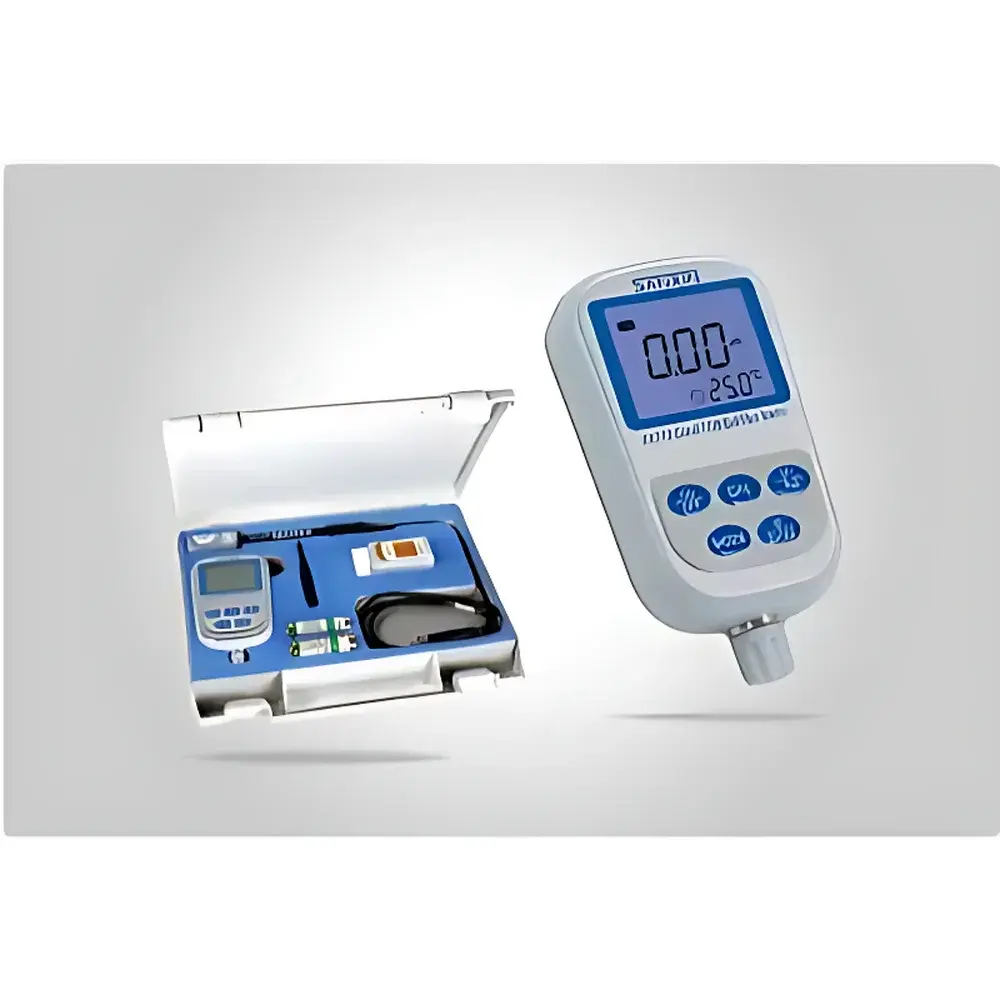
SANXIN SX713 Portable Multiparameter Conductivity Meter
| Brand | SANXIN |
|---|---|
| Model | SX713 |
| Type | Portable Conductivity/TDS/Salinity/Resistivity/Temp Meter |
| Origin | Shanghai, China |
| Manufacturer | SANXIN Peirui Instrument Co., Ltd. |
| Measurement Parameters | Conductivity (0.00–199.9 mS/cm), TDS (0–100 g/L), Salinity (0–100 ppt), Resistivity (0–100 MΩ·cm), Temperature (0–100 °C) |
| Accuracy | ±1.0% FS |
| Resolution | 0.01 (unit-dependent) |
| Temp Compensation | Automatic, 0–50 °C |
| Data Storage | 100 sets |
| Power | 2 × AA batteries (1.5 V) |
| Dimensions | 65 × 120 × 31 mm |
| Weight | 180 g |
| IP Rating | IP57 |
| Electrode | SANXIN 2301-S, K = 1.0 cm⁻¹ |
Overview
The SANXIN SX713 is a field-deployable, five-parameter electrochemical analyzer engineered for precise, real-time measurement of aqueous solution conductivity, total dissolved solids (TDS), salinity, resistivity, and temperature. Based on four-electrode or two-electrode AC conductance principles—optimized to minimize polarization effects and electrode fouling—the instrument delivers stable readings across a broad dynamic range. Its architecture integrates microprocessor-controlled signal conditioning, digital temperature compensation (ATC), and embedded firmware calibrated against NIST-traceable standard solutions. Designed for rugged operational environments, the SX713 meets the functional requirements of process monitoring, environmental fieldwork, wastewater characterization, and quality control in municipal water systems, aquaculture, desalination pre-treatment, and industrial cooling circuits. Unlike benchtop counterparts, its portability, battery autonomy, and ingress protection enable reliable use in rain, dust, high humidity, or submerged conditions up to 1 m depth for 30 minutes—fully compliant with IEC 60529 IP57 specifications.
Key Features
- Single-probe multi-parameter operation using the included SANXIN 2301-S conductivity cell (cell constant K = 1.0 cm⁻¹), eliminating cross-calibration drift between parameters
- Auto-recognition of eight standard conductivity calibration solutions (e.g., 84 μS/cm, 1413 μS/cm, 12.88 mS/cm), enabling one-point calibration with traceable verification
- Dedicated high-purity water mode applying non-linear temperature compensation algorithms per ISO 7888 and ASTM D1125 for ultrapure water resistivity < 1 MΩ·cm
- Backlit LCD with acrylic-reinforced viewing window ensures legibility under low-light or direct sunlight conditions
- Integrated data logger stores 100 measurement records with timestamp, parameter values, and temperature—exportable via manual transcription for audit-ready documentation
- Ruggedized housing with IP57-rated sealing prevents ingress of dust and transient immersion, supporting GLP-aligned field logging without external enclosures
Sample Compatibility & Compliance
The SX713 is validated for use with natural waters (surface, groundwater, seawater dilutions), treated effluents, boiler feedwater, swimming pool recirculation streams, and nutrient solutions in hydroponics. It complies with foundational metrological standards including ISO 7888 (electrical conductivity of water), ASTM D1125 (standard test methods for electrical conductivity of water), and USP (water conductivity testing for pharmaceutical use). While not FDA 21 CFR Part 11-compliant out-of-the-box due to absence of electronic signature capability, its manual data capture workflow supports paper-based GMP/GLP audits when paired with controlled logbooks and SOP-defined calibration intervals. Calibration verification against certified reference materials (CRM) is recommended prior to each field deployment or at 24-hour operational intervals.
Software & Data Management
The SX713 operates as a standalone instrument with no proprietary PC software or Bluetooth connectivity. All configuration, calibration, and measurement functions are accessed via tactile membrane keys and interpreted through the onboard display. Data storage is non-volatile and retained during battery replacement. Each record includes date/time stamp (user-settable), measured parameter value, unit, and ambient temperature—enabling traceable correlation with sampling location and time. For regulatory submissions, users export datasets manually into spreadsheets or LIMS-compatible formats. Firmware updates are not field-upgradable; revision control is maintained via device serial number and calibration certificate documentation.
Applications
- Environmental field surveys: rapid screening of river, lake, and estuarine conductivity gradients correlated with chloride intrusion or agricultural runoff
- Water treatment plant operations: real-time verification of reverse osmosis reject stream concentration and demineralizer effluent purity
- Aquaculture management: daily salinity and TDS tracking to maintain species-specific osmotic thresholds in hatcheries and raceways
- Industrial hygiene: cooling tower conductivity monitoring per ASHRAE Guideline 12-2020 to prevent scale formation and microbial proliferation
- Educational laboratories: undergraduate electrochemistry experiments involving Kohlrausch’s law, ion mobility estimation, and temperature coefficient analysis
FAQ
Does the SX713 support automatic temperature compensation across the full measurement range?
Yes—ATC is active from 0 to 50 °C using an integrated NTC thermistor. Compensation follows the linearized CaCl₂-based algorithm per ISO 7888, with user-selectable β coefficient (1.9–2.4 %/°C) for non-standard electrolytes.
Can the 2301-S electrode be used for measurements below 1 μS/cm?
The electrode is optimized for 0.01 μS/cm to 200 mS/cm. For sub-μS/cm ultrapure water, the dedicated high-purity mode applies enhanced noise filtering and extended integration time—but absolute accuracy remains limited by cell geometry and stray capacitance.
Is calibration verification required before each use?
Per ISO/IEC 17025 guidance, calibration verification using a mid-range standard (e.g., 1413 μS/cm) is recommended prior to critical measurements or after exposure to extreme temperatures or physical shock.
What is the expected service life of the 2301-S electrode under routine field use?
With proper rinsing in deionized water after each sample and storage in 3 M KCl solution, the electrode typically maintains specification compliance for 12–18 months. Performance degradation is indicated by slow response (>15 s to 95% stability) or calibration slope deviation >±5% from nominal.
Does the IP57 rating permit submersion during active measurement?
Yes—IP57 certification confirms operability while fully immersed up to 1 m for 30 minutes. However, prolonged submersion beyond this limit may compromise O-ring integrity over repeated cycles; post-immersion drying and visual seal inspection are advised.
Related Products





