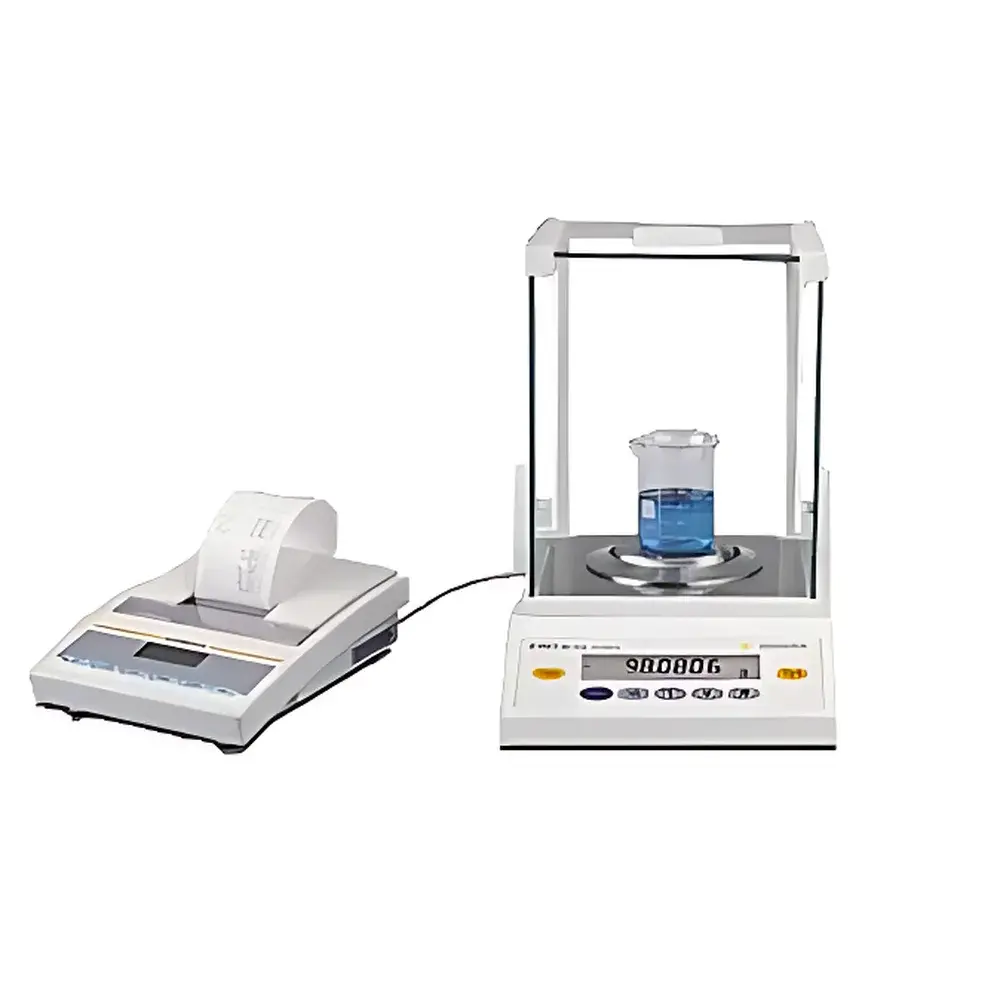
Sartorius BT Series Ultra-Micro, Analytical and Precision Balances
| Brand | Sartorius |
|---|---|
| Origin | Germany |
| Model | BT Series |
| Calibration | Internal |
| Readability | 0.01 mg to 0.1 mg |
| Capacity | 21 g to 120 g |
| Pan Size | Ø80 mm |
| Repeatability | ≤0.02 mg to ≤0.1 mg |
| Linearity | ≤0.03 mg to ≤0.2 mg |
| Temperature Compensation | Dynamic |
| Vibration Protection | Four-Stage Isolation |
| Sensor Technology | Super Dual-Lever Monolithic Sensor |
| Processor | 40 MHz Microcontroller (MC1) |
| Interface | RS232 (GLP-Compliant) |
| Draft Shield | Five-Sided Anti-Static Glass |
| Power Options | AC/DC or Rechargeable Battery |
| Applications | Counting, Percentage Weighing, Animal Weighing, Net Summation, 19 Unit Conversions |
| Overload Protection | Integrated |
| Compliance | GLP, ISO/IEC 17025 (when operated per SOP), ASTM E898, USP <41> |
Overview
The Sartorius BT Series represents a rigorously engineered family of ultra-micro, analytical, and precision balances designed for laboratories requiring high reproducibility, environmental resilience, and regulatory traceability. Built in Germany and compliant with international metrological standards, these balances operate on the principle of electromagnetic force compensation (EMFC), where sample mass is determined by the current required to restore a load-receiving lever to its null position. This architecture ensures exceptional stability under variable thermal and mechanical conditions—critical for applications ranging from pharmaceutical active ingredient quantification to nanomaterial formulation and reference standard preparation. The BT Series integrates dynamic temperature compensation algorithms that continuously adjust gain and offset parameters in real time, mitigating drift induced by ambient fluctuations. Its four-stage vibration isolation system—comprising passive damping, optimized mechanical resonance tuning, digital filtering, and adaptive signal processing—enables reliable operation on non-dedicated lab benches without external anti-vibration tables.
Key Features
- Super dual-lever monolithic sensor design: Enhances mechanical rigidity and reduces susceptibility to off-center loading errors while maintaining high sensitivity across the full weighing range.
- 40 MHz high-speed microcontroller (MC1): Accelerates A/D conversion, internal diagnostics, and data transmission—reducing measurement cycle time and improving throughput in high-volume QC environments.
- Five-sided anti-static glass draft shield: Provides unobstructed visual access and electrostatic shielding via conductive coating; eliminates charge-induced weighing artifacts common in low-mass measurements of insulating powders or polymers.
- Internal motorized calibration: Fully automated, user-initiated or time-scheduled calibration using built-in reference weights—ensuring continuous traceability without manual intervention or external mass standards.
- Dual tare keys (left/right): Accommodates ergonomic workflow preferences across diverse user populations, reducing repetitive strain during extended batch weighing sessions.
- Modular power architecture: Supports AC mains, DC input, or rechargeable Li-ion battery—enabling uninterrupted operation during power instability or mobile deployment in cleanrooms and field labs.
- RS232 interface with GLP-compliant data output: Generates timestamped, operator-ID-tagged records including weight, stability status, calibration history, and environmental metadata—fully compatible with LIMS integration and 21 CFR Part 11–enabled audit trail systems.
Sample Compatibility & Compliance
The BT Series accommodates a broad spectrum of sample types—from sub-milligram crystalline APIs and catalyst nanoparticles to larger volumetric containers (via optional bottom-loading hook). Its Ø80 mm stainless-steel pan and low-profile draft shield permit stable placement of vials, crucibles, and custom fixtures. All models meet the essential performance criteria defined in ISO 17025 for accredited testing laboratories when operated within specified environmental envelopes (temperature: 10–30 °C, humidity: 20–80% RH, no condensation). The internal calibration routine adheres to ASTM E898 (Standard Guide for Selection, Calibration, and Use of Laboratory Balances) and supports compliance with USP (Weights and Balances) for pharmaceutical applications. Full GLP documentation—including calibration certificates, uncertainty budgets, and installation qualification (IQ) templates—is available upon request.
Software & Data Management
Data export follows NIST-traceable formatting protocols via RS232, supporting ASCII-delimited output with configurable prefixes (e.g., “WGT”, “CAL”, “ERR”). Each record includes UTC timestamp, operator ID (if entered), balance serial number, net/gross/tare flags, stability indicator, and environmental sensor readings (where equipped). When connected to Sartorius LabX™ or third-party LIMS platforms, the BT Series enables automatic data archiving, electronic signature capture, and role-based access control. Audit trails are immutable and time-stamped at the firmware level, satisfying FDA 21 CFR Part 11 requirements for electronic records and signatures in regulated environments.
Applications
- Pharmaceutical QC: Quantitative assay of potent compounds, blend uniformity testing, and reference standard dilution verification.
- Materials science: Gravimetric analysis of catalysts, battery electrode slurries, and nanocomposite precursors.
- Academic research: Precise reagent dispensing in synthetic chemistry, isotopic tracer studies, and microgravimetric corrosion monitoring.
- Clinical labs: Calibration of pipette performance using gravimetric methods per ISO 8655.
- Environmental testing: Filter weighing for particulate matter (PM₂.₅/PM₁₀) analysis per EPA Method IO-4.2.
FAQ
What calibration standards does the BT Series support?
The BT Series uses internal motorized calibration with factory-traceable weights certified to ISO/IEC 17025. External calibration with NIST-traceable masses is supported for verification or periodic adjustment.
Is the RS232 interface compatible with modern LIMS platforms?
Yes—the interface outputs ASCII-formatted, delimiter-configurable data streams that integrate natively with LabWare, Thermo Fisher SampleManager, and Waters Empower via standard serial-to-IP gateways.
Can the BT Series operate in a Class A/B cleanroom environment?
All BT models are rated IP42 and feature static-dissipative housings and anti-static draft shields—meeting ISO 14644-1 requirements for particle generation when installed per Sartorius cleanroom deployment guidelines.
How is temperature drift compensated during extended measurements?
A dedicated thermal sensor network feeds real-time ambient and internal temperature gradients into a proprietary compensation algorithm that dynamically adjusts zero and span coefficients—verified per OIML R76 Annex C protocols.
Does the BT Series support multi-user operation with individual authentication?
Operator ID entry is supported via keyboard input; full role-based authentication requires integration with LabX™ or an external identity management system.