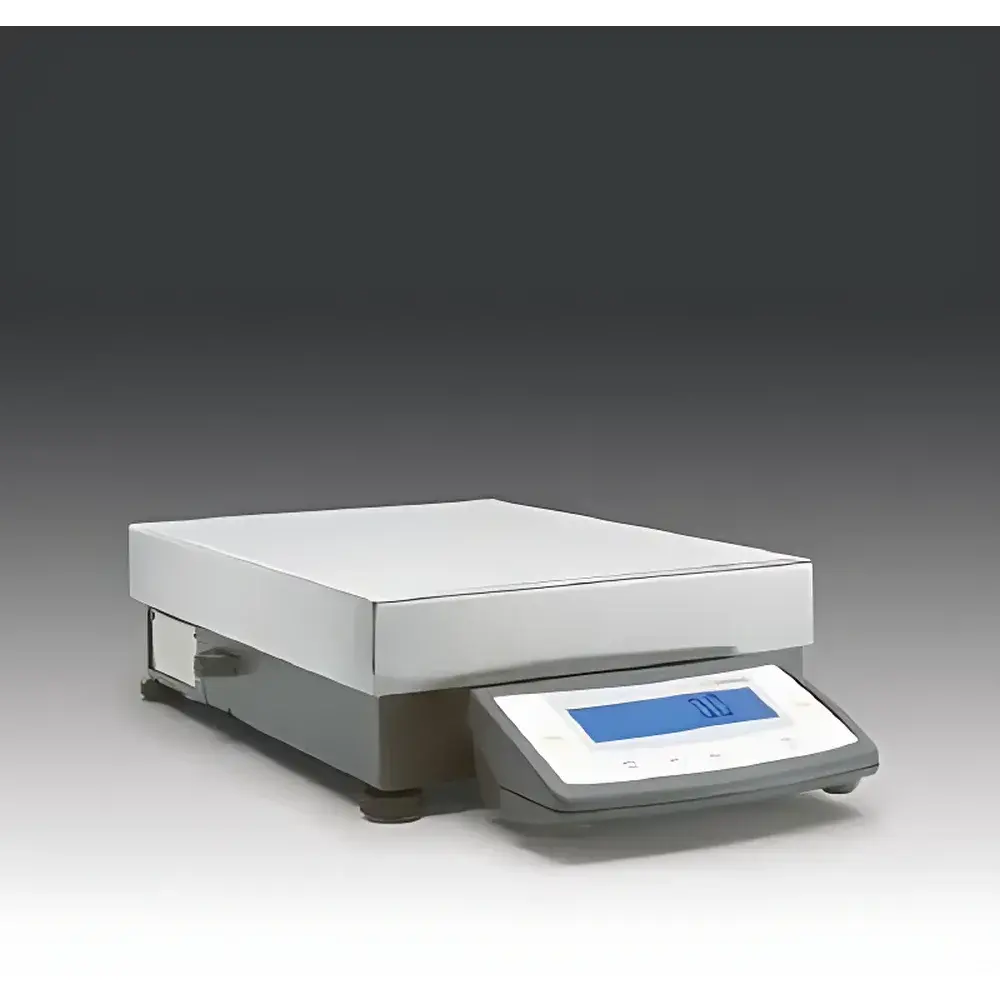
Sartorius CPA12001S Precision Balance
| Brand | Sartorius |
|---|---|
| Origin | Germany |
| Model | CPA12001S |
| Readability | 0.1 g |
| Capacity | 12,000 g |
| Calibration | Internal, isoCAL |
| Repeatability | ≤ ±0.1 g |
| Linearity | ≤ ±0.2 g |
| Pan Dimensions | 400 × 300 mm |
| Display | Backlit LCD (digit height: 16 mm) |
| Interface | RS-232C |
| Compliance | ISO/GLP-compliant data logging and printing |
| Built-in Applications | Percentage weighing, net/gross summation, animal weighing, unit conversion, piece counting |
| Sensor Technology | Monolithic electromagnetic force compensation sensor |
| Optional External Calibration | Negative ion generator (accessory) |
Overview
The Sartorius CPA12001S Precision Balance is an ISO/GLP-compliant laboratory balance engineered for high-reliability routine weighing in quality control, production support, and academic research environments. Designed and manufactured in Germany, it employs a monolithic electromagnetic force compensation sensor — a patented Sartorius architecture delivering exceptional long-term stability, minimal drift, and immunity to mechanical hysteresis. With a 12,000 g capacity and 0.1 g readability, the CPA12001S bridges the performance gap between analytical and top-loading balances, offering metrological rigor without compromising ergonomics or operational speed. Its isoCAL intelligent internal calibration system integrates motor-driven reference weights and temperature-compensated algorithms to execute fully automated, traceable calibration and adjustment — eliminating manual intervention while ensuring continuous compliance with ISO 9001, ISO/IEC 17025, and FDA 21 CFR Part 11 requirements for audit-ready documentation.
Key Features
- Monolithic electromagnetic force compensation sensor for superior linearity (≤ ±0.2 g), repeatability (≤ ±0.1 g), and resistance to environmental perturbations including vibration and air currents.
- isoCAL — Sartorius’ proprietary internal calibration technology featuring motorized, temperature-synchronized weight deployment and real-time drift correction; enables one-touch, GLP-compliant recalibration at user-defined intervals or upon environmental change detection.
- Backlit LCD display with 16 mm digit height ensures legibility under variable ambient lighting conditions, including laminar flow hoods and shared lab benches.
- RS-232C bidirectional serial interface supports direct connection to PCs, LIMS, or Sartorius YDP20-0CE/YDP03-0CE printers for fully traceable, timestamped printouts compliant with ISO 17025 documentation requirements.
- Built-in application modes include percentage weighing, net/gross accumulation, animal weighing (dynamic averaging), unit conversion (g, oz, ct, etc.), and piece counting — all accessible via intuitive soft-key navigation without software installation.
- Robust 400 × 300 mm stainless steel pan with reinforced perimeter design withstands repeated loading/unloading cycles and accommodates large containers or irregular samples common in pharmaceutical raw material handling and food QC workflows.
Sample Compatibility & Compliance
The CPA12001S is validated for use across diverse sample types — from bulk powders and granules to packaged intermediates and pre-filled vials — provided mass remains within its 12 kg capacity and center-of-gravity constraints are observed. Its sealed sensor housing and IP54-rated enclosure meet IEC 60529 standards for protection against dust ingress and water splashes, enabling safe operation in non-sterile but controlled manufacturing areas (e.g., API blending suites, excipient warehouses). All calibration events, zero checks, and weighing records generated via RS-232C output include embedded metadata: date/time stamp, operator ID (if configured), balance ID, temperature/humidity readings (when interfaced with optional environmental sensors), and digital signature fields — fulfilling ALCOA+ principles for data integrity in GMP-regulated settings per Annex 11 and USP .
Software & Data Management
No proprietary software installation is required for basic data capture; the balance natively formats output in ASCII-compatible strings compatible with Excel, LabWare LIMS, and custom SQL-based QA databases. For advanced workflow integration, Sartorius provides optional DataControl Lite (freeware) and DataControl Pro (licensed), both supporting 21 CFR Part 11-compliant electronic signatures, role-based access control, and automated report generation. Audit trails record every parameter change, calibration event, and firmware update with immutable timestamps — retained for ≥36 months as mandated by EU GMP Annex 11. Optional YDP20-0CE thermal printer delivers permanent, tamper-evident paper records with batch number, sample ID, and QC release status fields preconfigured per SOP templates.
Applications
- Pharmaceutical: Raw material receipt inspection, excipient dispensing, tablet weight uniformity sampling, and stability study sample preparation per USP and Ph. Eur. 2.2.17.
- Food & Beverage: Batch formulation verification, yield calculation in mixing tanks, and allergen cross-contamination monitoring through precise additive dosing.
- Chemical Manufacturing: Catalyst charge validation, solvent reconciliation, and drum-filling accuracy assurance prior to shipment.
- Academic Research: Teaching labs requiring robust, low-maintenance instrumentation for stoichiometric reagent preparation and physical property characterization (e.g., density determination via displacement).
- Environmental Testing Labs: Soil/sediment sample homogenization and subsampling where reproducibility across multi-operator shifts is critical.
FAQ
Is the CPA12001S suitable for GLP-regulated environments?
Yes — its isoCAL system, RS-232C audit trail capability, and built-in ISO/GLP print functions meet core documentation requirements for non-clinical laboratory studies per OECD GLP Principles.
Can external calibration weights be used alongside isoCAL?
While isoCAL is the primary calibration method, optional negative-ion generators and certified Class M2 external weights (sold separately) enable supplementary verification per ISO 17025 accredited procedures.
What is the warm-up time required before first use?
Sartorius recommends a minimum 30-minute stabilization period after power-on under constant ambient temperature (±2 °C/hour variation) to achieve full metrological specification.
Does the balance support automatic tare during continuous weighing sequences?
Yes — the “Auto-Tare” function can be enabled via menu settings, allowing rapid sequential weighing of multiple samples without manual tare reset.
How often must isoCAL be performed to maintain traceability?
Calibration frequency is risk-based: Sartorius recommends initiation upon installation, after relocation, following significant ambient temperature shifts (>5 °C), and at intervals defined in your site’s SOP — typically daily, per shift, or per batch depending on criticality.