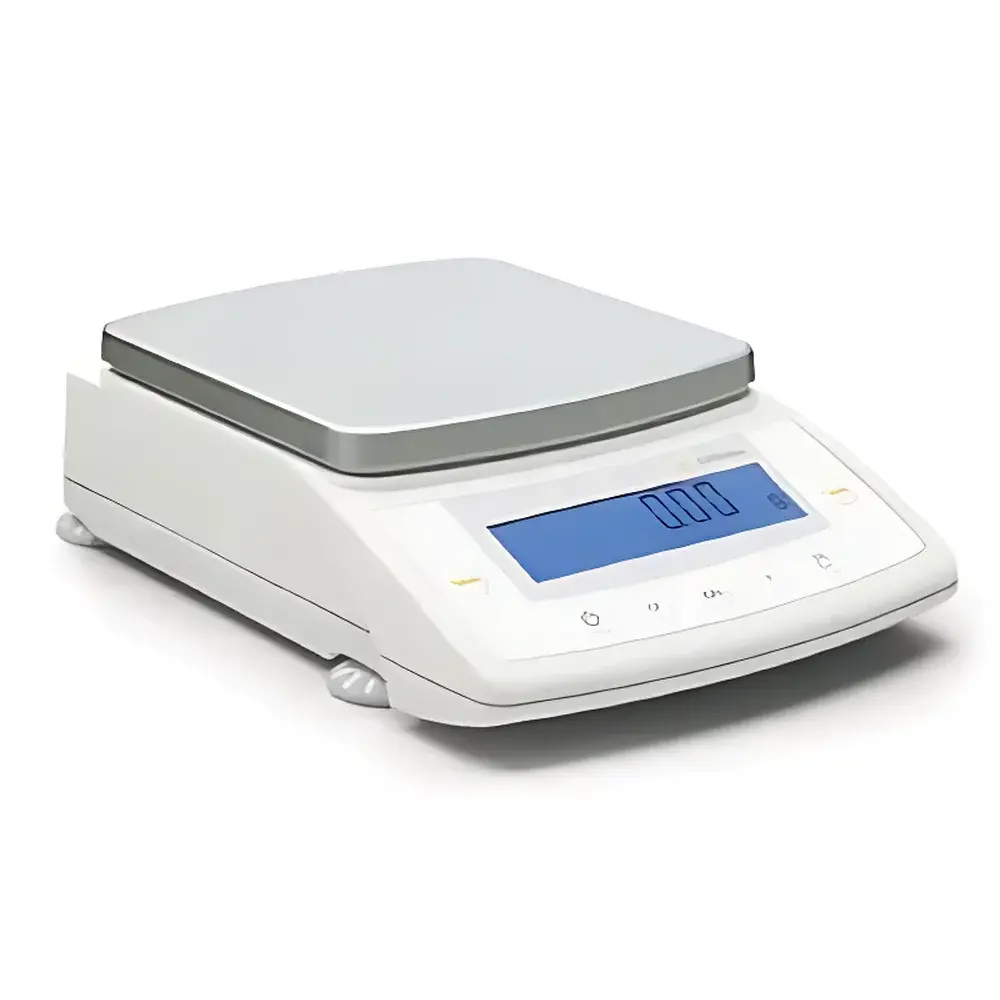
Sartorius CPA323S Precision Balance
| Brand | Sartorius |
|---|---|
| Origin | Germany |
| Model | CPA323S |
| Readability | 1 mg |
| Capacity | 320 g |
| Calibration | Internal, isoCAL |
| Repeatability | ≤ ±0.001 g |
| Linearity | ≤ ±0.002 g |
| Pan Diameter | Ø 110 mm |
| Display | Backlit LCD (Digit Height: 16 mm) |
| Interface | RS-232C |
| GLP/ISO Compliance | Yes |
| Software Integration | PC & YDP Series Printers |
| Optional Features | External Calibration, Ionizer |
Overview
The Sartorius CPA323S Precision Balance is an ISO/GLP-compliant laboratory balance engineered for reproducible, high-integrity mass measurement in regulated and non-regulated environments. Built upon Sartorius’ monolithic weighing sensor architecture — a patented single-piece transducer design — the CPA323S delivers exceptional mechanical stability, minimal thermal drift, and long-term metrological reliability. With a 320 g capacity and 1 mg readability, it meets the routine precision requirements of analytical chemistry, pharmaceutical formulation, quality control laboratories, and academic research workflows. Its internal isoCAL technology enables fully automated, motor-driven calibration and adjustment at user-defined intervals or upon environmental triggers (e.g., temperature shift ≥ 1.5 °C), ensuring continuous traceability without manual intervention. Designed and manufactured in Germany, the CPA323S adheres to stringent EN 45501 and OIML R76 metrological standards, and its hardware and firmware architecture supports compliance with FDA 21 CFR Part 11 when paired with validated software solutions.
Key Features
- Monolithic weighing sensor: Eliminates mechanical hysteresis and improves long-term repeatability and linearity performance.
- isoCAL automatic internal calibration: Integrated motorized weight system performs full-range calibration with one touch; configurable via time-based or temperature-triggered schedules.
- Backlit LCD display with 16 mm digit height: Ensures legibility under variable ambient lighting conditions and reduces operator reading error.
- RS-232C bidirectional interface: Enables direct data transfer to PCs, LIMS, or Sartorius YDP03-0CE/YDP20-0CE printers with real-time timestamping and GLP-compliant metadata (operator ID, date/time, balance ID).
- Dedicated application modes: Includes percentage weighing, piece counting, net/gross/tare summation, animal weighing (dynamic averaging), and unit conversion — all accessible without external software.
- Robust mechanical design: Stainless steel pan (Ø 110 mm), draft shield-compatible housing, and IP54-rated enclosure for resistance to dust and incidental splashes.
Sample Compatibility & Compliance
The CPA323S accommodates a broad range of sample types — from powders and granules to small solid components and liquid-filled containers — within its 110 mm diameter weighing pan. Its low-profile pan geometry and optimized airflow path minimize convection-induced instability during volatile or temperature-sensitive measurements. All firmware and hardware configurations comply with ISO 9001, ISO/IEC 17025, and GLP documentation requirements. When connected to Sartorius LabX or DataControl software (via RS-232), the balance supports full electronic audit trails, user access control, and electronic signature functionality aligned with FDA 21 CFR Part 11 Annex 11 expectations. External calibration using Class F1 or E2 weights remains supported via optional ionizer and calibration port for verification under ISO 17025-accredited procedures.
Software & Data Management
Data integrity is maintained through native support for ASCII-formatted output compliant with ASTM E2500-07 and ISO/IEC 17025 clause 7.7. The balance outputs timestamped, operator-tagged records including gross/net/tare values, stability indicators, and calibration status flags. When interfaced with Sartorius DataControl Lite (free PC software) or LabX (enterprise-grade platform), users gain automated report generation, statistical process control (SPC) charting, deviation alerts, and integration with ERP or MES systems. All exported files include embedded metadata required for regulatory inspections: instrument ID, firmware version, calibration history, and environmental logs (if external sensors are attached). No proprietary drivers are required — standard Windows COM port configuration suffices.
Applications
- Pharmaceutical QC: Active pharmaceutical ingredient (API) dispensing, excipient blending, and tablet weight uniformity testing per USP & Ph. Eur. guidelines.
- Chemical synthesis: Stoichiometric reagent weighing, yield calculation, and reaction mixture monitoring.
- Materials science: Density determination via buoyancy method, powder flow characterization (mass-based feed rate validation).
- Environmental labs: Filter weighing for particulate matter (PM2.5/PM10) analysis per EPA Method 201A.
- Educational institutions: Teaching metrology principles, uncertainty budgeting, and ISO/IEC 17025 documentation practices.
FAQ
Does the CPA323S support GLP-compliant data export?
Yes — all printed or transmitted records include date/time stamps, operator identification (if configured), balance serial number, and calibration status. When used with Sartorius DataControl or LabX, full electronic audit trails and user-level permissions are enabled.
Is external calibration possible?
Yes — the balance includes a dedicated external calibration port and supports manual calibration using certified weights. An optional ionizer accessory mitigates electrostatic interference during high-precision weighing of insulating materials.
What is the warm-up time required for optimal accuracy?
Sartorius recommends a minimum 30-minute stabilization period after power-on under stable ambient conditions (20–25 °C, <60% RH). isoCAL activation post-warm-up ensures immediate traceable performance.
Can the CPA323S be integrated into a networked lab environment?
While the CPA323S lacks Ethernet or Wi-Fi, its RS-232C interface supports reliable connection to centralized PCs or terminal servers. For full network integration, Sartorius LabX acts as a middleware hub, enabling multi-balance data aggregation and remote monitoring.
How often should isoCAL be scheduled?
Sartorius recommends initiating isoCAL at least once per shift in dynamic lab environments. Temperature-triggered mode (default ΔT = 1.5 °C) is advised for unattended operation or locations with HVAC fluctuations.