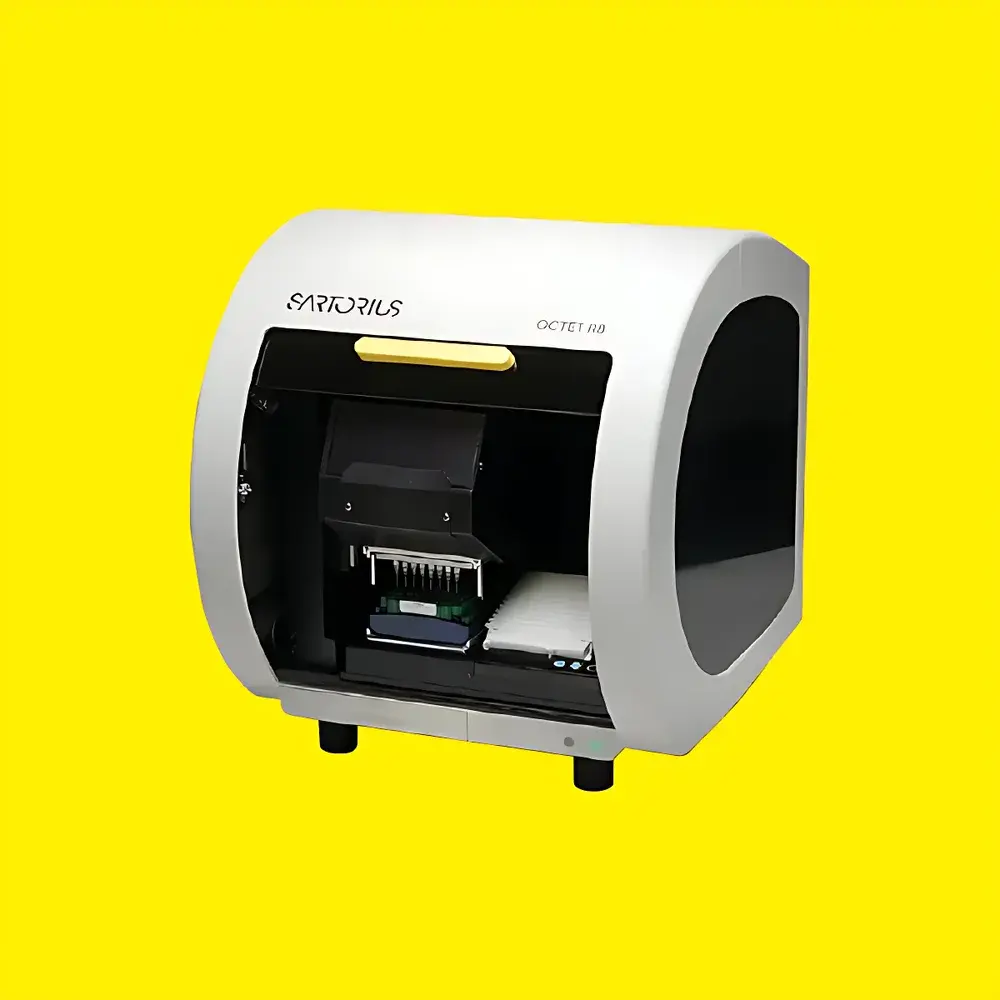
Sartorius Octet® R8 Biomolecular Interaction Analysis System
| Brand | Sartorius |
|---|---|
| Origin | Beijing, China |
| Manufacturer Type | Authorized Distributor |
| Product Category | Domestic |
| Model | Octet® R8 |
| Instrument Type | Bio-Layer Interferometry (BLI) |
| Detection Mode | Label-Free Detection |
| Sample Format | 96-Well Microplate |
| Sample Volume per Well | 200 µL |
| Assay Duration | 2–60 minutes |
| Temperature Control Range | 15–40 °C |
Overview
The Sartorius Octet® R8 Biomolecular Interaction Analysis System is a high-throughput, label-free platform engineered for real-time quantification and kinetic characterization of biomolecular interactions. It operates on the principle of Bio-Layer Interferometry (BLI), a fiber-optic-based optical sensing technology that measures interference patterns generated by reflected white light from the tip of disposable biosensors. As binding events occur on the sensor surface—such as antigen–antibody, receptor–ligand, or protein–small molecule interactions—the optical thickness of the molecular layer changes, producing a measurable shift in the interference pattern. This enables direct, real-time monitoring of association and dissociation kinetics without requiring immobilization to a solid surface or fluidic microchannels. The Octet® R8 is particularly suited for applications involving crude biological matrices—including cell culture supernatants, lysates, serum, and unpurified expression samples—where traditional SPR or ELISA methods often require extensive sample cleanup or labeling steps.
Key Features
- Eight independent, parallel detection channels enable simultaneous analysis of up to eight samples per cycle—maximizing throughput while maintaining assay reproducibility.
- Label-free, flow-cell-free architecture eliminates complex fluidics, reducing system maintenance, consumable costs, and risk of clogging or carryover.
- Disposable biosensors are pre-functionalized with streptavidin, anti-human IgG Fc, Ni-NTA, or other capture chemistries—enabling rapid assay setup with minimal optimization.
- Integrated plate temperature control (15–40 °C) ensures thermal stability for temperature-sensitive proteins and supports kinetic measurements across physiologically relevant conditions.
- Evaporation-resistant microplate lid allows unattended operation for up to 12 hours—critical for overnight affinity screening or long-dissociation phase experiments.
- Non-destructive measurement preserves sample integrity; recovered material can be reused for orthogonal assays such as mass spectrometry, functional cell-based assays, or structural characterization.
- Modular software architecture supports seamless upgrade to GMP-compliant configuration, including audit trail, electronic signatures, and 21 CFR Part 11–enabled data handling.
Sample Compatibility & Compliance
The Octet® R8 demonstrates robust performance across diverse sample types—including unpurified mammalian and insect cell lysates, bacterial supernatants, hybridoma supernatants, serum, plasma, and formulated biologics. Its tolerance for particulates, viscosity, and low-concentration analytes reduces or eliminates the need for centrifugation, filtration, or buffer exchange. From a regulatory standpoint, the system complies with ISO 13485 design controls when deployed in quality-controlled environments. When configured with the Octet® R8 GMP Data Package, it meets requirements for data integrity under FDA 21 CFR Part 11, EU Annex 11, and ICH-GCP guidelines. All instrument logs, sensor trace files, and processed kinetic reports are timestamped, user-authenticated, and stored in a secure, version-controlled database.
Software & Data Management
Data acquisition and analysis are performed using Sartorius’ integrated Octet Data Analysis Software (v12.x or later), which provides automated baseline correction, global fitting of 1:1, bivalent analyte, or heterogeneous ligand models, and batch processing for high-throughput screening. Raw sensorgrams are saved in vendor-neutral .octet format and exportable to CSV, PDF, or XML for integration into LIMS or enterprise data systems. The software supports GLP/GMP workflows through role-based access control, configurable electronic signatures, and full audit trail functionality—including operator actions, parameter changes, and report generation history. All raw and processed data are archived with metadata linking experimental conditions, sensor lot numbers, calibration records, and environmental logs.
Applications
- Antibody affinity ranking and epitope binning during early-stage biologics discovery
- Binding kinetics (kon, koff, KD) determination for therapeutic proteins, peptides, and oligonucleotides
- Concentration determination of IgGs, bispecifics, and ADCs in crude harvests—without standard curves
- Stability assessment of protein–protein complexes under varying pH or temperature conditions
- Cell-based assay support: real-time monitoring of secreted cytokines or extracellular vesicle surface markers
- QC release testing of biomanufactured products in compliance with USP <788>, ICH Q5E, and pharmacopeial monographs
FAQ
What biosensor types are compatible with the Octet® R8?
The system supports over 20 sensor formats—including SA (streptavidin), AHC (anti-human IgG Fc), HIS1K (Ni-NTA), AR2G (anti-rabbit IgG), and custom-coated sensors—enabling flexible capture strategies for diverse target classes.
Can the Octet® R8 analyze membrane proteins or virus-like particles?
Yes. BLI’s tolerance for large, heterogeneous, or aggregated species allows direct detection of VLPs, liposomes, exosomes, and detergent-solubilized membrane proteins—provided they bind stably to the sensor surface.
Is method validation required before use in regulated environments?
Yes. While the Octet® R8 GMP Data Package provides compliant infrastructure, users must perform system suitability testing, sensor lot qualification, and assay-specific validation per ICH Q2(R2) and internal SOPs prior to release testing.
How does BLI compare to surface plasmon resonance (SPR) in terms of sensitivity and mass transport limitations?
BLI exhibits comparable sensitivity (sub-nM KD range) but avoids convective mass transport artifacts common in flow-based SPR due to its static, diffusion-limited binding geometry—making it especially suitable for viscous or particulate-laden samples.
Does the system support kinetic analysis of multivalent interactions?
Yes. The software includes advanced fitting algorithms for bivalent analyte, two-state conformational change, and heterogeneous ligand models—validated against reference standards and orthogonal techniques such as ITC and SEC-MALS.