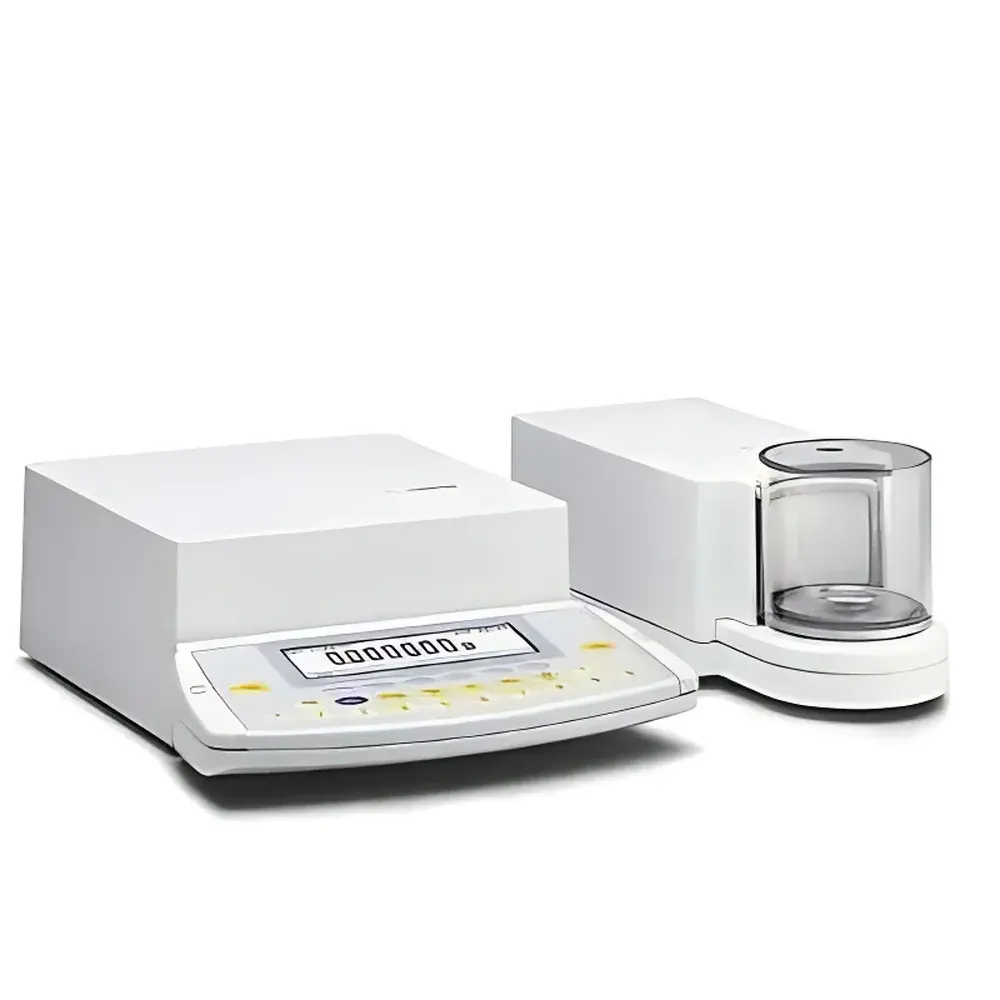
Sartorius SE2 Ultra-Micro Balance
| Brand | Sartorius |
|---|---|
| Origin | Germany |
| Model | SE2 |
| Capacity | 2.1 g |
| Readability | 0.0001 mg |
| Calibration | Internal, isoCAL |
| Draft Shield | Full-glass, electrostatically shielded, motorized, removable |
| Weighing Pan Diameter | Ø 20 mm |
| Display | High-contrast graphic LCD with white LED backlight |
| Interface | RS-232C (bidirectional, printer-compatible) |
| Compliance | ISO/GLP-compliant print output |
| Software Features | isoCAL, SQmin (USP minimum weight verification), EUREKA air buoyancy correction, 14 built-in applications, statistical calculation, 999 sample ID storage |
| Optional | External ionizer (negative ion generator), foot switch, PC control |
Overview
The Sartorius SE2 Ultra-Micro Balance is an engineered precision instrument designed for laboratories requiring trace-level mass measurement under stringent regulatory and metrological conditions. Operating on electromagnetic force compensation (EMFC) principle, the SE2 delivers reproducible measurements at the sub-microgram level—specifically, a readability of 0.0001 mg (0.1 µg) across its 2.1 g capacity. Its performance is anchored in a thermally stable monolithic sensor architecture and active temperature compensation, minimizing drift during extended weighing cycles. As a Class I ultra-micro balance per OIML R 76-1 and compliant with USP and , the SE2 is validated for critical applications including reference standard preparation, catalyst dosing, isotopic tracer quantification, and nanomaterial mass characterization—where uncertainty budgets must remain below 0.1% relative standard deviation.
Key Features
- Full-glass motorized draft shield with electrostatic-dissipative inner coating—eliminates frame obstructions and suppresses static-induced weighing errors without compromising optical access to the weighing chamber.
- One-step shield removal mechanism enables rapid cleaning and full chamber decontamination—essential for GLP/GMP environments where cross-contamination risk must be minimized.
- isoCAL temperature- and time-triggered internal calibration system ensures continuous traceability without manual intervention; fully documented and audit-ready per FDA 21 CFR Part 11 when paired with Sartorius LabX software.
- SQmin function provides real-time verification of minimum sample weight per USP , dynamically calculating the lowest mass that meets required repeatability thresholds based on current environmental and mechanical conditions.
- EUREKA air buoyancy correction algorithm applies real-time atmospheric parameter inputs (temperature, pressure, humidity, material density) to deliver true mass values—critical for high-accuracy gravimetric standardization.
- White LED-backlit graphical display with multilingual UI (English default) supports intuitive operation; all prompts and error messages conform to IEC 61000-4-30 EMC guidelines for laboratory instrumentation.
Sample Compatibility & Compliance
The SE2 accommodates samples up to Ø 20 mm on its polished stainless-steel pan, optimized for low-profile vials, microcrucibles, and filter membranes (with optional SE2-F configuration supporting Ø 90 mm filters). Its electrostatic mitigation design—including conductive glass coating and optional external negative ionizer—ensures stability when handling insulating materials such as polymers, powders, or dried biological matrices. The balance meets ISO/IEC 17025 requirements for calibration laboratories and supports full GLP documentation workflows via RS-232C interface, enabling direct integration with LIMS or electronic lab notebooks. All print outputs—including calibration logs, weighing records, and SQmin reports—are timestamped, user-identified, and configurable to meet ISO 9001 and Annex 11 data integrity standards.
Software & Data Management
The SE2 operates natively with Sartorius’ LabX Balance software (optional), enabling full 21 CFR Part 11 compliance through electronic signatures, role-based access control, and immutable audit trails. Raw weighing data, calibration history, environmental metadata, and application-specific parameters (e.g., EUREKA corrections, statistical summaries) are exported in CSV or XML format. The built-in 14 application programs—including moisture content, percentage weighing, density determination, and formulation—support method-driven workflows without external scripting. Up to 999 unique sample IDs can be stored locally, each associated with customizable metadata fields for traceability in regulated pharmaceutical or reference material production.
Applications
- Preparation and verification of certified reference materials (CRMs) per ISO Guide 34 and ISO/IEC 17025.
- Gravimetric calibration of pipettes and volumetric glassware in accordance with ISO 8655 and ASTM E2772.
- Weighing of nanogram-scale catalysts, APIs, or radiolabeled compounds in radiochemistry and oncology research.
- Filter membrane analysis for particulate matter quantification (e.g., EPA Method 13A, ISO 12103-1).
- Stability-indicating assays requiring mass change detection at ≤0.5 µg resolution over multi-hour kinetics studies.
- Microgram-level formulation of electrolytes for solid-state battery R&D.
FAQ
What is the minimum weighable mass (MWM) for the SE2 according to USP ?
The SE2 calculates MWM dynamically via its SQmin function, using current repeatability data and user-defined confidence level (typically 95%). Under standard lab conditions (23°C, 50% RH), typical MWM ranges from 0.8–1.2 mg.
Does the SE2 support external ionization to mitigate static?
Yes—an optional negative ion generator can be connected via the accessory port to neutralize static charge on non-conductive samples or containers.
Can the SE2 be integrated into a networked LIMS environment?
When used with LabX software and a TCP/IP-to-RS-232 converter, the SE2 supports automated data transfer to LIMS with full audit trail and electronic signature capability.
Is the draft shield compatible with glovebox or inert-atmosphere enclosures?
The SE2-F variant features a metal-only draft shield construction and is rated for integration into nitrogen-purged or argon-filled enclosures; standard SE2 requires ambient air circulation for thermal stabilization.
How frequently does isoCAL initiate calibration?
By default, isoCAL triggers every 2 hours and after ±1.5°C temperature change—but intervals and thresholds are fully configurable via the balance menu or LabX.