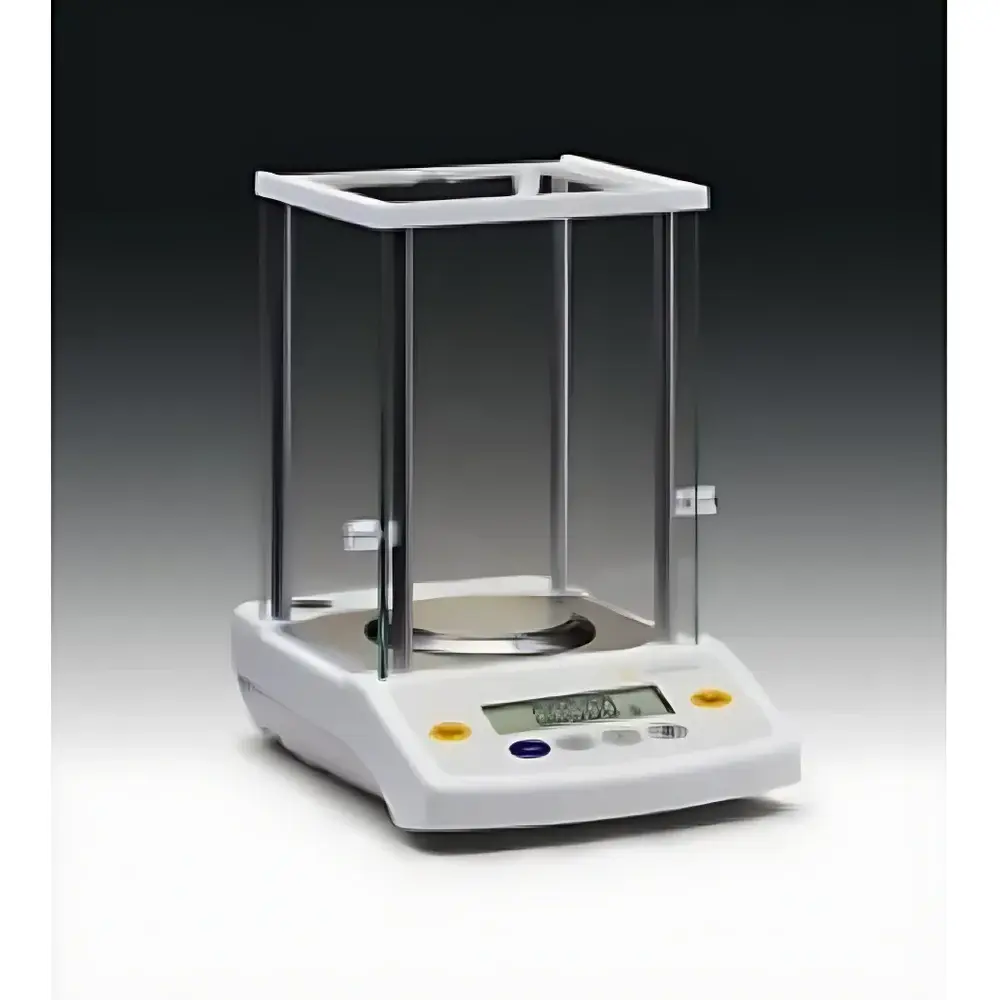
Sartorius TE124S Analytical Balance
| Brand | Sartorius |
|---|---|
| Origin | Germany |
| Model | TE124S |
| Instrument Type | Analytical Balance |
| Maximum Capacity | 120 g |
| Readability | 0.1 mg |
| Repeatability | 1 mg |
| Calibration | External |
| Display | High-contrast LCD |
| Draft Shield | Full-glass, removable windscreen |
| Weighing Pan Diameter | 90 mm |
| Interface | Bidirectional RS-232C |
| GLP/ISO Compliance | Yes (with optional printer or PC connection) |
| Filtering | 4-level digital filtering |
| Weighing Modes | Percentage weighing, net/gross/tare, averaging, dynamic weighing, piece counting, unit conversion |
| Overload Protection | Built-in |
Overview
The Sartorius TE124S Analytical Balance is a precision laboratory instrument engineered for high-reproducibility mass measurement in regulated and research-intensive environments. Operating on electromagnetic force compensation (EMFC) principle, the TE124S delivers stable, drift-compensated readings under variable ambient conditions—critical for applications demanding traceable accuracy at the 0.1 mg readability level. With a maximum capacity of 120 g and a repeatability specification of ±1 mg (at full load), it meets the performance criteria defined in ISO 17025 for analytical balance verification and aligns with USP requirements for weighing accuracy in pharmaceutical quality control. Its German-manufactured load cell architecture, combined with temperature-stabilized electronics, ensures minimal thermal drift and long-term calibration stability—key attributes for laboratories performing daily calibration checks, formulation work, or reference standard preparation.
Key Features
- High-contrast monochrome LCD display with intuitive icon-based navigation—optimized for visibility under low-light or gloved-hand operation.
- Full-glass, removable draft shield with seamless front access—designed to minimize air turbulence while enabling unobstructed sample placement and cleaning.
- Bidirectional RS-232C serial interface—supports real-time data streaming to LIMS, ELN, or custom acquisition software; compatible with Sartorius Printers (e.g., YDP10) and third-party serial-to-USB adapters.
- Four-stage digital filtering—adjustable via front-panel controls to suppress mechanical vibration or airflow-induced noise without compromising response time.
- Built-in overload protection circuitry—prevents sensor damage from accidental overloading up to 150% of nominal capacity (180 g).
- GLP-compliant data output—timestamps, operator ID (via optional keyboard), balance ID, and calibration status are embedded in printouts or ASCII data streams when connected to certified peripherals.
Sample Compatibility & Compliance
The TE124S accommodates standard laboratory samples—including powders, solids, filter papers, and small volumetric vessels—within its 90 mm diameter stainless-steel weighing pan. Its open-bottom design and low-profile base facilitate integration into fume hoods or gloveboxes where space is constrained. The balance conforms to ISO 9001 quality management standards and supports compliance with FDA 21 CFR Part 11 when used with validated data capture systems (e.g., Sartorius LabX Lite or third-party audit-trail-enabled software). It satisfies the minimum performance requirements outlined in ASTM E898–22 (Standard Guide for Selection and Use of Laboratory Balances) and is routinely deployed in GMP environments for raw material receipt testing, assay preparation, and stability study sample weighing.
Software & Data Management
While the TE124S operates as a standalone instrument, its RS-232C port enables seamless integration into automated workflows. Data transmission follows standard ASCII protocol with user-configurable delimiters and termination characters. When paired with Sartorius’ optional YDP10 thermal printer, outputs include date/time stamps, gross/net/tare values, statistical summaries (n, mean, SD), and GLP header fields. For electronic record integrity, integration with LabX Lite (freeware version) provides basic audit trail functionality—including user login tracking, parameter change logs, and export to CSV/PDF formats compliant with ALCOA+ principles. All exported data retains native timestamp resolution (1-second granularity) and is fully traceable to NIST-traceable calibration certificates issued at time of factory verification.
Applications
- Pharmaceutical QC labs: Accurate weighing of active pharmaceutical ingredients (APIs) and excipients during tablet formulation and content uniformity testing.
- Academic research: Precise mass determination in gravimetric analysis, catalyst loading, and nanomaterial synthesis protocols.
- Environmental testing labs: Weighing of pre- and post-dried filter membranes in total suspended solids (TSS) and particulate matter (PM10/PM2.5) analysis per EPA Method 160.1.
- Food safety laboratories: Net weight verification of reference standards used in pesticide residue quantification by GC-MS or LC-MS/MS.
- Materials science: Density determination via pycnometry and moisture content assessment using loss-on-drying (LOD) protocols.
FAQ
Does the TE124S support internal calibration?
No—the TE124S requires external calibration using certified weights traceable to national metrology institutes (e.g., NIST, PTB). Internal calibration is not available on this model.
Is the RS-232C interface compatible with modern Windows/macOS systems?
Yes—when used with an industry-standard USB-to-RS-232 adapter (e.g., FTDI-based), the interface functions reliably with Windows 10/11 and macOS 12+. Drivers and terminal configuration guidance are provided in the Sartorius Communication Manual (Doc. No. 98012-202-01).
What environmental conditions are recommended for optimal performance?
Operate within 15–30 °C ambient temperature, ≤70% RH (non-condensing), and on a vibration-isolated, level surface. Avoid direct sunlight, HVAC drafts, or proximity to centrifuges and pumps.
Can the TE124S be used for dynamic (moving) sample weighing?
Yes—it includes a dedicated dynamic weighing mode optimized for irregular or unstable samples (e.g., live organisms, viscous liquids in open containers), with configurable stabilization delay and averaging window.
How often should external calibration be performed?
Per ISO/IEC 17025:2017 Clause 6.5.2, calibration frequency must be risk-based. Typical practice includes daily zero check, weekly span verification with 100 g Class M2 weight, and full calibration every 3–6 months—or after relocation, maintenance, or observed drift exceeding ±0.5 mg.