
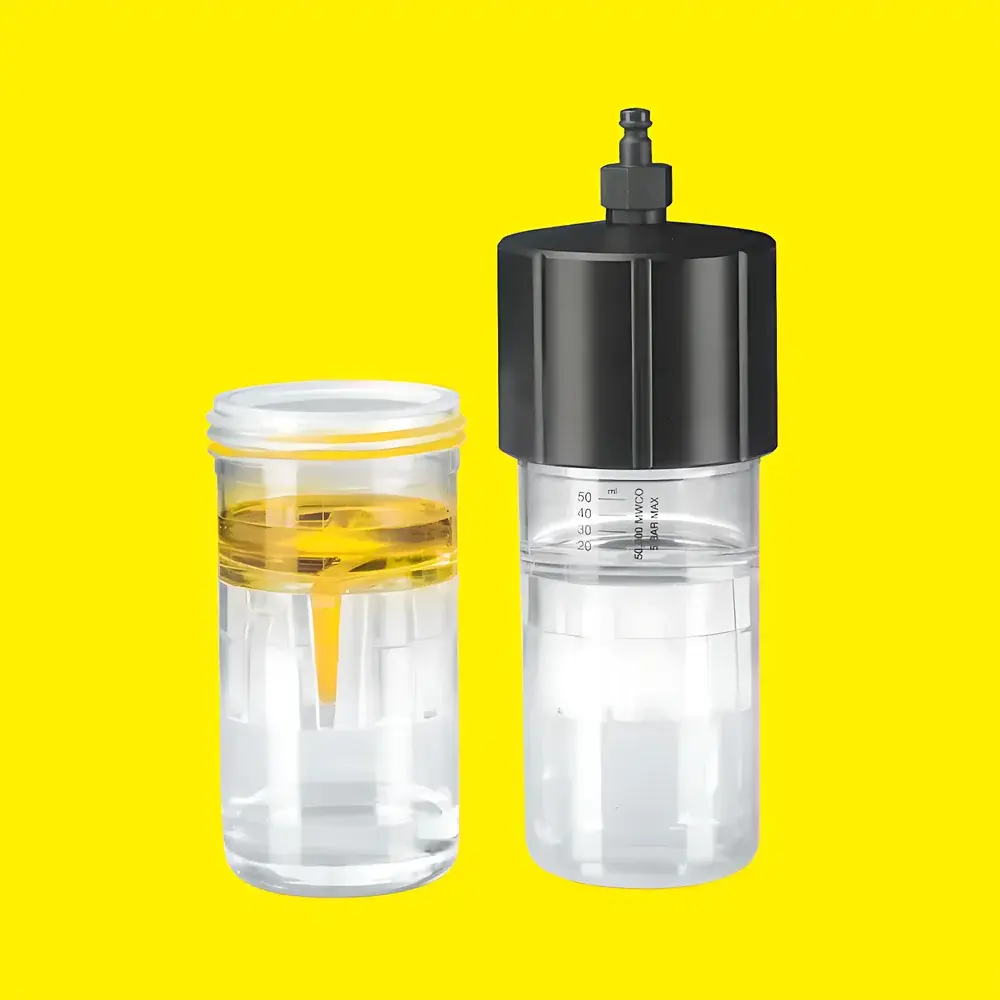
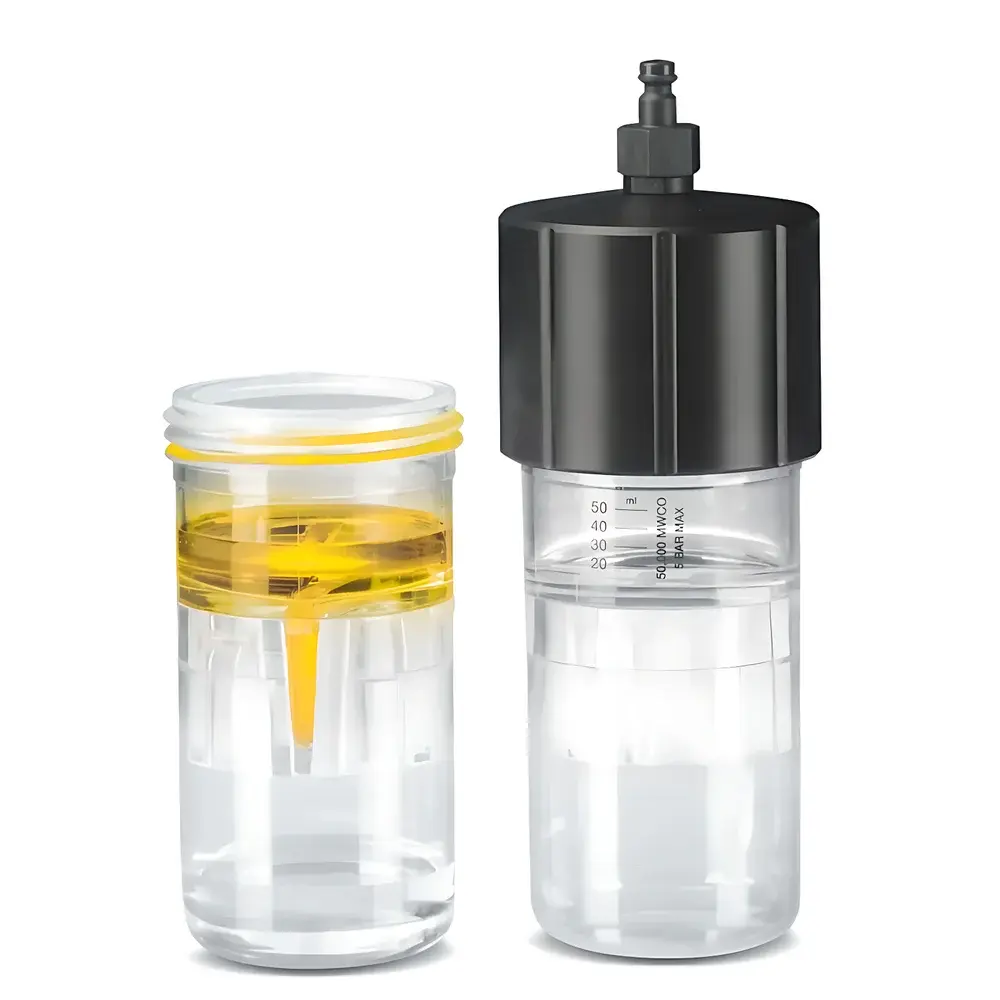
Sartorius Vivaspin 100 Ultrafiltration Concentrator
| Brand | Sartorius |
|---|---|
| Origin | Germany |
| Model | Vivaspin 100 |
| Sample Capacity | 100 mL |
| Retentate Hold-up Volume | 350 µL |
| Membrane Orientation | Vertical |
| Operating Modes | Centrifugation and/or Pressure-driven Filtration |
| MWCO Options | 5–1000 kDa (including 0.2 µm pore size) |
| Membrane Types | Regenerated cellulose (RC), Polyethersulfone (PES), Polyvinylidene fluoride (PVDF) |
| Pack Sizes | 2 units (e.g., VC1011) or 10 units (e.g., VC1012) |
Overview
The Sartorius Vivaspin 100 Ultrafiltration Concentrator is an engineered solution for rapid, scalable, and reproducible concentration and buffer exchange of biomolecular samples—particularly proteins, antibodies, enzymes, nucleic acids, and virus particles. Based on tangential-flow ultrafiltration (TFF) principles adapted to a single-use, vertical-membrane geometry, the Vivaspin 100 operates via either centrifugal force (compatible with standard fixed-angle or swing-bucket rotors) or pressurized gas (using nitrogen or compressed air up to 4.0 bar), or both simultaneously. Its patented vertical membrane orientation minimizes concentration polarization and membrane fouling, enabling higher flux rates and improved recovery compared to traditional horizontal flat-sheet or stirred-cell configurations. Designed for laboratory-scale processing, it bridges the gap between benchtop microconcentrators (e.g., Vivaspin 2/5/20) and preparative TFF systems—offering scalability without compromising precision or user control.
Key Features
- Vertical membrane architecture with optimized flow path geometry to reduce shear stress and enhance mass transfer efficiency.
- Dual-mode operation: fully compatible with standard centrifuges (up to 5,000 × g) and pressurized filtration manifolds (max 4.0 bar input pressure).
- Low retentate hold-up volume of only 350 µL—achieved through integrated dead-volume minimization design—enabling near-quantitative recovery without reverse centrifugation or additional elution steps.
- Wide range of molecular weight cut-off (MWCO) options: 5, 10, 30, 50, 100, 300, and 1000 kDa, plus 0.2 µm sterile-grade filtration variants.
- Multiple membrane chemistries available: regenerated cellulose (RC) for high protein recovery and low binding; polyethersulfone (PES) for high flux and broad chemical compatibility; polyvinylidene fluoride (PVDF) for enhanced durability and solvent resistance.
- Pre-sterilized, pyrogen-free, DNase/RNase-free units supplied in individually sealed packaging—validated for use in GLP-compliant workflows and early-stage bioprocess development.
Sample Compatibility & Compliance
The Vivaspin 100 supports aqueous and mildly organic solvent-based solutions (e.g., ≤20% acetonitrile, ≤10% methanol, ≤5% DMSO), making it suitable for downstream purification of recombinant proteins, monoclonal antibodies, plasmid DNA, and viral vectors. All RC and PES membranes are certified non-pyrogenic and tested per USP and EP 2.6.14. Device construction complies with ISO 10993-5 (cytotoxicity) and ISO 10993-10 (sensitization and irritation). Units are manufactured under Sartorius’ ISO 13485-certified quality management system and support audit readiness for FDA 21 CFR Part 11–aligned data integrity requirements when used with validated centrifuge or pressure-control instrumentation.
Software & Data Management
While the Vivaspin 100 itself is a passive, single-use device, its integration into automated workflows is supported via compatibility with Sartorius’ BioFlo® and Ambr® platforms for process monitoring and parameter logging. When paired with centrifuges equipped with time/temperature/g-force recording (e.g., Eppendorf 5810 R, Thermo Scientific Sorvall ST 16R), users can maintain full traceability of operational conditions. For pressure-driven applications, digital pressure controllers with data export (e.g., Parker IQ+ series) enable SOP-driven execution and electronic batch record generation—facilitating alignment with GMP Annex 11 and ALCOA+ data governance principles.
Applications
- Rapid concentration of dilute protein stocks prior to SEC, IEX, or SDS-PAGE analysis.
- Buffer exchange (diafiltration) during antibody purification or refolding protocols.
- Removal of small-molecule contaminants (salts, imidazole, glycerol) from enzymatic reaction mixtures.
- Concentration and desalting of CRISPR-Cas ribonucleoprotein (RNP) complexes for electroporation.
- Preparative isolation of exosomes and extracellular vesicles from cell culture supernatants (in combination with differential centrifugation).
- Scalable process development for upstream clarification and intermediate hold steps in mAb manufacturing.
FAQ
What is the maximum recommended centrifugal force for the Vivaspin 100?
The device is rated for continuous operation at up to 5,000 × g using fixed-angle rotors (17°–30° angle); swing-bucket rotors require lower g-forces (≤3,000 × g) to prevent seal deformation.
Can I use the Vivaspin 100 with organic solvents?
Yes—PES and PVDF membranes tolerate up to 20% acetonitrile or methanol in aqueous mixtures; RC membranes are limited to ≤10% organic content. Always verify chemical compatibility prior to use.
How do I select the appropriate MWCO for my sample?
Choose an MWCO approximately 3–5× lower than the molecular weight of your target analyte to ensure >90% retention; for mixed samples, prioritize the largest species of interest.
Is the Vivaspin 100 suitable for sterile filtration?
Only the 0.2 µm pore size variants (VC1071/VC1072) are validated for sterile filtration of aqueous solutions; they are pre-sterilized by gamma irradiation and certified per ISO 11140-1.
Does the device support diafiltration?
Yes—by adding fresh buffer to the retentate chamber after initial concentration and repeating the filtration cycle, users can achieve ≥95% salt removal in 3–5 diafiltration volumes.
Related Products




