
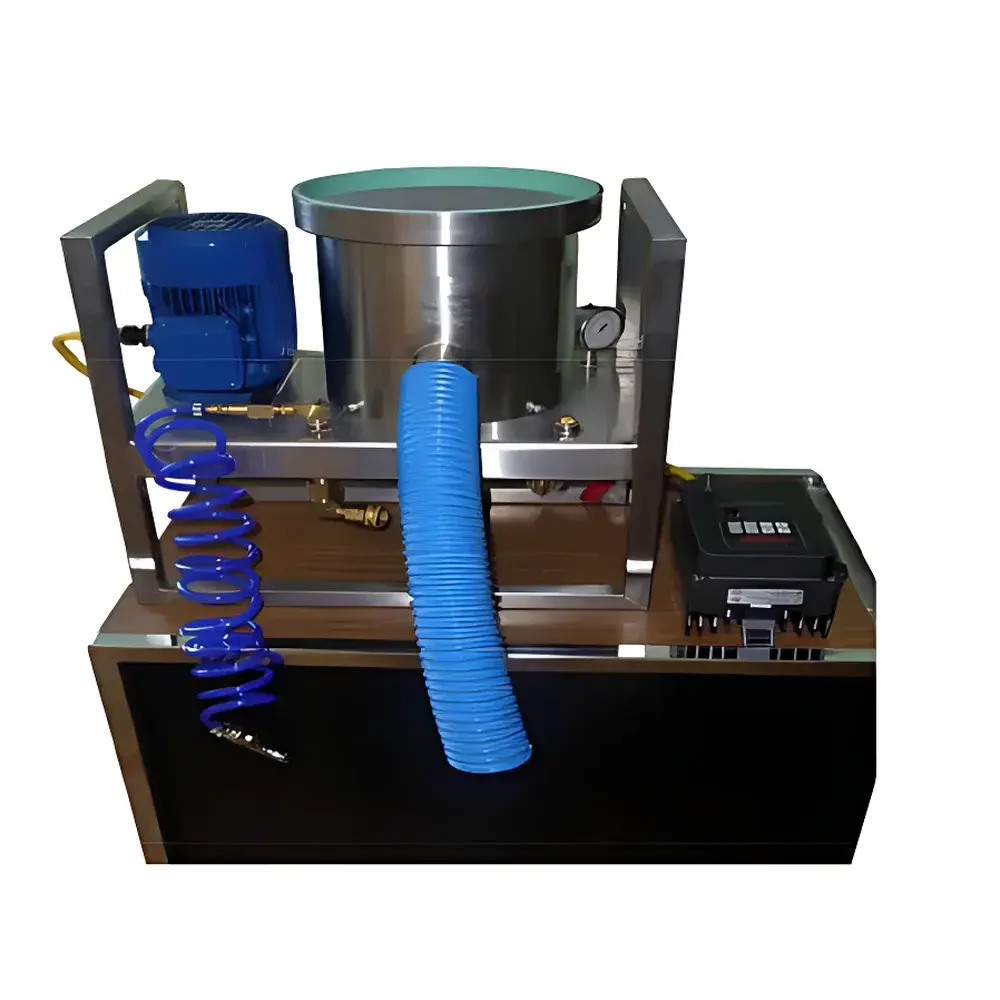
SB-40 Centrifugal Concentrator
| (在此处输出精准翻译� | �纯英文产品名称。极其重要:仅输出一行名称,严禁输出备选名、严禁换行重复、严禁包含任何中文字符) |
|---|---|
| [Origin | USA |
| Manufacturer Type | Authorized Distributor |
| Origin Category | Imported |
| Model | SB-40 |
| Quotation | Upon Request |
| Solids Capacity | 0.0–0.3 t/h |
| Max Slurry Flow Rate | 10 US gal/min |
| G-Force Range | 50–200 × g |
| Machine Weight | 81 lb (36.7 kg) |
| Motor Power | 1/5 HP (150 W) |
| Process Water Requirement | 1–5 US gal/min |
| Max Feed Particle Size | 0.06 in (1.5 mm) |
| Dimensions (W×D×H) | 20 in × 14 in × 23 in (508 × 356 × 584 mm) |
| Construction | Stainless Steel Frame with UHMW Polyethylene Wear Liner] |
Overview
The SB-40 Centrifugal Concentrator is a gravity-based, high-G mineral separation device engineered for the selective recovery of free native precious metals—including gold (Au), silver (Ag), and platinum group elements (PGEs)—from fine to coarse feed streams. Operating on the principle of enhanced gravitational sedimentation within a rotating conical bowl, the SB-40 generates centrifugal forces ranging from 50 to 200 × g, enabling efficient stratification of particles by specific gravity under controlled fluidized bed dynamics. Unlike continuous concentrators, the SB-40 functions as a semi-batch unit: feed slurry is introduced while the rotor spins at set G-force; heavy minerals migrate downward through a shallow, water-fluidized concentrate bed retained in riffled grooves near the drum apex; lighter gangue overflows radially. When the concentrate bed reaches optimal grade—typically 1–3 wt% Au—the feed is halted, rotation decelerated, and an integrated spray manifold flushes accumulated concentrate from beneath the rotor baffles into the discharge port. This intermittent cycle ensures high-grade concentrate production (often >1% metal content) at inherently low mass recovery rates (<1%), consistent with the physical constraints of gravity concentration targeting liberated, dense phases.
Key Features
- Stainless steel structural frame with ultra-high-molecular-weight (UHMW) polyethylene wear-resistant liner in critical abrasion zones
- Variable-speed AC drive system enabling precise G-force control (50–200 × g) across operational cycles
- Optimized conical rotor geometry with precision-machined riffle grooves to retain and stabilize the concentrate bed
- Integrated process water injection system upstream of the concentrate bed to induce particle migration and improve stratification efficiency
- Self-flushing discharge mechanism using timed spray manifolds to evacuate concentrate without manual intervention
- Compact footprint (20″ × 14″ × 23″) and low power demand (1/5 HP), suitable for pilot-scale testing, laboratory evaluation, or small-scale production circuits
Sample Compatibility & Compliance
The SB-40 accepts feed slurries with solids concentrations typical of gravity circuit tailings or mill discharge streams (e.g., 10–25% w/w solids). It accommodates particle size distributions from ~10 µm up to 1.5 mm (0.06 in), though optimal performance is achieved with feed pre-screened to ≤2 mm. The unit is designed for operation with potable or process water only—no reagents or surfactants required. While not certified to ISO 9001 or CE as a standalone industrial machine (as it is distributed for laboratory and pilot use), its mechanical design adheres to ASME B30.27 (Equipment for Material Handling) safety guidelines for rotating equipment. All wetted components comply with FDA 21 CFR §177.1520 for indirect food-contact polymers (UHMW liner), supporting applications in metallurgical research labs operating under GLP-aligned protocols.
Software & Data Management
The SB-40 operates via manual or semi-automated control using an analog speed controller and timer-based cycle sequencing. No embedded firmware or proprietary software is included; however, third-party data acquisition systems (e.g., LabVIEW, MATLAB, or PLC-based SCADA) can interface with its motor drive output signals (0–10 V analog speed reference, digital start/stop I/O) for full-cycle logging. Users may record rotational speed, cycle duration, feed flow rate (via external flowmeter), and concentrate mass per batch to generate reproducible performance metrics—essential for comparative testing against ASTM E1933 (Standard Guide for Sampling and Analysis of Gold-Bearing Materials) or internal QA/QC reporting. Audit trails are maintained manually or via external logging hardware compliant with 21 CFR Part 11 requirements where applicable.
Applications
- Recovery of free-milling native gold and silver from cyanide-leach residues or carbon-in-pulp (CIP) tailings
- Pilot-scale evaluation of gravity recoverable gold (GRG) content in exploration drill core composites
- Pre-concentration of PGE-bearing placers prior to smelting or leaching
- Metallurgical testwork for optimizing upstream comminution—assessing liberation vs. overgrinding trade-offs
- Small-scale artisanal or remote-site operations where chemical-free, low-energy concentration is mandated
- Teaching laboratories demonstrating fundamental principles of density-based particle separation and centrifugal force effects
FAQ
What is the typical concentrate grade achievable with the SB-40?
Concentrate grades commonly range from 0.5% to 3% Au (or equivalent for Ag/Pt), depending on feed grade, particle liberation, and operational tuning. Higher grades correlate with lower mass recovery, reflecting inherent selectivity of gravity concentration.
Does the SB-40 require flocculants or chemical additives?
No. The SB-40 relies solely on physical separation mechanisms—centrifugal force, fluidization, and differential settling—and requires no reagents, making it suitable for environmentally sensitive or regulatory-restricted environments.
Can the SB-40 handle abrasive feeds such as quartz-rich gravels?
Yes, provided feed is pre-screened to ≤2 mm and process water flow is maintained within the recommended 1–5 US gpm range. The UHMW liner provides proven resistance to silica abrasion in long-term pilot trials.
Is the SB-40 compatible with automated plant control systems?
It supports integration via analog speed input (0–10 V) and discrete I/O for start/stop commands, enabling synchronization with DCS or PLC networks for semi-autonomous batch sequencing.
What maintenance intervals are recommended?
Routine inspection every 200 operating hours includes checking UHMW liner wear, drive belt tension, and spray manifold nozzle integrity. Bearing lubrication is specified at 1,000-hour intervals per OEM guidelines.






