
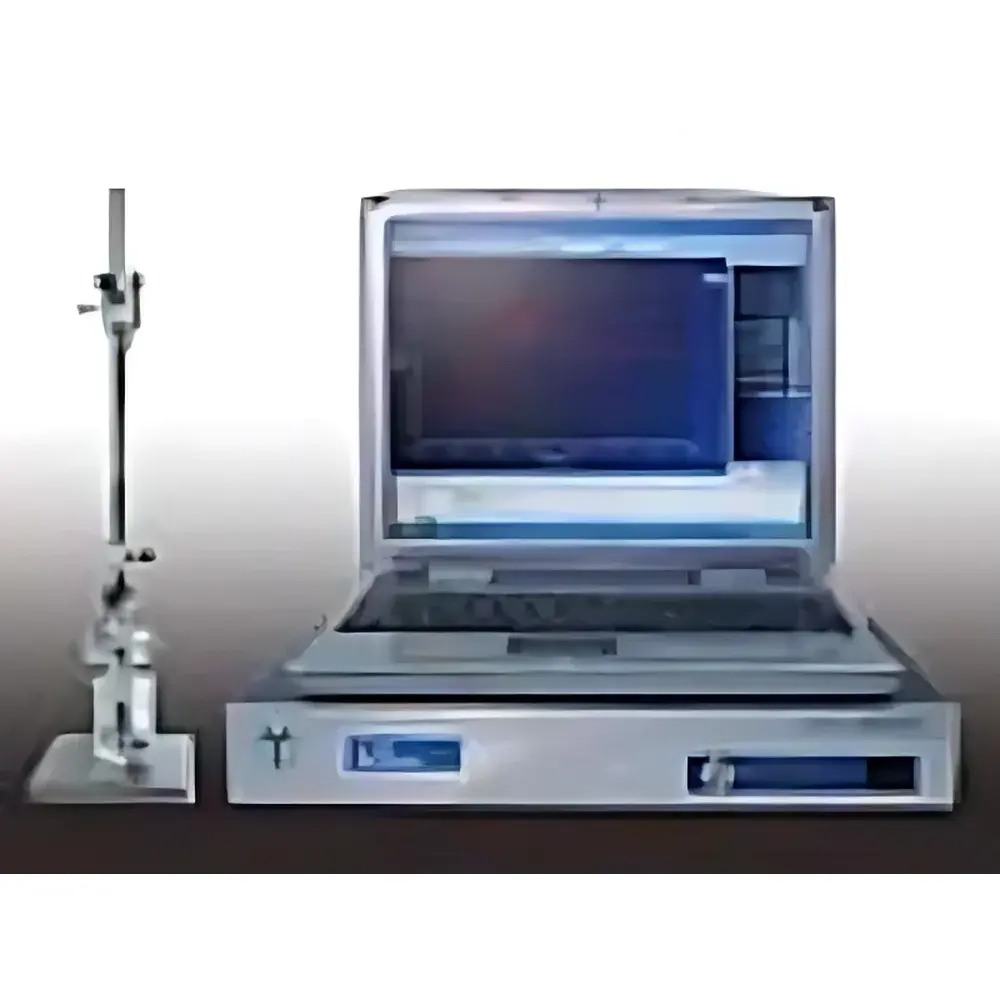
scchengyi JP-06A Advanced Voltammetric Polarograph
| Brand | scchengyi |
|---|---|
| Origin | Sichuan, China |
| Model | JP-06A |
| Current Measurement Range | 1×10⁻³ A to 1×10⁻⁹ A (F.S.) |
| Sensitivity | 5×10⁻⁸ mol/L for Cd²⁺ (Linear Sweep Polarography) |
| Potential Range | −4000 mV to +4000 mV (min. step: 0.15 mV) |
| Scan Rate | 0.05–1 V/s |
| DME Drop Period | 1–1000 s |
| Resolution | < 2.5 mV |
| Anti-Interference Ratio (for pre-reduced species) | 10⁴ : 1 |
| Repeatability Error | < 0.1 % |
| Range Switching Error | < 0.1 % |
| ADC | 24-bit |
| DAC | 16-bit |
| Power Consumption | < 10 W |
Overview
The scchengyi JP-06A Advanced Voltammetric Polarograph is a high-precision, microprocessor-controlled electrochemical instrument engineered for classical and modern polarographic analysis using the dropping mercury electrode (DME). It operates on the fundamental principle of controlled-potential voltammetry, where current response is measured as a function of applied potential in solutions containing electroactive analytes. The JP-06A implements linear sweep polarography (LSP), differential pulse polarography (DPP), and square-wave polarography (SWP) modes—enabling quantitative trace metal detection, speciation studies, and kinetic investigations in aqueous and non-aqueous electrolytes. Its design emphasizes low-noise signal acquisition, wide dynamic current range, and precise potential control—critical for achieving sub-nanomolar detection limits and high reproducibility in regulated and research environments.
Key Features
- Ultra-low-noise current measurement architecture with full electronic switching and hardware-based capacitive compensation, extending usable current range from 1 nA to 1 mA (F.S.)
- 24-bit analog-to-digital converter coupled with ultra-low-drift programmable gain amplifier, resolving signals down to 1 µV and enabling robust baseline stability
- Onboard first- and second-derivative circuitry for direct peak sharpening and improved resolution of overlapping waves
- Integrated free-drop mercury timing circuitry that autonomously detects drop formation intervals and optimizes scan initiation—eliminating manual synchronization and enhancing operational consistency
- Programmable polarization potential range from −4000 mV to +4000 mV with 0.15 mV resolution, supporting both cathodic and anodic scans across diverse redox couples
- Adjustable scan rates (0.05–1 V/s) and DME drop periods (1–1000 s), facilitating method development for diffusion-controlled, adsorption-controlled, and kinetic-limited systems
- USB 2.0 interface compliant with Windows-based laboratory workstations; driver-free plug-and-play operation under modern OS environments
Sample Compatibility & Compliance
The JP-06A is optimized for use with standard three-electrode electrochemical cells (working electrode: DME or static mercury film electrode; counter electrode: Pt wire; reference electrode: saturated calomel or Ag/AgCl). It supports analysis of cations (e.g., Cd²⁺, Pb²⁺, Zn²⁺, Cu²⁺), anions (e.g., NO₂⁻, I⁻), organic reducibles (e.g., nitroaromatics, quinones), and coordination complexes in buffered aqueous media. The instrument meets essential functional requirements of ISO 17025-accredited laboratories performing trace metal analysis per ASTM D3559 (lead in water), EPA Method 7063 (cadmium in soils), and Chinese national standard GB/T 7475—providing traceability through internal calibration routines and documented system verification protocols. While not inherently 21 CFR Part 11-compliant, its software architecture supports audit-trail-ready data export (CSV, TXT, XLSX) and user-defined metadata tagging—facilitating integration into GLP/GMP workflows when deployed with validated third-party LIMS or ELN platforms.
Software & Data Management
The bundled PC application provides a modular, intuitive interface built on Qt framework, compatible with Windows 10/11 (64-bit). Core functionalities include real-time adaptive scaling—automatically adjusting oscilloscope window amplitude and timebase without manual range selection—and multi-curve overlay mode for simultaneous visualization of background electrolyte, calibration standards, and unknown samples. Background subtraction is supported both during acquisition (real-time digital filtering) and post-run (polynomial or spline-based baseline correction). All raw and processed datasets retain full metadata: timestamp, electrode configuration, scan parameters, environmental conditions (user-entered), and operator ID. Export formats comply with FAIR principles (Findable, Accessible, Interoperable, Reusable), including ASCII-compatible files suitable for import into OriginLab, MATLAB, or Python-based electrochemical analysis toolkits (e.g., PyEC, Pycse). Printer support includes color and monochrome output with customizable report templates aligned to institutional documentation standards.
Applications
- Trace heavy metal quantification in environmental water, soil extracts, and biological fluids (e.g., Cd²⁺ at 5×10⁻⁸ mol/L LOD)
- Speciation analysis of metal complexes in pharmaceutical excipients and chelation therapy formulations
- Electrochemical characterization of corrosion inhibitors in industrial cooling water systems
- Quality control of electroplating bath composition in metallurgical and electronics manufacturing
- Teaching laboratories: hands-on instruction in fundamental electroanalytical concepts—including diffusion layer theory, Ilkovič equation validation, and pulse technique optimization
- Research in electrocatalysis, sensor development, and bioelectrochemistry requiring high-fidelity current transients and derivative-enhanced peak resolution
FAQ
What electrode configurations are supported?
Standard three-electrode setups with DME (dropping mercury electrode) are fully supported; optional static mercury film electrodes (SMFE) and carbon paste electrodes may be used with appropriate cell adapters and parameter tuning.
Is the instrument compatible with automated sample changers?
The JP-06A does not include native autosampler integration; however, its USB command protocol is documented and scriptable via Python or LabVIEW—enabling custom automation with third-party XYZ liquid handlers or carousel-based systems.
How is calibration verified?
Calibration is performed using certified reference solutions (e.g., 1 ppm Cd²⁺ in 0.1 M KCl). System verification includes open-circuit potential drift monitoring (< 0.5 mV/h), current offset stability testing (< ±2 pA over 30 min), and linearity assessment across five decades of current range.
Can data be exported for statistical process control (SPC)?
Yes—peak current, peak potential, half-wave potential, and limiting current values are automatically tabulated per run and exportable to CSV for SPC charting (e.g., X-bar R charts) in JMP, Minitab, or Excel-based QMS platforms.





