
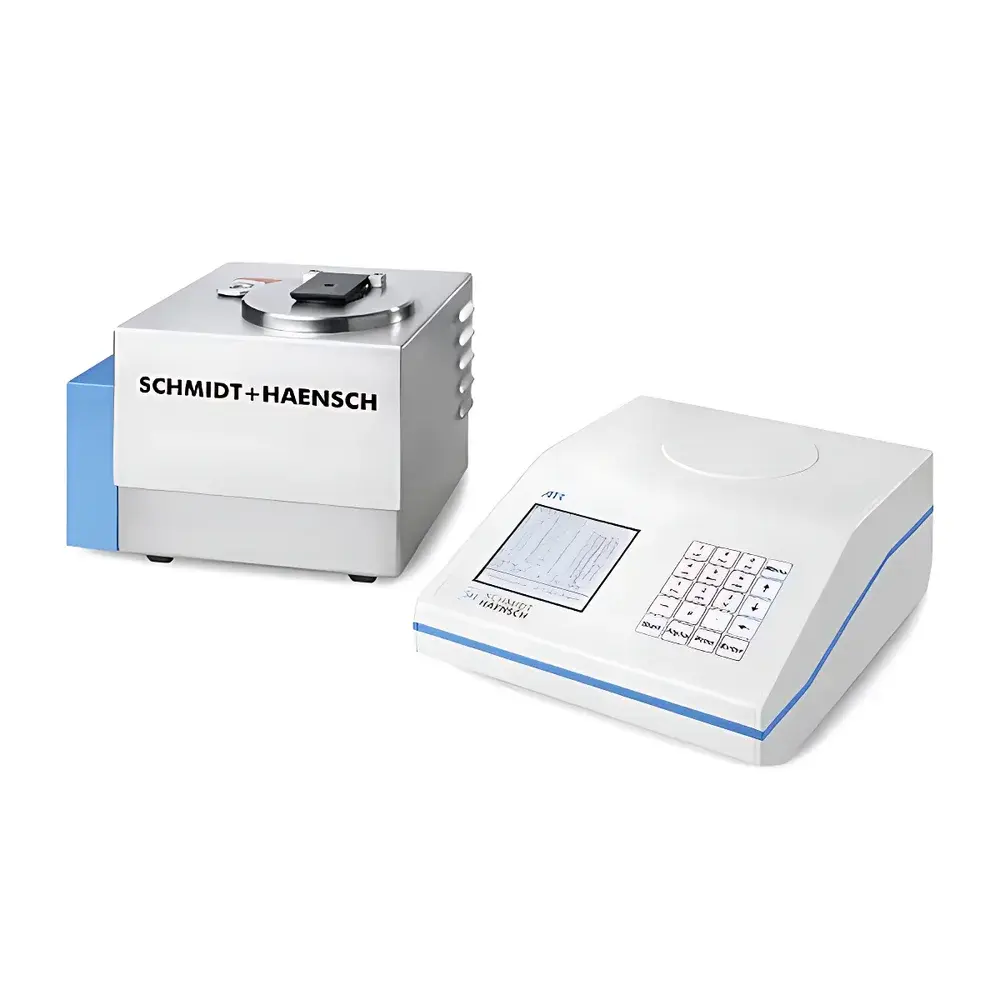
Schmidt + Haensch ATR-L Multi-Wavelength Automatic Refractometer
| Brand | Schmidt + Haensch (S+H) |
|---|---|
| Origin | Germany |
| Model | ATR-L |
| Product Type | In-line Refractometer |
| Temperature Control | Yes |
| Digital Display | Yes |
| Measurement Range | 1.33200–1.70000 RI / 0–100% Brix |
| Measurement Accuracy | ±0.00001 RI / ±0.01 Brix |
| Temperature Control Range | 10–80 °C |
| Temperature Accuracy | ±0.03 °C |
| Wavelengths | 400, 450, 490, 525, 589, 660, 700 nm (LED-based) |
| Prism Material | YAG |
| Detection Principle | Critical Angle of Total Internal Reflection (ATR) |
| Sensor | CCD array |
| Compliance | ASTM, ISO, AOAC, DIN, ICUMSA, USP, FDA 21 CFR Part 11 (software-enabled), GLP/GMP-ready |
Overview
The Schmidt + Haensch ATR-L Multi-Wavelength Automatic Refractometer is an advanced optical instrument engineered for high-precision, wavelength-resolved refractive index (RI) measurement across the visible spectrum. Based on the physical principle of total internal reflection (TIR), the ATR-L determines RI by optically detecting the critical angle at the interface between a high-refractive-index YAG prism and the sample liquid. Unlike conventional single-wavelength refractometers operating exclusively at 589 nm (the sodium D-line), the ATR-L integrates seven discrete, thermally stabilized LED sources—400, 450, 490, 525, 589, 660, and 700 nm—to enable full spectral dispersion profiling in a single, automated measurement cycle. This capability transforms RI from a scalar value into a spectral fingerprint, revealing material-specific optical dispersion behavior that correlates with molecular composition, purity, and structural homogeneity. With a resolution of 0.00001 RI and temperature stability of ±0.03 °C, the ATR-L meets stringent metrological requirements for research-grade characterization and regulated process analytics.
Key Features
- Seven fixed-wavelength LED illumination system covering 400–700 nm, enabling true multi-point dispersion curve acquisition
- Integrated Peltier-based temperature control (10–80 °C) with embedded NTC sensor directly adjacent to the measuring prism—no external water bath required
- YAG (yttrium aluminum garnet) prism offering exceptional thermal stability, chemical resistance, and optical clarity across UV–VIS range
- CCD-based angular detection system delivering sub-pixel resolution for critical angle determination and long-term repeatability
- Dual-mode output: absolute RI per wavelength + derived parameters (Brix, % w/w, g/mL, moisture content) with user-configurable calibration tables
- Comprehensive traceability: factory-calibrated against NIST-traceable reference liquids; optional S+H Berlin Calibration Certificate available
- Robust stainless-steel probe design suitable for both laboratory benchtop use and integration into hygienic or hazardous-area process lines
Sample Compatibility & Compliance
The ATR-L accepts liquid samples with minimum volume of 0.3 mL, accommodating aqueous solutions, organic solvents, oils, fuels, polymer melts (within temperature limits), and viscous media such as syrups or emulsions. Its sealed, corrosion-resistant flow cell supports CIP/SIP protocols and complies with EHEDG and 3-A sanitary standards when configured with appropriate wetted materials. Regulatory alignment includes full support for pharmacopeial methods (USP , EP 2.2.6), food analysis standards (AOAC 932.12, ICUMSA Method GS7/8-11), and petrochemical testing (ASTM D1218, D1298). When paired with compliant software (e.g., S+H RefraSoft™), the system provides full audit trail, electronic signatures, and 21 CFR Part 11–compliant data handling—enabling deployment in GMP/GLP environments without modification.
Software & Data Management
The ATR-L operates natively via its integrated microcontroller and backlit LCD interface (16×16 characters), but achieves full analytical power through optional PC connectivity via RS-232, USB, or parallel port. RefraSoft™ software enables real-time spectral dispersion visualization, Abbe number calculation (nF–nC)/(nD–1), polynomial fitting of RI(λ) curves, and export of raw angular data for third-party modeling (e.g., Cauchy or Sellmeier equation regression). All measurements are timestamped, temperature-stamped, and annotated with operator ID and calibration status. Data files conform to ASTM E1382-compliant ASCII format and can be imported directly into LIMS or ELN systems. Firmware updates and method templates are distributed via S+H’s secure customer portal, ensuring ongoing compliance with evolving regulatory expectations.
Applications
The ATR-L serves as a primary tool in R&D laboratories where compositional fingerprinting is essential: distinguishing enantiomeric variants in chiral pharmaceutical intermediates, quantifying polymer branching via dispersion slope analysis, or verifying authenticity of premium beverages (e.g., wine, spirits, essential oils) through spectral RI deviation thresholds. In industrial settings, it monitors continuous sugar concentration in juice evaporation plants, verifies additive concentrations in lubricant formulations, and validates refractive matching in optical adhesive curing processes. Its sensitivity to subtle dispersion shifts also supports quality control of ophthalmic lens monomers, contact lens hydrogels, and telecom-grade optical fluids—where even ppm-level impurities induce measurable deviations below 450 nm. The instrument’s ability to correlate RI dispersion with UV-Vis absorbance trends further enables indirect turbidity or chromophore profiling without additional instrumentation.
FAQ
What is the minimum sample volume required for measurement?
0.3 mL—sufficient to fully cover the prism surface and ensure stable thermal equilibration.
Can the ATR-L operate outside standard laboratory conditions?
Yes—the stainless-steel probe and Peltier module support ambient operation from 15–40 °C; temperature-controlled measurements remain valid from 10–80 °C.
Is calibration traceable to international standards?
All factory calibrations are performed using NIST-traceable sucrose and bromonaphthalene reference standards; S+H Berlin maintains ISO/IEC 17025-accredited calibration laboratories.
How does the ATR-L handle highly colored or turbid samples?
Because measurement relies on critical angle detection—not light transmission—it remains unaffected by sample opacity or absorbance, provided the interface remains optically coupled.
Can custom wavelengths be added beyond the standard seven?
Yes—S+H offers OEM configuration with alternative LED sets (e.g., 365 nm UV or 850 nm NIR) upon request, subject to optical path validation and firmware adaptation.






