
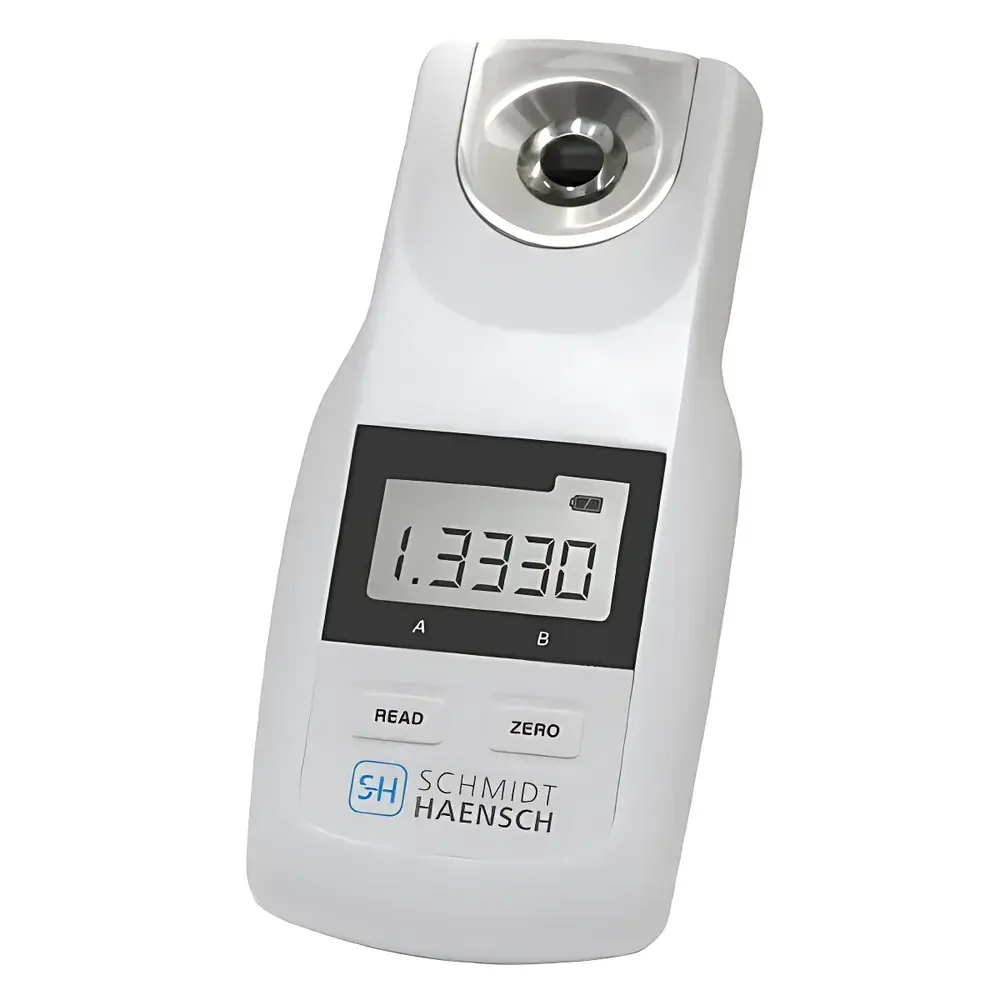
Schmidt + Haensch DHR Digital Handheld Refractometer
| Brand | Schmidt + Haensch (S+H) |
|---|---|
| Origin | Germany |
| Model | DHR |
| Type | Digital handheld refractometer |
| Temperature control | Yes (ATC) |
| Digital display | Yes (5-digit LCD) |
| Measurement range | 0–95 °Brix / 1.3300–1.5400 RI |
| Resolution | 0.1 °Brix / 0.0001 RI |
| Accuracy | ±0.2 °Brix / ±0.0003 RI |
| Operating sample temperature | 5–60 °C |
| Ambient temperature range | 5–40 °C |
| ATC compensation range | 5–70 °C |
| IP rating | IP65 |
| Compliance | CE, RoHS |
| Power | 2×AAA batteries |
| Dimensions (L×W×H) | 115×54×30 mm |
| Weight | 85 g (without batteries) |
| Prism material | Optical glass |
Overview
The Schmidt + Haensch DHR Digital Handheld Refractometer is a precision optical instrument engineered for rapid, field-deployable refractive index and concentration measurements across diverse liquid matrices. Based on the fundamental principle of total internal reflection at the prism–sample interface, the DHR determines refractive index (RI) with high reproducibility and minimal operator dependency. Its core optical architecture utilizes high-transmission optical glass prisms calibrated to NIST-traceable standards, ensuring metrological integrity in routine QC and process monitoring environments. Unlike analog or low-resolution digital units, the DHR integrates real-time automatic temperature compensation (ATC) over a broad 5–70 °C range—critical for maintaining accuracy when measuring viscous or thermally sensitive samples such as honey, wine must, antifreeze glycol solutions, or DEF (AdBlue®). Designed for ISO/IEC 17025-aligned laboratories and GMP-compliant production floors, the DHR delivers traceable, repeatable results without requiring external calibration hardware or software intervention.
Key Features
- 5-digit panoramic LCD display with 2-second measurement response time
- Integrated ATC system compliant with ASTM D1218 and ISO 21748 standards for temperature-dependent refractive index correction
- IP65-rated enclosure for dust- and water-resistant operation in humid, outdoor, or industrial settings
- Optical glass prism with scratch-resistant coating and long-term stability under repeated cleaning cycles
- Battery-powered (2×AAA) design enabling continuous operation for >10,000 measurements per set
- Zero-drift electronics with auto-shutdown after 3 minutes of inactivity to preserve battery life and measurement consistency
- Multi-scale firmware options preconfigured for industry-specific applications—including honey moisture, wine alcohol, Oechsle, saline, seawater PPT, veterinary urine SG, propylene glycol, ethylene glycol, and DEF concentration
Sample Compatibility & Compliance
The DHR accommodates liquids spanning low-viscosity aqueous solutions (e.g., fruit juice, brine) to highly viscous media (e.g., undiluted honey, syrup, glycol-based coolants) without dilution or heating. Its wide dynamic range (0–95 °Brix; 1.3300–1.5400 RI) supports compliance with multiple international testing protocols: USP for injectable solution clarity assessment, AOAC Official Method 932.12 for sugar content in beverages, and EN 13806 for DEF quality verification. All factory calibrations are documented per ISO/IEC 17025 requirements and include uncertainty budgets traceable to PTB (Physikalisch-Technische Bundesanstalt) reference materials. The device meets electromagnetic compatibility (EMC) Directive 2014/30/EU and carries CE marking for conformity with EU health, safety, and environmental protection legislation. RoHS 2011/65/EU compliance ensures absence of restricted hazardous substances in all electronic and optical components.
Software & Data Management
While the DHR operates as a standalone instrument, its firmware architecture supports optional PC connectivity via USB-to-serial adapter for raw data export in CSV format. This enables integration into LIMS environments supporting ASTM E1384 or ISO/IEC 17025 audit trails. Each measurement record includes timestamp, ambient temperature, sample temperature (via integrated thermistor), selected scale ID, and measured value—meeting FDA 21 CFR Part 11 requirements for electronic records when paired with validated third-party data acquisition software. No proprietary drivers or cloud services are required; exported datasets retain full metrological provenance and are compatible with Excel, MATLAB, and statistical process control (SPC) platforms.
Applications
- Agriculture & Viticulture: Real-time Brix monitoring during grape harvest decisions; Oechsle grading of must prior to fermentation
- Honey Production: Simultaneous determination of % sucrose (°Brix) and % water content for compliance with Codex Alimentarius Standard 12-1981
- Automotive & Industrial Fluids: Ethylene/propylene glycol concentration verification in engine coolants and DEF (AdBlue®) for SCR systems
- Food & Beverage QA/QC: Salt concentration in brines, sugar content in syrups, alcohol by volume (ABV) estimation in wines and spirits
- Aquaculture & Marine Science: Seawater salinity (‰) and specific gravity (SG) tracking for tank management
- Veterinary Diagnostics: Urine specific gravity screening in small and large animal clinics per WSAVA guidelines
FAQ
What calibration standards are recommended for routine verification?
Distilled water (RI = 1.3330 at 20 °C) and certified sucrose reference solutions (e.g., 10 %, 30 %, 60 % w/w) are recommended per ISO 21748. Calibration should be performed daily before first use and after significant ambient temperature shifts.
Is the DHR suitable for measuring hot or frozen samples?
Sample temperature must remain within 5–60 °C. Direct measurement of boiling or sub-zero liquids is not supported; allow samples to equilibrate to acceptable range prior to analysis.
Can the DHR be used for non-aqueous solvents like ethanol or acetone?
Yes—provided the solvent’s RI falls within the instrument’s specified range (1.3300–1.5400) and does not chemically attack optical glass. Verify compatibility with Schmidt + Haensch’s chemical resistance guide prior to use.
Does the DHR support GLP-compliant audit trails?
When connected to validated data acquisition software, the DHR-generated CSV logs contain immutable timestamps, operator IDs (if entered), and environmental metadata—fulfilling GLP requirements for raw data archiving and reviewer access.
How often does the prism require cleaning or maintenance?
Clean after each sample using lint-free tissue and reagent-grade isopropanol. Avoid abrasive cleaners. Prism surface inspection is recommended monthly; no recalibration is needed unless physical damage or persistent residue is observed.




