
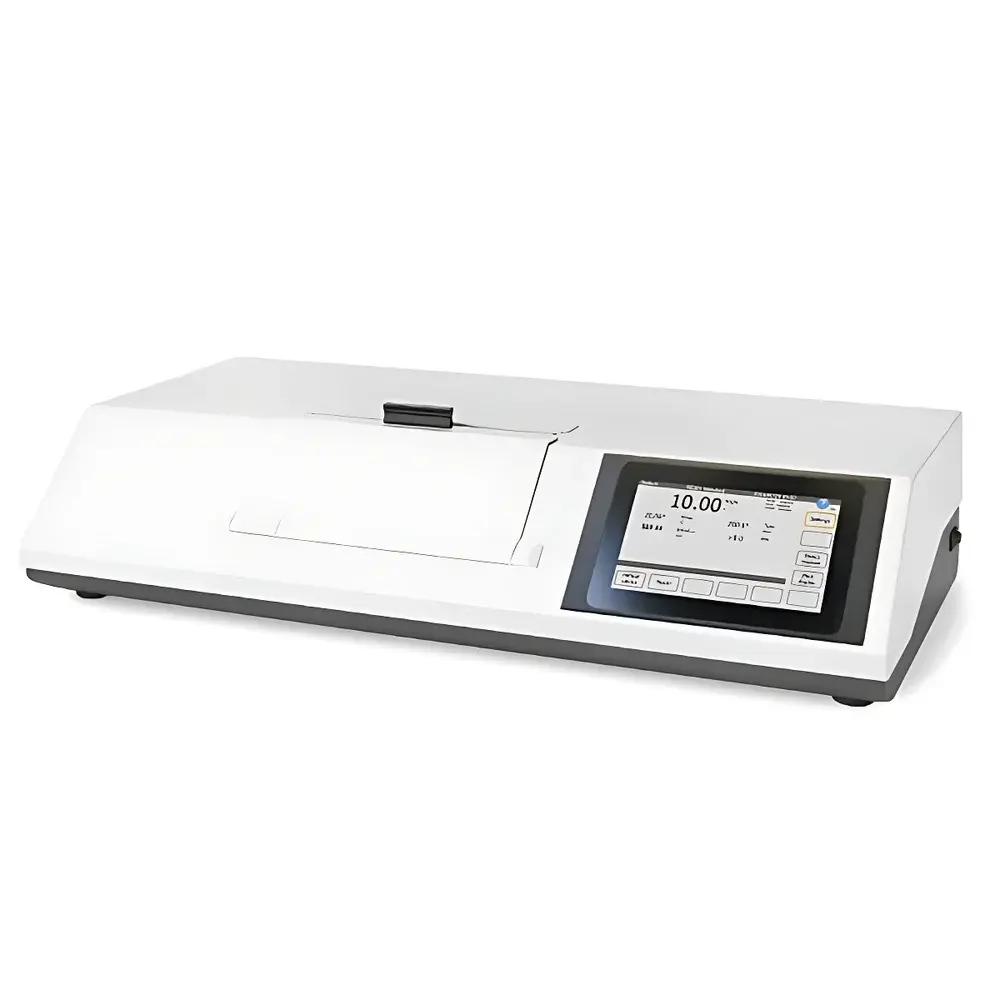
SCHMIDT + HAENSCH Polartronic V Automated Polarimeter
| Brand | SCHMIDT + HAENSCH |
|---|---|
| Origin | Germany |
| Model | Polartronic V |
| Sample Tube Length | up to 200 mm |
| Measurement Range | ±360° / ±259°Z |
| Accuracy | ±0.005° / ±0.015°Z |
| Resolution | 0.001° / 0.01°Z |
| Repeatability | ±0.005° / ±0.015°Z |
| Wavelength Options | 589 nm (Na-D), 882 nm, or dual-wavelength (589 & 882 nm) |
| Light Source | Long-life LED |
| Temperature Control | External Peltier or water bath (18–40 °C, ±0.03 °C accuracy) |
| Optical Density Range | Up to OD 5 |
| Response Time | ~4 s |
| Display | 7" TFT touchscreen (800×480, 16-bit color) |
| Interfaces | RS232 ×1, USB-A ×4, USB-B ×1, Ethernet ×1, Analog output, optional WLAN/LAN |
| Compliance | GLP/GMP, FDA 21 CFR Part 11 ready |
Overview
The SCHMIDT + HAENSCH Polartronic V is a high-precision, fully automated polarimeter engineered for quantitative chiral analysis in regulated and research-intensive environments. Based on the fundamental principle of optical rotation—where plane-polarized light undergoes angular deflection upon passing through optically active substances—the Polartronic V delivers traceable, reproducible measurements of specific rotation ([α]), observed rotation (α), and derived parameters such as sugar concentration (% w/w) or custom-defined units. Its robust aluminum alloy chassis, sealed optical path, and vibration-damped base ensure mechanical stability under continuous operation, making it suitable for long-term kinetic monitoring in pharmaceutical QC labs, fine chemical synthesis, and food & beverage quality control. Unlike conventional manual or semi-automated instruments, the Polartronic V integrates real-time temperature compensation, digital signal processing, and hardware-level wavelength selection to eliminate drift and inter-operator variability.
Key Features
- Full-range continuous measurement from ±360° (angular) or ±259°Z (Zahn scale), with resolution down to 0.001° and certified accuracy of ±0.005°—validated using NIST-traceable quartz control plates (SQCP/TQCP).
- Dual-wavelength capability (589 nm and/or 882 nm) enables material-specific method development and correction for dispersion effects; selectable via front-panel interface or remote command.
- Integrated 7-inch capacitive touchscreen (800×480, 16-bit color) with intuitive icon-driven workflow—supporting pre-configured SOPs, multi-step sequences, and user-defined parameter sets.
- Temperature-controlled sample measurement via external Peltier module or recirculating water bath (18–40 °C); temperature accuracy maintained at ±0.03 °C with optional T-CELL sensor integration.
- LED light source with >50,000-hour lifetime, zero warm-up delay, and stable spectral output—eliminating mercury lamp hazards and calibration drift associated with aging filaments.
- Modular I/O architecture: four USB-A ports for peripheral integration (barcode scanners, keyboards, printers), one USB-B for firmware updates, dual Ethernet (LAN/WLAN-ready), RS232, analog voltage output, and optional remote diagnostics via secure SSH tunnel.
Sample Compatibility & Compliance
The Polartronic V accommodates standard and custom sample cells up to 200 mm in length—including jacketed tubes for active thermal management—and supports both aqueous and organic solvent systems with optical density up to OD 5. Its optical design minimizes stray light and polarization crosstalk, ensuring reliable performance across highly absorbing or turbid matrices. The instrument complies with international regulatory frameworks: data integrity is enforced via audit-trail-enabled software (optional validation package available), electronic signatures conform to FDA 21 CFR Part 11, and operational records meet GLP and GMP documentation requirements. All calibration events, user actions, and system status logs are timestamped, immutable, and exportable in CSV or PDF format.
Software & Data Management
The embedded operating system supports method-based measurement protocols with configurable pass/fail criteria, statistical reporting (mean, SD, RSD, trend charts), and automatic report generation. Raw data—including time-stamped rotation values, temperature readings, and wavelength metadata—are stored locally on internal flash memory and simultaneously mirrored to network drives via SMB/CIFS. Optional PolarSoft Pro software extends functionality with advanced curve fitting for reaction kinetics, batch comparison tools, and LIMS integration via ASTM E1384-compliant HL7 or RESTful API interfaces. All software modules undergo annual re-validation per ISO/IEC 17025:2017 Annex A.2 guidelines.
Applications
- Pharmaceutical QC: Quantification of enantiomeric excess (ee) in chiral APIs, verification of stereochemical integrity post-synthesis or during stability studies.
- Sugar industry: Direct determination of sucrose, glucose, and fructose concentrations in cane/beet juice, syrups, and finished products per ICUMSA and AOAC methods.
- Chemical manufacturing: In-process monitoring of asymmetric catalysis, hydrolysis, or epimerization reactions using time-resolved polarimetric profiling.
- Academic research: Characterization of novel chiral materials (e.g., liquid crystals, MOFs, supramolecular assemblies) under controlled thermal conditions.
- Food & beverage: Authenticity testing of honey, maple syrup, and fruit concentrates via optical rotation fingerprinting aligned with EU Regulation (EC) No 1234/2007.
FAQ
Does the Polartronic V support 21 CFR Part 11 compliance out of the box?
Yes—when configured with PolarSoft Pro and enabled audit-trail mode, the system provides role-based access control, electronic signatures, and tamper-evident data storage meeting all technical and procedural requirements of FDA 21 CFR Part 11.
Can I use non-standard sample tube lengths or custom cell geometries?
The instrument accepts any standard circular cross-section tube up to 200 mm in length and 30 mm outer diameter; custom holders and alignment fixtures are available upon request for specialized applications.
Is temperature calibration traceable to national standards?
Temperature sensor calibration certificates (traceable to PTB or NIST) are provided with each T-CELL module; in-house verification procedures follow ISO/IEC 17025-accredited protocols.
What maintenance is required beyond routine cleaning?
No scheduled optical recalibration or lamp replacement is needed—the LED source is rated for >50,000 hours, and the sealed optical train requires only periodic dust filter inspection.
How does the Polartronic V handle highly colored or scattering samples?
Its high-dynamic-range photodetector and adaptive gain control maintain signal fidelity up to OD 5; for extreme cases, optional polarization modulation techniques can be implemented via firmware upgrade.





