
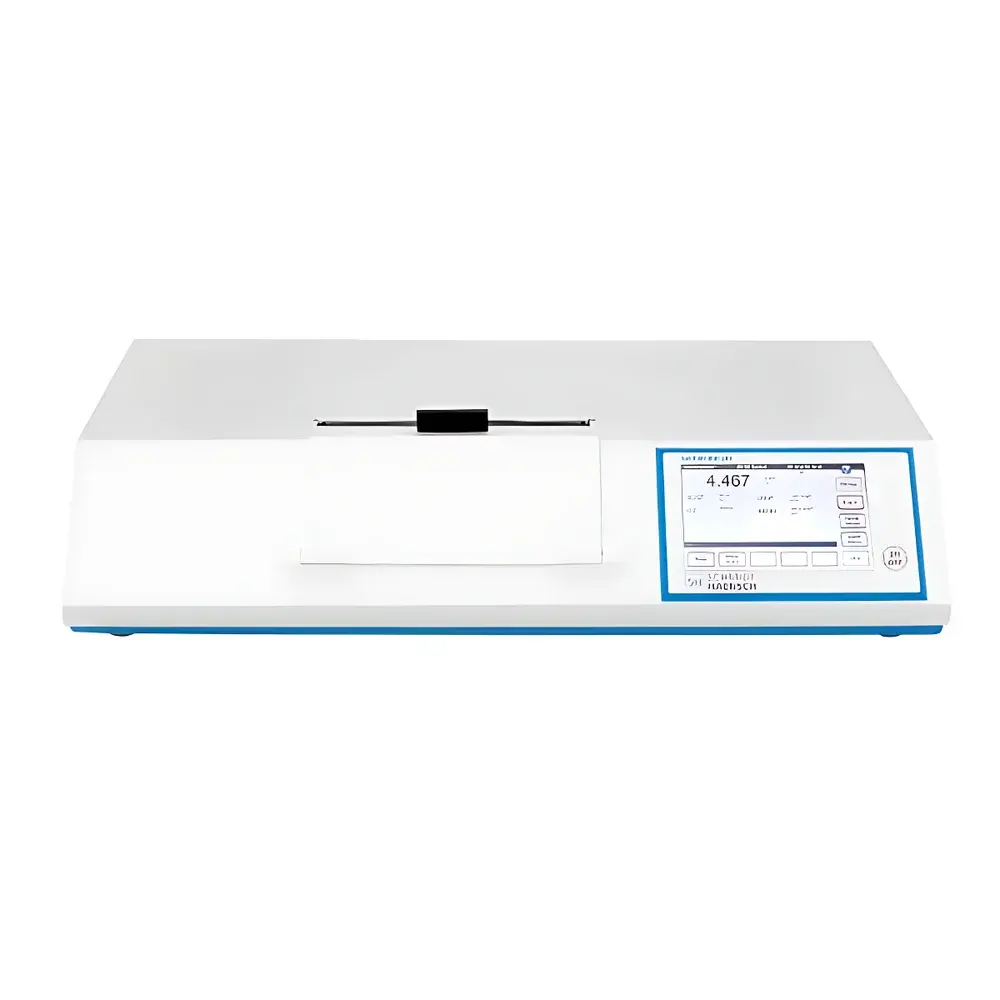
Schmidt + Haensch Saccharomat V Quartz Wedge Automatic Polarimeter for Sucrose Analysis
| Brand | Schmidt + Haensch (S+H) |
|---|---|
| Origin | Germany |
| Model | Saccharomat V |
| Product Type | Automatic Polarimeter |
| Temperature Control | Yes (external or Peltier-based) |
| Digital Display | Yes |
| Light Source | LED |
| Measurement Range | −35 to +105 °Z |
| Measurement Resolution | 0.01 °Z |
| Accuracy | ±0.01 °Z |
| Photometric Sensitivity | up to OD 5 |
| Response Time | ~4 s |
| Wavelength Options | 587.6 nm (D-line), 882.6 nm (NIR), or dual-wavelength configuration |
| Temperature Control Range (with thermostatted cell) | 18–40 °C |
| Temperature Accuracy (with T-Cell) | ±0.03 °C |
| Repeatability | 0.01 °Z |
| Optical Path Length | up to 200 mm |
| Display | 7″ TFT touchscreen (800 × 480 px, 16-bit color) |
| Interfaces | RS232 ×1, USB-A ×4, USB-B ×1, Ethernet ×1, Analog output, optional WLAN/LAN |
| Compliance | GLP/GMP-ready, FDA 21 CFR Part 11–compatible software architecture |
Overview
The Schmidt + Haensch Saccharomat V is a purpose-built, fully automatic polarimeter engineered exclusively for high-precision sucrose concentration analysis in sugar production, refining, and quality control laboratories. Unlike conventional polarimeters based on half-shade or photoelectric null-detection principles, the Saccharomat V employs a patented quartz wedge compensation mechanism—rooted in the nearly identical optical rotatory dispersion (ORD) profiles of crystalline quartz and aqueous sucrose solutions. This physical equivalence enables real-time, wavelength-dependent cancellation of dispersion-induced measurement drift. As a result, the instrument maintains metrological stability over extended operational periods without requiring recalibration—even across decades of service. The system operates at standardized wavelengths (587.6 nm and/or 882.6 nm NIR), with the latter enabling direct analysis of highly colored, turbid, or light-absorbing cane or beet juice samples post-filtration (e.g., via AutoFilt Z), eliminating the need for chemical clarification or dilution. Its primary output is international standard sugar scale (°Z), directly traceable to ISO 5775 and ICUMSA Method GS2/3-11.
Key Features
- Quartz wedge compensation principle—eliminates chromatic error and ensures long-term calibration stability
- Dual-wavelength capability (587.6 nm and 882.6 nm NIR) for universal sample compatibility, including dark-colored industrial syrups and molasses
- Integrated temperature-controlled measurement cell (T-Cell) with optional Peltier or external water bath coupling (18–40 °C range)
- High photometric sensitivity (OD 5) and rapid response time (~4 seconds per measurement)
- 7″ high-resolution TFT touchscreen interface with intuitive, icon-driven navigation and multilingual OS support
- Configurable user-defined measurement methods (up to 1000 stored protocols), each with independent unit scaling, formula assignment, and password-protected access levels
- Triple Quartz Control Plate (TQCP) option for enhanced angular reproducibility and drift monitoring
- Self-diagnostic firmware with maintenance logging, remote diagnostic port, and audit-trail-enabled service history
- Compliance-ready architecture supporting electronic signatures, data integrity controls, and 21 CFR Part 11–compliant audit trails when paired with certified software modules
Sample Compatibility & Compliance
The Saccharomat V accommodates standard and custom-length polarimetric cells (up to 200 mm path length), including self-sealing quick-connect variants compatible with circulating thermostats. Its NIR capability (882.6 nm) allows direct analysis of raw juice, affination liquors, and evaporator condensates without pre-treatment—significantly reducing analytical turnaround time and operator exposure to hazardous clarifying reagents. All measurement routines adhere to internationally recognized standards: ISO 5775 (sugar analysis), ICUMSA Methods GS2/3-11 and GS3/8-13 (polarimetric sucrose determination), and AOAC Official Method 952.04. The system’s hardware design and firmware architecture are aligned with GLP and GMP requirements—including secure user authentication, immutable data logs, version-controlled method storage, and configurable electronic signature workflows.
Software & Data Management
The embedded operating system provides hierarchical user management (administrator, supervisor, operator) with role-based permissions for method editing, calibration access, data export, and system configuration. Measurement data can be exported in multiple formats—including CSV, TXT, PDF, and native Excel (.xlsx)—with timestamping, metadata embedding (operator ID, method name, cell ID, temperature, wavelength), and optional LIMS integration via TCP/IP or OPC UA protocols. Custom formulas (e.g., purity calculation via simultaneous refractometric Brix and polarimetric °Z inputs) are programmable using a built-in equation editor with variable referencing and unit-aware arithmetic. All system events—including login attempts, method changes, calibration actions, and data exports—are recorded in a tamper-evident audit trail compliant with FDA 21 CFR Part 11 Annex 11 expectations.
Applications
- Real-time sucrose quantification in raw juice, clarified juice, syrup, and molasses during sugar mill and refinery operations
- Quality assurance of white sugar, liquid sugar, and invert syrups per ICUMSA specifications
- Process optimization in evaporation, crystallization, and centrifugation stages through continuous °Z trending
- Integration with inline refractometers (e.g., S+H Refracto series) to compute polarization purity (PPU) and massecuite purity indices
- Research applications in carbohydrate chemistry, enzymatic hydrolysis kinetics, and fermentation monitoring where chiral specificity is critical
- Regulatory compliance testing for food labeling (EU Regulation 1169/2011), customs tariff classification (HS Code 1701), and export certification
FAQ
Is the Saccharomat V suitable for measuring dark-colored cane juice without filtration?
No—while the 882.6 nm NIR mode significantly extends usable absorbance limits (up to OD 5), particulate suspension still requires mechanical filtration. We recommend pairing with the AutoFilt Z automated filtration system for unattended sample preparation.
Does the quartz wedge require periodic recalibration?
No—the quartz wedge is a passive, physically stable optical element. Its compensation function is inherent to material properties and does not degrade over time; no scheduled recalibration is required under normal operating conditions.
Can the Saccharomat V interface with existing LIMS or MES platforms?
Yes—via Ethernet (TCP/IP), RS232, or USB virtual COM port, using configurable ASCII or XML data frames. Optional middleware supports HL7, ASTM E1384, and OPC UA for enterprise-level integration.
What temperature control options are available?
Two configurations: (1) External recirculating chiller connection (standard), or (2) Integrated Peltier-based T-Cell (optional), both maintaining ±0.03 °C accuracy across 18–40 °C.
Is firmware update support provided remotely?
Yes—secure over-the-air updates are delivered via encrypted HTTPS channel with version verification and rollback capability, accessible through administrator-level credentials.




