
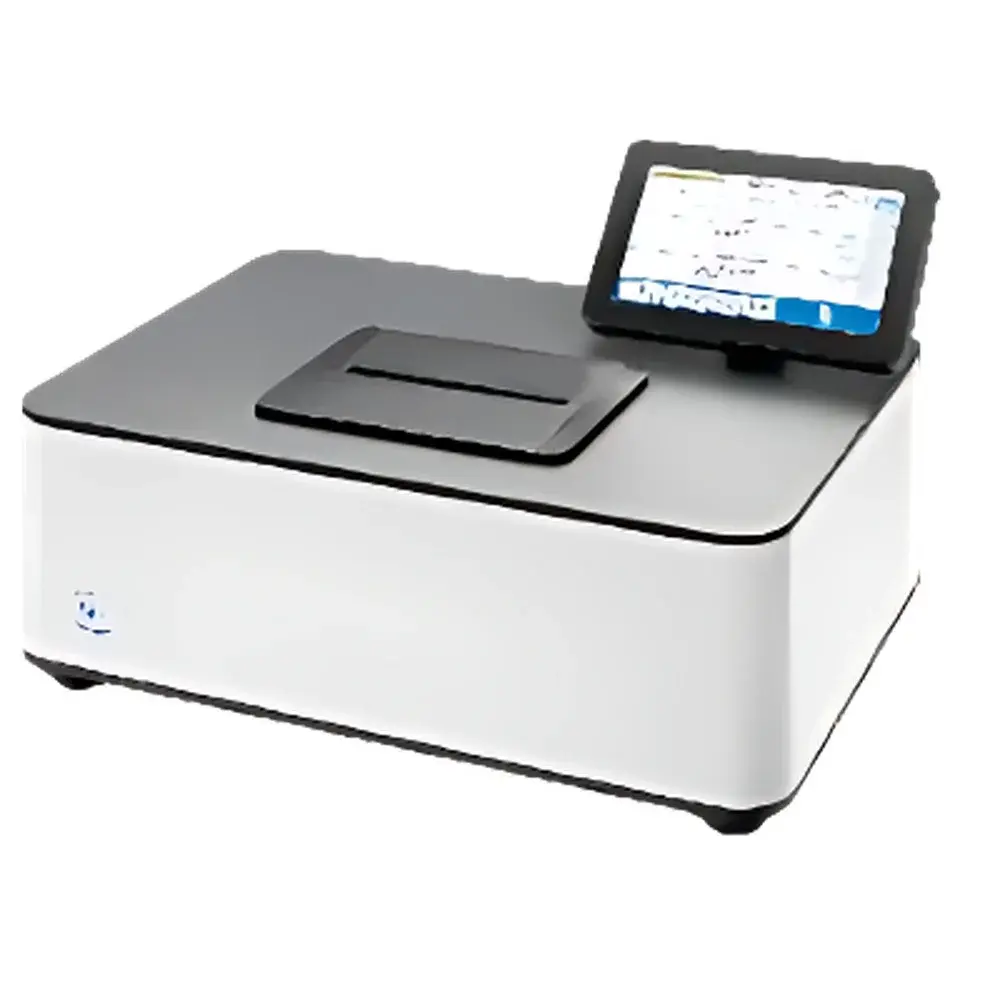
Schmidt + Haensch VariPol Automated Polarimeter
| Brand | Schmidt + Haensch (S+H) |
|---|---|
| Origin | Germany |
| Model | VariPol |
| Product Type | Automated Polarimeter |
| Temperature Control | Peltier-regulated |
| Display | Digital Touchscreen |
| Light Source | LED with Interference Filter |
| Temperature Range | 10–40 °C |
| Temperature Accuracy | ±0.1 °C |
| Temperature Resolution | 0.01 °C |
| Optical Rotation Accuracy | ±0.01° (VariPol C), ±0.005° (VariPol B) |
| Optical Rotation Resolution | 0.001° |
| Repeatability | ±0.01° (VariPol C), ±0.005° (VariPol B) |
| Wavelength | Standard 589 nm (Na-D line), customizable between 365–882 nm |
| Measurement Time | 6–8 s |
| Optical Path Length Compatibility | Up to 100 mm |
| Detector Dynamic Range | OD 3 |
| Interface Options | 3× USB, 1× RS-232, 1× Ethernet (LAN), optional Modbus, CAN bus, WLAN |
| Dimensions | 430 × 300 × 160 mm (W × D × H) |
| Compliance | 21 CFR Part 11, USP <781>, Ph. Eur. 2.2.7, JP 2.03 |
Overview
The Schmidt + Haensch VariPol Automated Polarimeter is a high-precision, CE-certified optical measurement instrument engineered for regulatory-compliant analysis of optically active substances in pharmaceutical, chemical, and academic laboratories. Based on the fundamental principle of optical rotation—where plane-polarized light undergoes angular deviation upon passing through chiral media—the VariPol delivers traceable, temperature-stabilized measurements of specific rotation ([α]), observed rotation (α), and derived concentration values (e.g., % w/v, g/100 mL, or °Z sucrose scale). Its core architecture integrates a thermally stabilized optical path, a narrow-band LED source with interference filtering (standard 589 nm, compliant with pharmacopoeial sodium D-line requirements), and a high-resolution photoelastic modulator detection system. Designed explicitly for GxP environments, the VariPol meets the metrological and data integrity demands of modern quality control labs operating under FDA 21 CFR Part 11, EU Annex 11, and ISO/IEC 17025 frameworks.
Key Features
- Peltier-based temperature regulation with dual-range capability: 18–25 °C (VariPol C) and 10–40 °C (VariPol B), ensuring thermal stability within ±0.1 °C and resolution of 0.01 °C—critical for temperature-sensitive assays such as enzyme kinetics or thermally labile APIs.
- High-accuracy optical rotation measurement: ±0.005° accuracy (VariPol B) and ±0.01° (VariPol C), with 0.001° digital resolution and repeatability matching specification limits—enabling reliable detection of subtle enantiomeric excess shifts.
- Modular wavelength configuration: Fixed 589 nm standard; optional single- or dual-wavelength setups across 365–882 nm range to support UV-active analytes (e.g., amino acids at 546 nm or antibiotics at 436 nm) per USP and Ph. Eur. 2.2.7.
- Full 21 CFR Part 11 compliance: Role-based user access control, electronic signatures, full audit trail with timestamped event logging (including method changes, calibration entries, and result modifications), and secure data export to LIMS or network storage.
- Flexible sample handling: Supports standard 100 mm, micro (25 mm), and custom-length cells—including quartz, borosilicate glass, stainless steel, and corrosion-resistant variants—for diverse matrices ranging from concentrated syrups to aggressive organic solvents.
- Industrial-grade connectivity: Three USB ports, one RS-232 serial interface (SH connector), Gigabit Ethernet, and optional fieldbus integration (Modbus TCP/RTU, CAN bus, WLAN) for automated production line synchronization or MES integration.
Sample Compatibility & Compliance
The VariPol accommodates a broad spectrum of optically active samples without dilution or derivatization, including small-molecule pharmaceuticals (e.g., levodopa, ibuprofen, chloramphenicol), biologics (e.g., insulin, heparin), natural products (essential oils, flavonoids), and synthetic polymers (poly-lactic acid, chitosan derivatives). All measurement protocols adhere to pharmacopoeial standards: USP “Optical Rotation”, European Pharmacopoeia 2.2.7, and Japanese Pharmacopoeia JP 2.03. Temperature-controlled cell holders maintain thermal equilibrium during extended kinetic runs, while OD 3 detector head sensitivity ensures robust signal capture even in highly absorbing solutions (e.g., dark-colored botanical extracts). Instrument qualification documentation (IQ/OQ/PQ templates) and certified reference standards (e.g., sucrose solutions traceable to NIST SRM 84g) are available to support GLP/GMP validation.
Software & Data Management
The embedded VariPol Control Software (v5.x) runs on a dedicated ARM-based platform with a 5″ capacitive touchscreen (800 × 480 px), enabling fully standalone operation without external PCs. It supports method-driven workflows with configurable pass/fail criteria, automatic report generation (PDF/CSV), and direct printing via USB or network printers. Data export complies with ALCOA+ principles: attributable, legible, contemporaneous, original, accurate, complete, consistent, enduring, and available. Raw measurement logs—including timestamps, operator ID, environmental parameters (T, λ), and raw photodiode signals—are stored in encrypted SQLite databases with SHA-256 hashing. Audit trails are immutable and exportable in XML format for regulatory inspection readiness.
Applications
- Pharmaceutical QC/QA: Identity testing and assay of chiral APIs per ICH Q5C and Q6A; batch release of antibiotics (penicillins, cephalosporins), vitamins (B1, B6), and anticholinergics.
- Biotechnology: Monitoring enantioselective enzymatic reactions (e.g., lipase-catalyzed ester hydrolysis), real-time tracking of racemization kinetics, and purity assessment of recombinant peptides.
- Food & Beverage: Quantification of sucrose, fructose, and invert sugar in syrups and juices using °Z scale; verification of honey adulteration and botanical origin.
- Academic Research: Structural elucidation of novel chiral catalysts; time-resolved studies of asymmetric synthesis pathways; correlation of optical rotation with absolute configuration via quantum-chemical modeling.
- Chemical Manufacturing: In-process control of stereoselective hydrogenations and epoxidations; release testing of chiral intermediates in fine chemical synthesis.
FAQ
Does the VariPol support multi-wavelength measurement in a single run?
No—wavelength selection is fixed per measurement sequence. However, dual-wavelength configurations (e.g., 589 nm + 436 nm) can be pre-installed and switched manually or via software command.
Is calibration traceable to national metrology institutes?
Yes—factory calibration uses NIST-traceable sucrose reference standards and certified quartz control plates; on-site recalibration kits with documented uncertainty budgets are available.
Can the instrument operate unattended overnight for kinetic studies?
Yes—scheduled measurements, auto-cell recognition, and thermal soak stabilization routines enable fully autonomous time-series acquisition with integrated data backup.
What is the maximum allowable absorbance for reliable measurement?
The detector maintains linear response up to OD 3 at the selected wavelength; higher-absorbance samples require dilution or shorter pathlength cells to avoid signal saturation.
Are software updates provided free of charge during the warranty period?
Yes—firmware and application software updates, including security patches and regulatory enhancements (e.g., new 21 CFR Part 11 features), are delivered via secure HTTPS portal at no additional cost for 24 months post-installation.




