
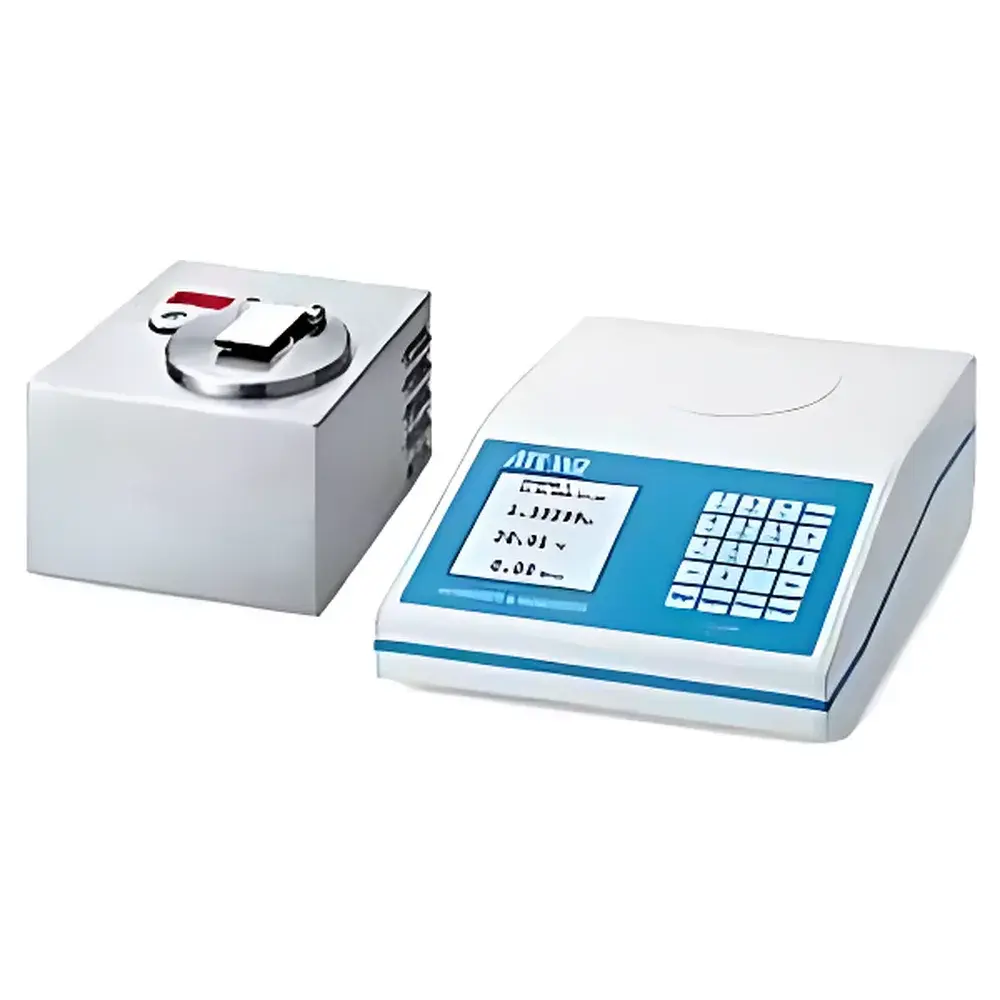
Schmidt+Haensch ATR W1 / W1 Plus / W2 / W2 Plus Automatic Refractometer
| Brand | Schmidt+Haensch (S+H) |
|---|---|
| Country of Origin | Germany |
| Model | ATR W1 / W1 Plus / W2 / W2 Plus |
| Refractive Index Range | RI 1.33200–1.53200 (W1/W1 Plus), RI 1.33200–1.70000 (W2/W2 Plus) |
| Brix Range | 0–95% (W1/W1 Plus), 0–100% (W2/W2 Plus) |
| Resolution | RI 0.00002 / Brix 0.02 (W1/W1 Plus), RI 0.00001 / Brix 0.01 (W2/W2 Plus) |
| Accuracy | ±0.00004 RI / ±0.04 Brix (W1/W1 Plus), ±0.00002 RI / ±0.02 Brix (W2/W2 Plus) |
| Temperature Control | Peltier-controlled sapphire prism, operating range +10°C to +80°C |
Overview
The Schmidt+Haensch ATR W1, W1 Plus, W2, and W2 Plus are high-precision automatic refractometers engineered for laboratory and quality control environments requiring traceable, repeatable refractive index (RI) and Brix measurements. Based on the principle of total internal reflection at a solid–liquid interface—using an integrated sapphire prism and temperature-stabilized optical path—these instruments deliver metrologically sound results compliant with international standards including ISO 21646, ASTM D1218, and USP . Designed and manufactured in Germany since 1864, each unit integrates a thermally regulated sapphire measuring surface, high-stability LED light source, and a multi-pixel CCD detector array to ensure minimal drift and high angular resolution in critical angle determination. The ATR (Attenuated Total Reflection) optical configuration eliminates sample evaporation artifacts and enables precise measurement of viscous, volatile, or low-volume samples without solvent dilution.
Key Features
- Four-tier platform architecture: W1 (standard precision), W1 Plus (enhanced stability), W2 (extended RI range), and W2 Plus (highest resolution and accuracy)
- Peltier-based temperature control with ±0.02°C stability over the full operating range (+10°C to +80°C), ensuring compliance with temperature-sensitive methods (e.g., pharmacopeial assays)
- Sapphire prism—chemically inert, scratch-resistant, and thermally stable—designed for long-term calibration integrity and compatibility with aggressive solvents and cleaning agents
- Automated prism cleaning sequence with programmable rinse cycles to minimize carryover between analyses
- Modular connectivity: RS-232, USB, and optional Ethernet interfaces support integration into LIMS and automated QC workflows
- Self-diagnostic optics module with real-time signal-to-noise monitoring and automatic lamp intensity compensation
Sample Compatibility & Compliance
The ATR series accommodates aqueous solutions, organic solvents, emulsions, syrups, essential oils, and highly concentrated polymer solutions. Its contact-free measurement geometry minimizes contamination risk and supports GLP/GMP-aligned operation. All models meet CE marking requirements and are validated for use under FDA 21 CFR Part 11 when paired with compliant software configurations. Instrument qualification documentation—including IQ/OQ protocols, traceable calibration certificates (NIST-traceable reference fluids), and uncertainty budgets—is available upon request. The W2 and W2 Plus variants are routinely deployed in pharmaceutical excipient release testing per EP 2.2.6 and JP 2.05, where RI serves as a primary identity and purity parameter.
Software & Data Management
RefractoSoft™ v5.2 (included) provides full instrument control, method storage, audit trail logging, and electronic signature capability. The software supports configurable user roles, password-protected method editing, and immutable data archiving compliant with ALCOA+ principles. Raw angular data, temperature logs, and spectral profiles are stored in vendor-neutral CSV and XML formats. Optional add-ons include GMP report generation modules, automated statistical process control (SPC) charting, and API-driven integration with SAP QM and LabWare LIMS. All data entries include timestamp, operator ID, method version, and environmental metadata for full traceability.
Applications
- Food & Beverage: Brix quantification in fruit juices, dairy concentrates, and sugar syrups; detection of adulteration in honey and maple syrup; inline monitoring of evaporation endpoints in concentration processes
- Pharmaceuticals: Identity testing of glycerin, propylene glycol, and ethanol; assay of ophthalmic solutions; water content estimation in hygroscopic APIs via RI correlation
- Cosmetics & Fragrances: Refractive index profiling of essential oils (e.g., limonene, linalool) for botanical origin verification; fatty acid composition estimation in saponified oils
- Chemical Manufacturing: Real-time monitoring of reaction progress in esterification and polymerization; purity assessment of solvents (e.g., acetone, THF, DMF); concentration control in antifreeze formulations
- Academic Research: Thermodynamic characterization of binary and ternary liquid mixtures; validation of predictive models (e.g., Lorentz–Lorenz, Gladstone–Dale)
FAQ
What is the difference between the W1 and W2 series?
The W1 series covers RI up to 1.53200 and offers standard laboratory-grade resolution; the W2 series extends the upper RI limit to 1.70000 and delivers twice the resolution and improved accuracy—making it suitable for high-refractivity materials such as iodinated compounds, heavy organometallics, and concentrated ionic liquids.
Can the instrument be used for non-aqueous samples?
Yes. The sapphire prism and sealed optical path are compatible with alcohols, ketones, chlorinated solvents, and hydrocarbons. Cleaning protocols for residual organics are pre-programmed in RefractoSoft™.
Is temperature calibration traceable to national standards?
Each unit ships with a factory-verified Peltier temperature sensor calibrated against PT100 reference standards accredited to ISO/IEC 17025. Optional on-site recalibration services include NIST-traceable fluid verification at three points across the operational range.
How is compliance with 21 CFR Part 11 achieved?
When operated with RefractoSoft™ GMP Edition and configured with network authentication, electronic signatures, and disabled local data export, the system satisfies Part 11 requirements for audit trails, record retention, and role-based access control.
What maintenance is required beyond routine prism cleaning?
No optical alignment or lamp replacement is needed during normal operation. The LED light source has a rated lifetime exceeding 50,000 hours. Annual performance verification using certified reference fluids is recommended for regulated environments.





