
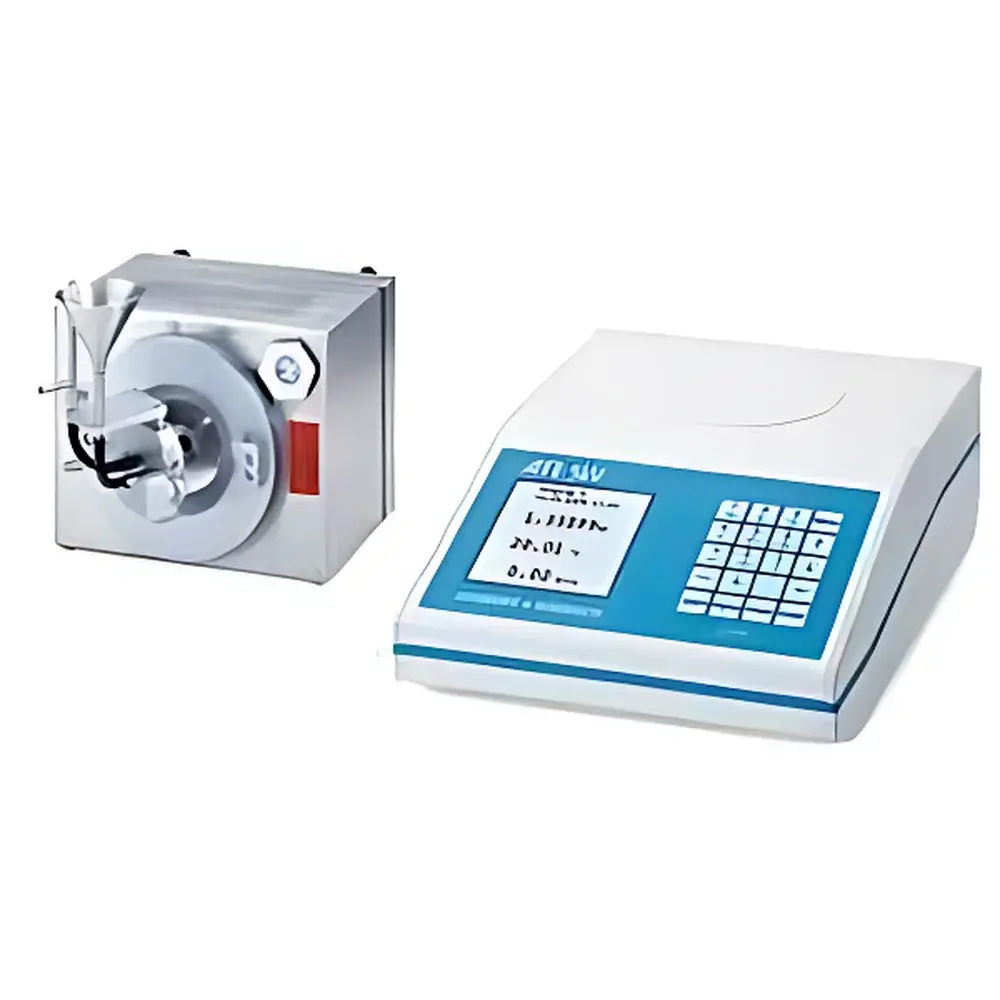
Schmidt+Haensh ATR SW and ATR SW Plus Automatic Refractometers
| Brand | Schmidt+Haensh (S+H) |
|---|---|
| Country of Origin | Germany |
| Model | ATR SW / ATR SW Plus |
| Refractive Index Range | RI 1.33200–1.53200 (ATR SW), RI 1.30000–1.54000 (ATR SW Plus) |
| Brix Range | 0–95% (ATR SW), 0–100% (ATR SW Plus) |
| Resolution | RI 0.00002 / 0.00001, Brix 0.02 / 0.01 |
| Accuracy | RI ±0.00004 / ±0.00002, Brix ±0.04 / ±0.02 |
| Temperature Control Range | +5 °C to +50 °C |
| Prism Material | Sapphire |
| Light Source | LED with 589 nm interference filter |
| Display | 16×16 character LCD |
| Data Interface | Parallel port and RS-232C |
Overview
The Schmidt+Haensch ATR SW and ATR SW Plus are high-precision automatic refractometers engineered for laboratory and quality control environments requiring traceable, temperature-stabilized refractive index (RI) and Brix measurements. Based on the principle of total internal reflection at a sapphire prism–sample interface, these instruments employ a fixed-wavelength (589 nm) sodium-D line-equivalent LED source and high-resolution angular detection to determine RI with metrological rigor. Unlike traditional Abbe refractometers, the ATR (Attenuated Total Reflection) design eliminates sample evaporation concerns, enables rapid measurement of small-volume or volatile samples, and supports direct integration into controlled process workflows. The dual-model architecture—ATR SW (standard range) and ATR SW Plus (extended range)—provides flexibility across diverse industrial matrices, from aqueous sugar solutions to hydrocarbon-rich formulations.
Key Features
- Sapphire prism with integrated Peltier temperature regulation, ensuring thermal stability within ±0.02 °C over the full operating range (+5 °C to +50 °C)
- Auto-temperature calibration function compliant with ISO 21747 and ASTM D1218 for traceable RI reporting
- Dual-resolution modes: high-sensitivity mode (RI resolution 0.00001, Brix 0.01%) and standard mode (RI 0.00002, Brix 0.02%) selectable via firmware
- Robust mechanical housing designed for continuous operation in ISO Class 7 cleanrooms and GMP-compliant QC labs
- Non-contact optical path with sealed LED light source and interference filter—no lamp replacement required over >50,000 measurement cycles
- RS-232C and parallel interfaces support legacy LIMS integration and automated data logging without proprietary drivers
Sample Compatibility & Compliance
The ATR SW series accommodates liquid, semi-liquid, and low-viscosity suspensions—including syrups, emulsions, ethanol-water mixtures, pharmaceutical elixirs, and hydrocarbon solvents—without dilution or filtration. Sample volume requirement is ≤0.5 mL per measurement. The sapphire prism surface resists chemical attack from acids (pH ≥1), alkalis (pH ≤13), and organic solvents (e.g., acetone, methanol, hexane), enabling repeated use across multi-product facilities. Instrument compliance includes adherence to DIN EN ISO 21747:2021 (Refractometry — Determination of refractive index), GLP audit readiness (full measurement timestamping, user ID logging, and parameter lockout), and compatibility with FDA 21 CFR Part 11 requirements when paired with validated data acquisition software.
Software & Data Management
While the instrument operates autonomously via its built-in LCD interface, raw RI/Brix values, temperature readings, and measurement timestamps are transmitted in ASCII format via RS-232C. Third-party SCADA systems, Excel-based QA templates, or enterprise LIMS platforms can ingest this structured output without middleware. Optional firmware upgrades enable extended data logging (up to 1,000 records onboard) and configurable pass/fail limits with visual/audible alerts. Audit trails—including operator login, method selection, calibration history, and environmental deviation flags—are retained in non-volatile memory and exportable as CSV for regulatory review.
Applications
- Food & Beverage: Real-time Brix quantification in juice concentrates, dairy whey, honey, and confectionery syrups; detection of adulteration in olive oil and essential oils via RI deviation from reference standards
- Pharmaceuticals: Assay of active pharmaceutical ingredient (API) concentration in liquid dosage forms; osmolality estimation in parenteral solutions; excipient purity verification per USP
- Cosmetics & Fragrances: Batch-to-batch consistency monitoring of essential oil blends; fatty acid profile estimation in saponified surfactants; glycerin/water ratio validation in toners
- Chemical Manufacturing: In-process monitoring of polymerization reaction endpoints (e.g., polyol RI drift); solvent recovery efficiency assessment; catalyst concentration tracking in esterification
- Academic Research: Thermodynamic characterization of binary and ternary liquid mixtures; calibration reference for FTIR-ATR spectral interpretation
FAQ
What is the difference between ATR SW and ATR SW Plus?
The ATR SW Plus extends the refractive index range to 1.30000–1.54000 and Brix to 0–100%, enabling accurate measurement of highly concentrated sucrose solutions, molasses, and certain mineral oil fractions not covered by the base ATR SW model.
Is temperature calibration required before each measurement?
No—the instrument performs automatic temperature compensation using its embedded Pt100 sensor and sapphire prism thermal coupling; however, periodic verification against NIST-traceable thermostats (e.g., Fluke 724) is recommended per ISO/IEC 17025 internal calibration schedules.
Can the ATR SW interface with modern Ethernet-based lab networks?
The native interface is RS-232C and parallel; Ethernet connectivity requires an external serial-to-Ethernet converter configured in TCP server mode—validated configurations are documented in the technical supplement (Ref: S+H Doc-ID ATR-SW-INT-2023-EN).
Does the sapphire prism require special cleaning protocols?
Yes—use only lint-free wipes dampened with spectroscopic-grade isopropanol or deionized water; avoid abrasive cleaners or ultrasonic baths, which may micro-scratch the optical surface and degrade angular resolution over time.
Is firmware update supported in the field?
Yes—updates are delivered as signed .hex files via USB-to-serial adapter; update procedures follow IEC 62304 Class B software lifecycle controls and preserve all user-defined calibration constants.





