
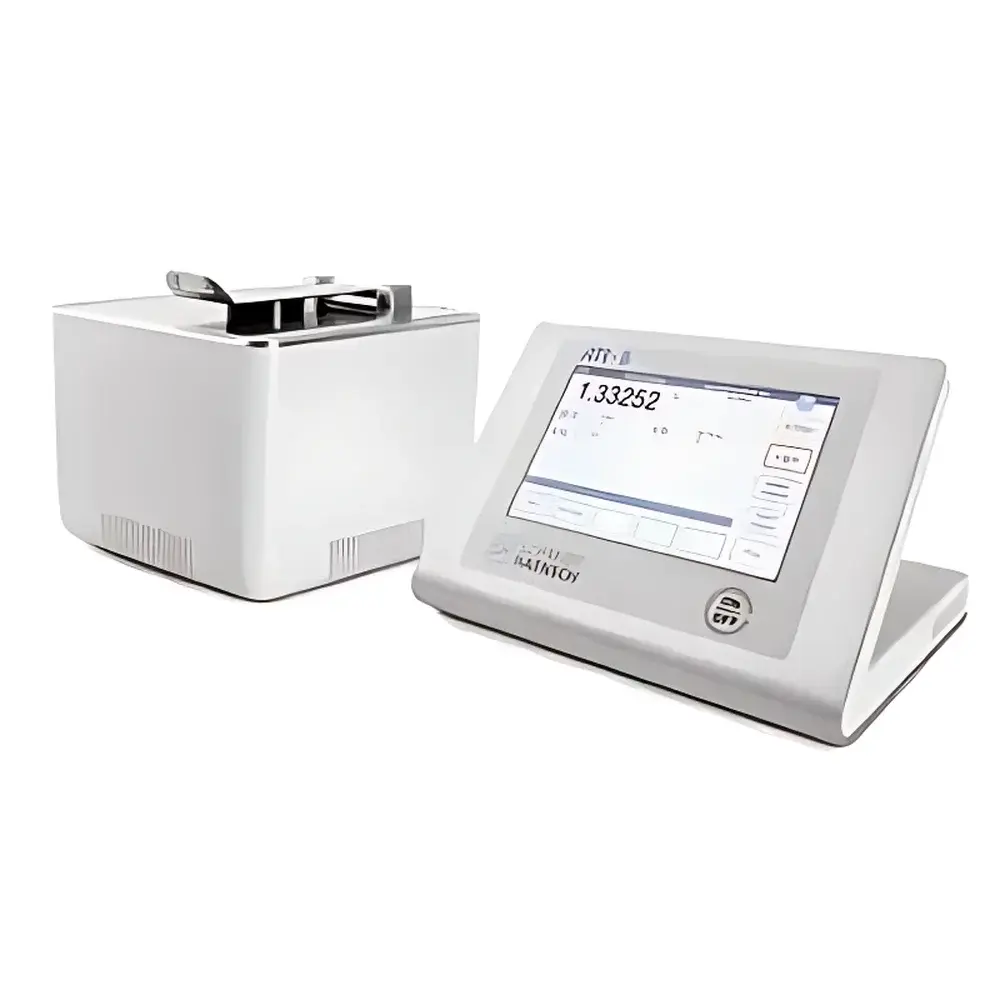
Schmidt+Haensh ATR-TOUCH Series ATR-B/F Benchtop Refractometer
| Brand | Schmidt+Haensh (S+H) |
|---|---|
| Country of Origin | Germany |
| Model | ATR-B/F new |
| Type | Benchtop Refractometer |
| Temperature Control | Built-in Peltier |
| Digital Display | 7" TFT Touchscreen |
| Measurement Range | 1.32000–1.7000 RI / 0–100% Brix |
| Resolution | 0.00001 RI / 0.01% Brix |
| Accuracy | ±0.00002 RI / ±0.02% Brix |
| Light Source | LED with 589 nm interference filter (>100,000 h lifetime) |
| Compliance | ASTM, ISO, DIN, USP, ICUMSA, FDA 21 CFR Part 11 ready (optional software), GLP/GMP compliant |
Overview
The Schmidt+Haensch ATR-TOUCH Series ATR-B/F is a high-precision benchtop refractometer engineered for rigorous laboratory and industrial quality control environments. Based on the principle of total internal reflection at an Attenuated Total Reflection (ATR) interface—using a YAG (Yttrium Aluminum Garnet) crystal prism—the instrument delivers traceable, temperature-compensated refractive index (RI) measurements in accordance with internationally recognized optical metrology standards. Designed and manufactured in Berlin, Germany since 1864, S+H instruments integrate century-proven optical engineering with modern solid-state electronics and thermally stable mechanical architecture. The ATR-B/F model specifically targets applications requiring extended RI range coverage (up to 1.7000 RI), making it suitable for highly concentrated or high-refractive-index samples—including organic solvents, pharmaceutical excipients, petrochemical intermediates, and viscous cosmetic formulations—where conventional Abbe-type refractometers reach operational limits.
Key Features
- ATR measurement principle with YAG prism ensures robust, contamination-resistant sample interface and eliminates need for prism cleaning between measurements
- Integrated solid-state Peltier temperature control system (5–100 °C for ATR-F; 5–80 °C for ATR-B) with direct NTC sensing at the prism surface, achieving ±0.03 °C accuracy and 0.01 °C resolution
- Dual-mode operation: single-point static measurement or continuous flow mode via optional flow cell integration
- 7-inch capacitive TFT touchscreen (800 × 480 pixels, 16-bit color) with intuitive, icon-driven UI supporting multilingual operation and guided calibration workflows
- Modular hardware design: optically isolated measurement head housed in stainless-steel enclosure, physically decoupled from electronic control unit to minimize thermal drift and electromagnetic interference
- Long-life 589 nm LED light source with integrated interference filter—no lamp replacement required over instrument lifetime (>100,000 h MTBF)
- Onboard data storage for up to 1,000 samples × 1,000 methods, with timestamped, user-annotated records and full audit trail capability
- Comprehensive connectivity: RS232, three USB-A ports, one USB-B port, and Gigabit Ethernet for LIMS integration, remote diagnostics, and peripheral support (barcode scanners, printers, keyboards)
Sample Compatibility & Compliance
The ATR-B/F accommodates liquid, semi-liquid, and low-viscosity paste samples—including aqueous solutions, hydrocarbons, glycols, acids, alcohols, and emulsions—without dilution or filtration. Its ATR geometry enables reliable measurement of turbid, colored, or particulate-laden samples that would otherwise obstruct conventional prism-based optics. The instrument complies with multiple international regulatory frameworks: ASTM D1218 (refractive index of hydrocarbon liquids), ASTM D1747 (Brix determination), AOAC Official Methods, DIN 51743, ISO 21542, USP , and ICUMSA standard methods for sugar analysis. Optional 21 CFR Part 11-compliant software provides electronic signatures, role-based access control, and immutable audit logs—fully supporting GLP and GMP validation requirements in pharmaceutical, food, and chemical manufacturing settings.
Software & Data Management
The ATR-TOUCH platform supports both standalone operation and PC-integrated workflows via Ethernet or USB-B. Standard firmware includes method templates for Brix, Oechsle, Zeiss, % fat, % water in honey, H2O2, propylene glycol, phenol, and acetic acid—plus over 1,000 user-definable scales. Calibration is performed using certified reference materials (CRMs) or sucrose standards; all calibration events are automatically logged with operator ID, date/time, and deviation metrics. Data export supports CSV, PDF, and XML formats, with native compatibility for major LIMS platforms (e.g., LabWare, STARLIMS, Thermo Fisher SampleManager). Optional validation packages include IQ/OQ documentation, traceable calibration certificates, and 21 CFR Part 11 module with electronic signature enforcement and change control tracking.
Applications
- Pharmaceutical QC: Excipient identity verification, active ingredient concentration monitoring, solvent purity assessment (e.g., ethanol, isopropanol), and formulation stability testing under controlled temperature
- Food & Beverage: Brix quantification in fruit juices, syrups, and concentrates; dry matter content in dairy products; sugar-to-acid ratio validation in wine must (Oechsle scale); honey adulteration screening
- Chemical Industry: Concentration monitoring of caustic soda, sulfuric acid, ethylene glycol, and methanol solutions; polymer solution refractivity profiling; reaction endpoint detection in esterification processes
- Petrochemicals: Hydrocarbon blend analysis, lubricant base oil characterization, and additive concentration verification in fuel formulations
- Cosmetics & Personal Care: Viscosity proxy measurement in shampoos, conditioners, and toothpastes; glycerin and propylene glycol content verification; preservative concentration tracking
FAQ
What is the difference between the ATR-B and ATR-F models?
The ATR-F extends the upper RI limit to 1.7000 and supports temperature control up to 100 °C, making it suitable for high-boiling-point solvents and thermally demanding applications. The ATR-B is optimized for food, beverage, and pharmaceutical use with a maximum RI of 1.5800 and 80 °C temperature ceiling.
Can the ATR-TOUCH be validated for GMP environments?
Yes—when equipped with the optional 21 CFR Part 11 software module and used with documented IQ/OQ protocols, the system meets ALCOA+ data integrity principles and supports full GMP audit readiness.
Is external calibration verification required?
No routine external verification is mandated; however, periodic checks using NIST-traceable CRMs (e.g., sucrose standards or certified RI oils) are recommended per ISO/IEC 17025 and internal QA procedures.
How is sample carryover prevented during sequential measurements?
The YAG ATR prism’s non-wetting surface and integrated rinse cycle (via optional automated fluid handling module) ensure minimal residue retention—validated by <0.00001 RI residual signal in consecutive high-viscosity sample tests.
Does the instrument support custom scale development?
Yes—users can define and store proprietary concentration-to-RI correlation functions, including polynomial, exponential, or multi-point linear fits, with full metadata tagging and version control.





