
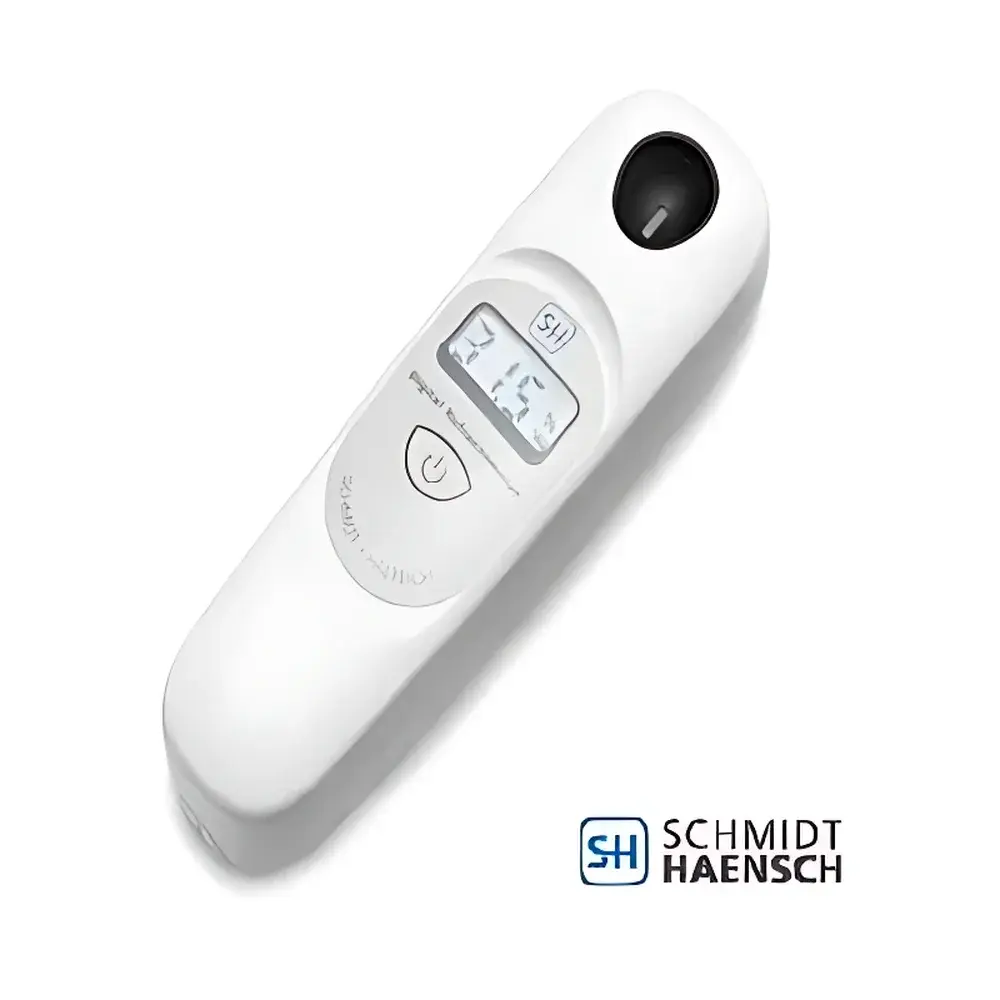
Schmidt+Haensh S+H Portable Digital Refractometer
| Brand | Schmidt+Haensh (S+H) |
|---|---|
| Country of Origin | Germany |
| Model | Portable Refractometer |
| Measurement Range | 0.0–60.0 °Brix or 45–90 °Brix |
| Resolution | 0.1 °Brix |
| Accuracy | ±0.2 °Brix |
| Measurement Time | 2 s |
| Sample Volume | >0.1 mL |
| Operating Temperature | +10 °C to +70 °C |
| Measured Temperature Range | up to 100 °C |
| Power Supply | Battery-operated |
| Units | °Brix |
Overview
The Schmidt+Haensh S+H Portable Digital Refractometer is a precision optical instrument engineered for rapid, field-deployable determination of refractive index and related concentration parameters—primarily expressed in degrees Brix (°Brix). Based on the fundamental principle of total internal reflection at the prism-sample interface, this handheld device employs a high-stability Abbe-type optical system with temperature-compensated sapphire prism and integrated thermistor for real-time thermal correction. Unlike analog refractometers requiring visual interpolation, the S+H unit digitizes the critical angle shift via high-resolution photodiode array detection and applies factory-calibrated algorithms traceable to NIST-certified sucrose standards. Its compact, ergonomic design—engineered in Germany to ISO 9001-certified manufacturing protocols—enables consistent performance under variable ambient conditions while maintaining metrological integrity across laboratory, production floor, and field inspection environments.
Key Features
- German-engineered optical architecture featuring a sapphire measuring prism for exceptional scratch resistance and long-term calibration stability
- Dual-range measurement capability: 0.0–60.0 °Brix (standard food & beverage range) and 45–90 °Brix (high-concentration applications such as honey, syrups, and concentrated extracts)
- Automatic temperature compensation (ATC) with ±0.1 °C resolution thermistor integrated directly into the prism block
- Measurement completed in ≤2 seconds with automatic endpoint detection—no user interpretation required
- Battery-powered operation (4×AAA, typical life >10,000 measurements), enabling true portability without AC dependency
- IP65-rated housing for dust and water jet resistance, suitable for humid or washdown-prone industrial zones
- Non-destructive analysis requiring only >0.1 mL sample volume—ideal for precious or limited-quantity materials
Sample Compatibility & Compliance
The S+H Portable Refractometer accommodates aqueous solutions, transparent liquids, and homogeneous suspensions compatible with standard Abbe refractometry—including sugar solutions, fruit juices, dairy products, pharmaceutical electrolytes, glycerin-based cosmetics, and hydrocarbon solvents. It complies with core international standards governing refractive index measurement methodology, including ASTM D1218 (Standard Test Method for Refractive Index of Hydrocarbon Liquids), ISO 21744 (Refractometry — General principles and practice), and USP (Refractometry). While not inherently 21 CFR Part 11 compliant due to its standalone nature, audit-ready measurement records can be exported via optional USB interface (S+H DataLink software) supporting GLP/GMP documentation requirements when integrated into validated workflows.
Software & Data Management
Though primarily designed as an autonomous handheld instrument, the S+H Portable Refractometer supports optional connectivity through the S+H DataLink PC software suite (Windows-compatible). This application enables batch data logging, statistical process control (SPC) charting, user-defined calibration verification routines, and export to CSV or PDF formats for quality documentation. All stored measurements include timestamp, ambient temperature, sample ID, and operator code—facilitating traceability in regulated environments. Firmware updates are delivered via secure encrypted download, ensuring continued alignment with evolving metrological best practices and regulatory expectations.
Applications
- Food & Beverage QC: Rapid verification of sugar content in raw fruits, intermediate syrups, pasteurized juices, fermented beverages, and finished confectionery products per Codex Alimentarius and EU Regulation (EC) No 1333/2008
- Pharmaceutical Manufacturing: Quantitative assessment of dissolved solids in parenteral solutions, osmolality screening of dialysates, and excipient concentration checks during formulation development
- Cosmetic & Fragrance Production: Refractive index validation of essential oils (e.g., citrus terpenes), fatty acid profile estimation in saponified bases, and consistency grading of emulsifiers
- Chemical Process Control: In-line verification of solvent purity (e.g., ethanol, isopropanol), concentration monitoring of acid/base titrants, and quality gate checks for polymerization inhibitors
- Agricultural & Research Field Use: On-site ripeness assessment of horticultural crops, honey authenticity screening, and botanical extract standardization prior to chromatographic analysis
FAQ
What is the calibration procedure for this refractometer?
Factory calibration is performed using certified sucrose reference standards traceable to PTB (Physikalisch-Technische Bundesanstalt). Users may perform two-point verification with distilled water (0.0 °Brix) and a secondary standard (e.g., 30.0 °Brix sucrose solution); full recalibration requires authorized service centers.
Can it measure non-aqueous samples like oils or organic solvents?
Yes—provided the sample is optically clear and does not etch or dissolve the sapphire prism surface. Refractive index values will be reported; conversion to °Brix is only valid for sucrose-water systems unless custom calibration curves are applied.
Is temperature control built into the instrument?
No active Peltier cooling/heating is included, but the integrated ATC system compensates for sample temperature drift between +10 °C and +70 °C using a high-precision thermistor embedded in the prism assembly.
How is measurement uncertainty defined for this model?
Total measurement uncertainty is ±0.2 °Brix at 20 °C, derived from combined contributions of optical resolution, thermal sensor accuracy, and calibration standard uncertainty—fully documented in the instrument’s EU Declaration of Conformity (DoC).



