
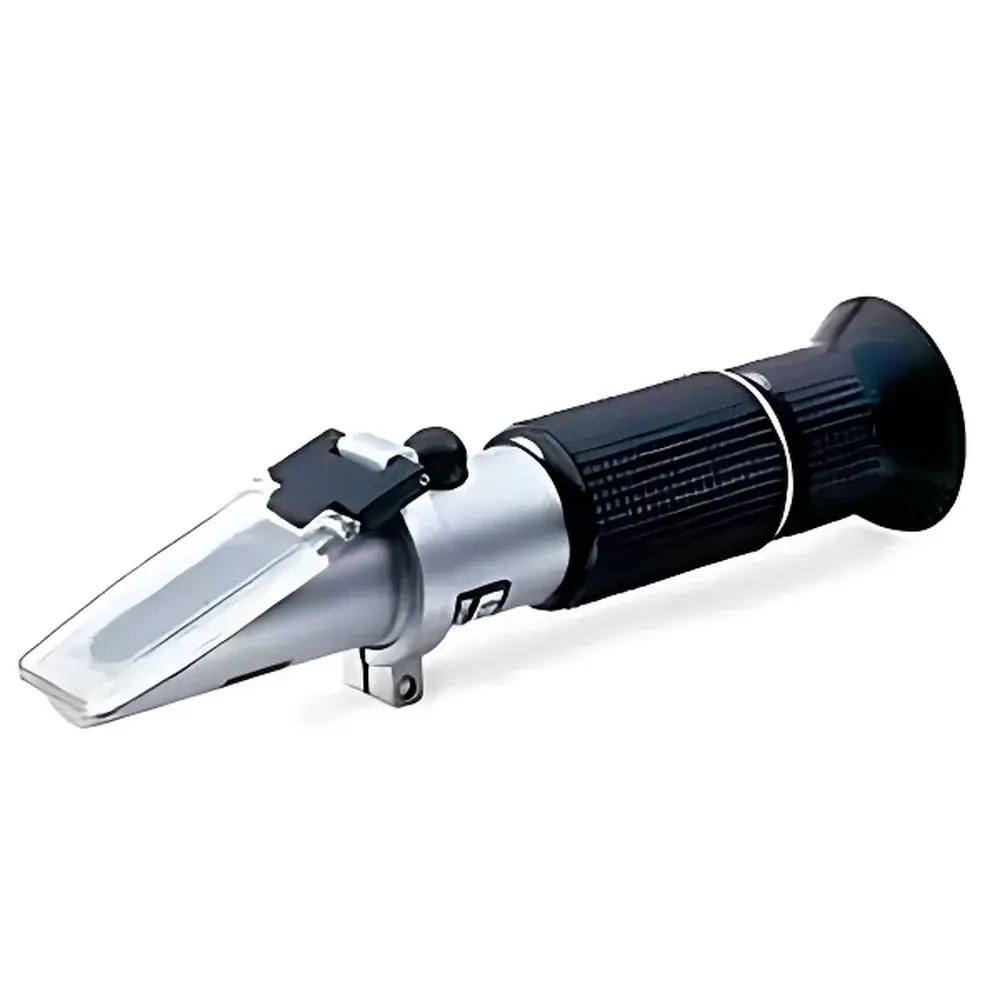
Schmidt+Haensh S+H Portable Handheld Refractometer
| Brand | Schmidt+Haensh (S+H) |
|---|---|
| Country of Origin | Germany |
| Model | Portable Handheld Refractometer |
| Measurement Ranges | Brix (4 selectable ranges), Urine (0–12 g/dL), Salt (0–28%), Alcohol (0–32 °Brix |
| Operating Temperature | +10°C to +40°C |
| Automatic Temperature Compensation (ATC) for Brix | +10°C to +30°C |
| Weight | 0.25 kg |
| Compliance | Designed per ISO 21749:2022 (Refractometric determination of soluble solids), ASTM D1218, USP <781> |
Overview
The Schmidt+Haensch S+H Portable Handheld Refractometer is a precision optical instrument engineered for rapid, field-deployable refractive index measurement of liquid samples in laboratory, production, and on-site environments. Based on the fundamental principle of total internal reflection at the prism-sample interface, the device determines refractive index (nD) by measuring the critical angle shift induced by sample contact with a high-stability optical glass prism. This value is directly correlated to solute concentration—most commonly expressed as Brix (% w/w sucrose equivalent), but also applicable to urine specific gravity, sodium chloride content, ethanol concentration, and other binary or quasi-binary solutions. Manufactured in Germany since 1864, Schmidt+Haensch instruments adhere to metrological traceability standards and are calibrated using NIST-traceable reference fluids. The handheld unit integrates an ergonomically optimized aluminum alloy chassis, temperature-compensated optical path, and parallax-free viewing optics—enabling repeatable measurements without external power or consumables.
Key Features
- German-engineered optical system with fused silica prism and anti-reflective coated ocular lens for high contrast and minimal chromatic aberration
- Four independent Brix scales (0–10%, 0–32%, 0–50%, 0–90%) selectable via interchangeable scale plates—no recalibration required between ranges
- Integrated automatic temperature compensation (ATC) compliant with ISO 21749:2022 for Brix readings between +10°C and +30°C
- Compact, lightweight design (0.25 kg) with IP54-rated housing suitable for controlled lab use and industrial field applications
- No battery or electronics required—fully mechanical operation ensures long-term reliability and zero drift over time
- Calibration verification port accessible via removable cap; supports routine verification using certified sucrose standards (e.g., 5.00% and 20.00% w/w)
Sample Compatibility & Compliance
The S+H handheld refractometer accommodates aqueous solutions, alcohols, glycols, organic solvents, and low-viscosity emulsions with surface tension >20 mN/m. It is not intended for highly volatile, corrosive (e.g., concentrated HNO3, HF), or strongly light-absorbing media (OD >0.5 at 589 nm). Sample volume requirement: ≤0.1 mL. All models comply with ISO 21749:2022 for refractometric determination of soluble solids in foodstuffs, ASTM D1218 for petroleum product refractive index, and USP for pharmaceutical excipient qualification. For regulated environments (GMP/GLP labs), documentation packages—including factory calibration certificates, uncertainty budgets, and traceability statements to PTB (Physikalisch-Technische Bundesanstalt)—are available upon request.
Software & Data Management
As a fully analog, non-digital instrument, the S+H handheld refractometer does not incorporate embedded firmware, Bluetooth, or data logging capabilities. This architecture eliminates software validation requirements under FDA 21 CFR Part 11 and simplifies audit readiness in regulated QC laboratories. Users record readings manually in bound logbooks or LIMS-integrated electronic notebooks. Optional accessories include a digital imaging adapter (S+H Model RA-DIGI) for photomicrography of the shadow line—enabling archival image capture for review and training purposes without altering the core measurement principle.
Applications
- Food & Beverage: Brix monitoring in juice extraction, syrup blending, dairy whey concentration, and fermentation control (e.g., must sugar in winemaking)
- Clinical Diagnostics: Urine specific gravity assessment (0–12 g/dL scale) aligned with CLIA-waived point-of-care testing protocols
- Chemical Manufacturing: In-process verification of glycol concentration in antifreeze formulations and solvent purity screening per ASTM E291
- Pharmaceuticals: Excipient identity testing (e.g., propylene glycol, glycerin) and batch release checks against pharmacopeial monographs
- Automotive & Lubricants: Coolant glycol concentration verification and used oil contamination screening via refractive index deviation trends
FAQ
Is this instrument suitable for measuring high-viscosity samples such as honey or syrups?
Yes—provided the sample fully wets the prism surface and is free of air bubbles or particulates. Pre-warming viscous samples to 25–30°C improves spreading and measurement repeatability.
Does the ATC function correct for all temperature-induced refractive index shifts?
No—the built-in ATC compensates only for Brix-equivalent concentration changes per ISO 21749:2022. It does not compensate for non-sucrose solutes with different thermo-optic coefficients (e.g., NaCl, ethanol); users must apply empirical correction factors where required.
Can the refractometer be recalibrated by the end user?
Yes—using the supplied calibration screwdriver and certified reference fluids. Full recalibration procedure is documented in the DIN EN ISO/IEC 17025-compliant service manual (S+H Doc. No. RH-UM-EN-2023).
What is the typical measurement uncertainty for Brix at 20°C?
±0.1% w/w for standard models when operated within ATC range and verified with traceable standards; ±0.2% w/w outside ATC range or with non-standard illumination conditions.
Is third-party calibration certification available?
Yes—accredited calibration services (ISO/IEC 17025) are offered through authorized S+H service centers in Europe, North America, and APAC regions, including full uncertainty reporting and PTB-traceable certificates.




