
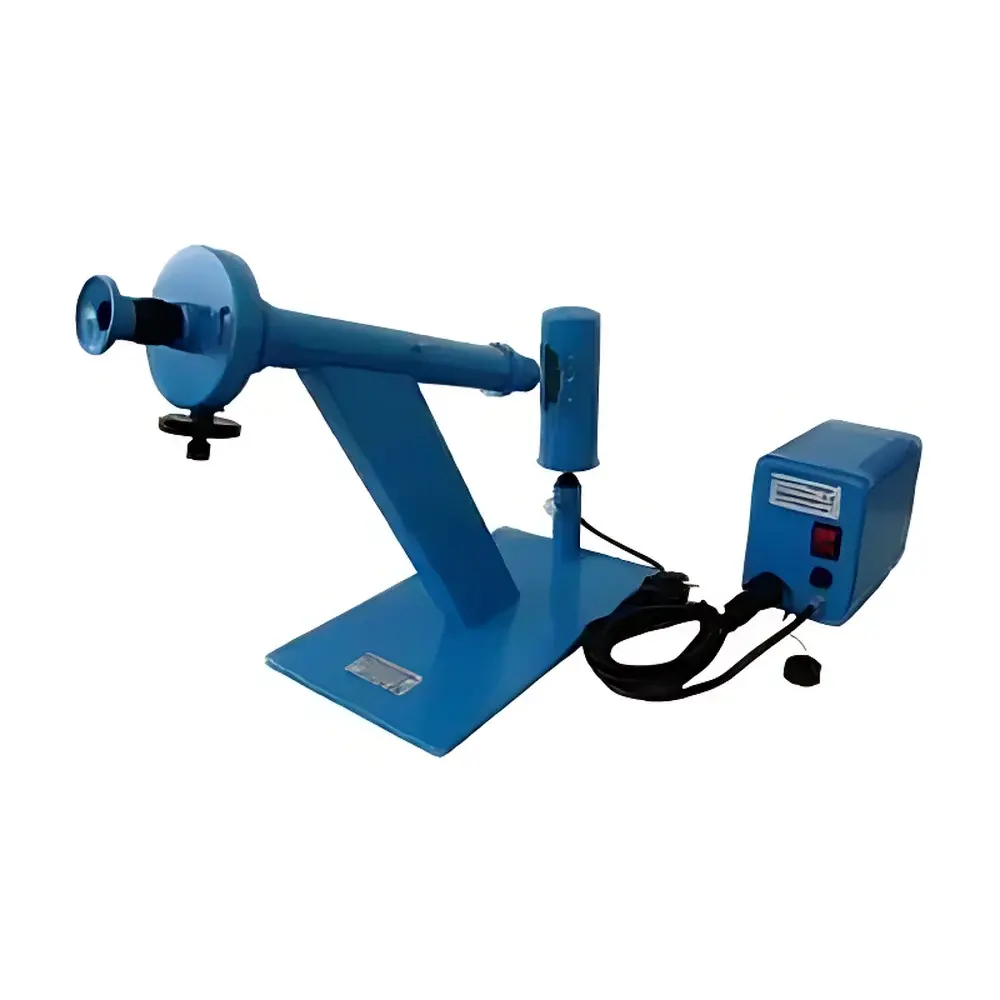
Schmidt+Haensh S+H Visual Disc Polarimeter
| Brand | Schmidt+Haensh (S+H) |
|---|---|
| Country of Origin | Germany |
| Model | Visual Disc Polarimeter |
| Measurement Range | ±180° |
| Sensitivity | 0.1° |
| Accuracy | ±0.1° |
| Light Source | Halogen Lamp or Sodium Spectral Lamp |
| Wavelength | 546 nm or 589 nm |
| Sample Cell Length | Up to 200 mm |
| Cell Features | Bubble-trap or filter cup integrated |
| Accessories | Temperature-controlled and material-varied polarimetric cells (glass, quartz, stainless steel) |
Overview
The Schmidt+Haensch S+H Visual Disc Polarimeter is a precision optical instrument engineered for manual, high-reproducibility measurement of optical rotation — the angular deflection of plane-polarized light as it passes through chiral substances. Based on the classical half-shade or double-image field method, this visual polarimeter employs a calibrated rotating analyzer disc in conjunction with a fixed polarizer and compensator system. Its mechanical-optical architecture reflects over 145 years of refinement since Schmidt+Haensch’s first commercial polarimeter in 1875. Designed for laboratories requiring traceable, operator-independent endpoint detection without electronic automation, the instrument delivers fundamental compliance with pharmacopoeial standards including USP , EP 2.2.7, and JP 2.05, where visual null-point determination remains the reference method for official assays.
Key Features
- Manual dual-field visual null detection using a precisely graduated aluminum disc with vernier scale, enabling direct reading of rotation angle to 0.1° resolution
- High-stability optical train incorporating strain-free prisms, achromatic quarter-wave plates, and anti-reflection coated lenses for minimal depolarization and stray-light suppression
- Dual-wavelength capability: Interchangeable sodium D-line (589.3 nm) and mercury e-line (546.1 nm) illumination modules, each optimized for spectral purity and thermal stability
- Modular sample compartment accommodating standard 100 mm, 200 mm, and custom-length cells; all cells feature integrated bubble-trap geometry or optional filtration cups for particulate-sensitive samples
- Robust cast-iron base with micrometer-adjustable leveling feet and vibration-damping elastomeric mounts for stable operation in non-ideal lab environments
- Compliance-ready mechanical design: No embedded software or data storage, ensuring full auditability under GLP and GMP environments where electronic systems require validation
Sample Compatibility & Compliance
The S+H Visual Disc Polarimeter supports a broad range of optically active liquid and solution-phase samples across regulated and research settings. Standard quartz or borosilicate glass cells (1–4 dm pathlength) are available with temperature-jacketed variants (±0.1 °C stability via external circulator). Cells conform to ISO 1042 and ASTM E288 specifications for volumetric accuracy. The instrument meets the physical verification requirements of EURACHEM/CITAC Guide CG4 for manual polarimetry and is routinely deployed in QC labs performing compendial testing per USP-NF, Ph. Eur., and JP monographs for sucrose, glucose, amino acids, antibiotics (e.g., chloramphenicol), and synthetic chiral intermediates. Its absence of digital signal processing eliminates concerns related to firmware versioning, electronic calibration drift, or CFR Part 11 compliance overhead.
Software & Data Management
This is a purely manual, analog optical instrument with no onboard electronics, firmware, or digital interface. All measurements are recorded directly by the analyst into laboratory notebooks or LIMS-compatible paper-based worksheets. Calibration is performed using certified quartz control plates traceable to PTB (Physikalisch-Technische Bundesanstalt) standards. Documentation follows ALCOA+ principles (Attributable, Legible, Contemporaneous, Original, Accurate, Complete, Consistent, Enduring, Available) without dependency on electronic audit trails. For labs implementing hybrid workflows, S+H provides standardized Excel-based calculation templates for concentration derivation using specific rotation equations ([α]ₜᴸ = 100·α / (l·c)), compatible with validated spreadsheet controls per FDA guidance.
Applications
- Pharmaceutical Quality Control: Identity and assay of chiral APIs per USP ; verification of enantiomeric excess in asymmetric synthesis batches
- Food & Beverage Analysis: Sucrose concentration in syrups (ICUMSA Method), lactose quantification in dairy products, and authenticity testing of honey and fruit juices
- Clinical Chemistry: Manual confirmation of urinary glucose (via enzymatic conversion to dextrose) and protein-bound chiral metabolites in metabolic screening
- Flavor & Fragrance Industry: Purity assessment of limonene, menthol, camphor, and other terpenoid compounds per ISO 5921 and IFRA guidelines
- Polymer & Materials Science: Monitoring helical conformation changes in polysaccharides (e.g., cellulose derivatives) and synthetic chiral polymers during solvent-induced transitions
- Academic Research: Teaching core principles of molecular chirality, optical activity, and symmetry breaking in undergraduate and graduate physical chemistry laboratories
FAQ
Is this instrument compliant with pharmacopoeial requirements for official testing?
Yes — the visual disc method is explicitly referenced in USP , Ph. Eur. 2.2.7, and JP 2.05 as a primary reference technique for optical rotation measurement.
Can temperature-controlled measurements be performed?
Yes — optional thermostatted cells (with inlet/outlet ports) are available and compatible with standard laboratory circulators (e.g., Huber, Julabo) for measurements at 20 °C, 25 °C, or user-defined setpoints.
What calibration standards are supplied or recommended?
S+H provides NIST-traceable quartz control plates (±0.01° uncertainty) and aqueous sucrose solutions certified per ISO/IEC 17025 accredited reference material producers.
Does the instrument require electrical power?
Only for the optional halogen lamp module (12 V DC, 50 W); the sodium lamp variant operates from standard 115/230 V AC supply. No power is required for mechanical adjustment or optical alignment.
Are replacement parts and service support available globally?
Yes — Schmidt+Haensch maintains an authorized service network across North America, EMEA, and APAC; all critical optical components (prisms, compensators, discs) are serialized and supported with lifetime calibration documentation.




