
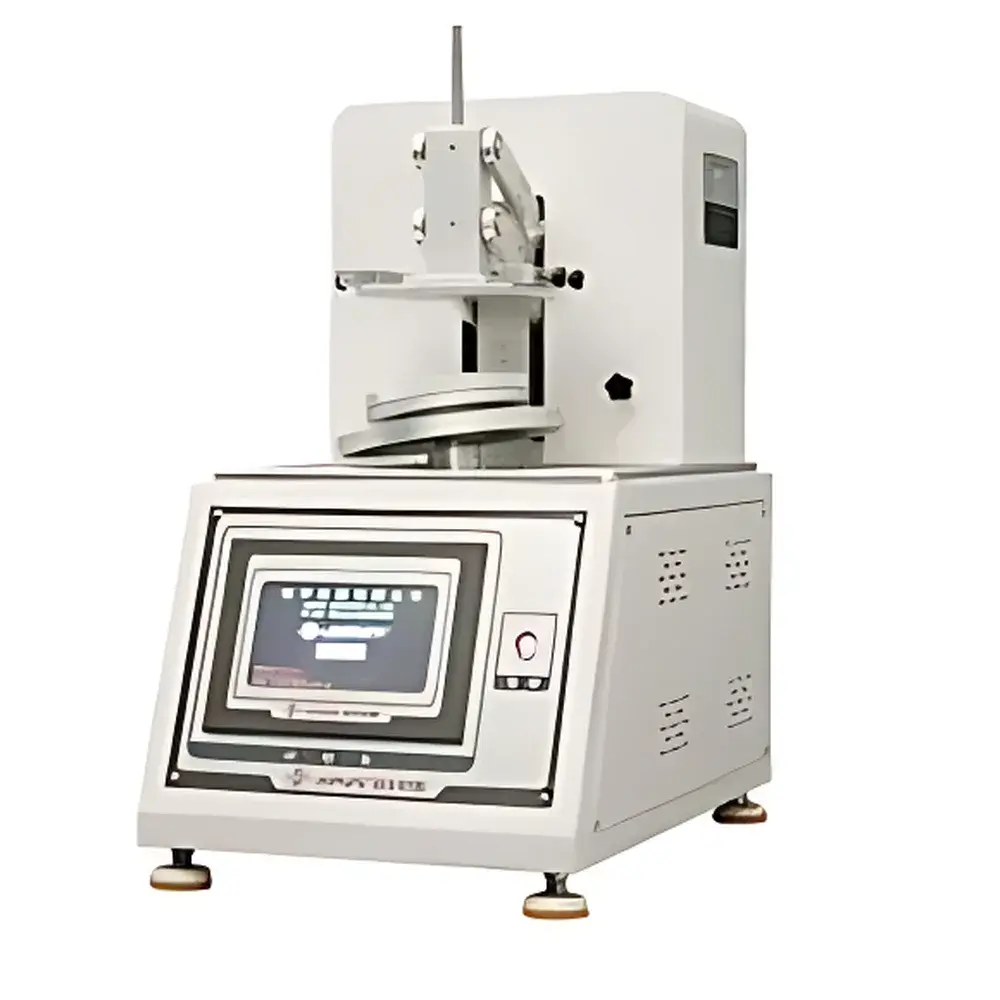
Schopper Abrasion Tester HY-628B1
| Brand | NYX |
|---|---|
| Origin | Tianjin, China |
| Manufacturer Type | Direct Manufacturer |
| Product Category | Domestic |
| Model | HY-628B1 |
| Price Range | USD 1,400 – 7,000 |
| Instrument Type | Oscillating/Reciprocating Tribological Tester |
| Max Friction Force | 0.5–25 N |
| Force Resolution | Not Specified |
| Max Operating Temperature | Ambient Only (No Heating Capability) |
| Cone Apex Angle | 166° |
| Oscillation Frequency | 75 cycles/min |
| Sample Holder Tilt Angle | 7° |
| Contact Load Range | 0.5–25 N (Adjustable) |
| Sample Area | 100 cm² |
| Effective Abrasion Area | 50 cm² |
| Dimensions (L×W×H) | 34 × 60 × 63 cm |
| Net Weight | 50 kg |
Overview
The Schopper Abrasion Tester HY-628B1 is a precision-engineered oscillating tribological instrument designed to evaluate surface durability of textile and nonwoven materials under controlled mechanical stress. It operates on the principle of reciprocating linear motion combined with defined normal loading and geometric contact geometry—specifically utilizing a conical abrading tip (166° apex angle) that oscillates across the specimen surface at a fixed frequency of 75 cycles per minute. This configuration replicates real-world wear mechanisms such as pilling, fuzzing, abrasion resistance, and colorfastness to rubbing—critical performance indicators for automotive interior textiles including floor carpets, trunk liners, and seat covers. Unlike high-temperature or multi-axis tribometers, the HY-628B1 is optimized for ambient-condition testing in compliance with standardized test protocols requiring reproducible mechanical input without thermal modulation.
Key Features
- Adjustable normal load from 0.5 N to 25 N, enabling graded severity assessment across material classes and end-use requirements.
- Fixed 7° tilt angle of the sample holder, ensuring consistent contact geometry and directional wear vector alignment relative to fiber orientation.
- Conical abrader with precisely manufactured 166° apex angle—engineered to match the geometry specified in DIN 53863-2 and GME 60345 for inter-laboratory comparability.
- Stable mechanical architecture with rigid cast-aluminum base and low-vibration drive system, minimizing parasitic motion and enhancing repeatability across replicate tests.
- Manual load calibration via calibrated weights; no integrated force transducer—consistent with cost-optimized design for routine QC environments where traceable static loading suffices.
- Compact footprint (34 × 60 × 63 cm) and moderate mass (50 kg), facilitating integration into standard laboratory workbenches without structural reinforcement.
Sample Compatibility & Compliance
The HY-628B1 accommodates flat, flexible specimens measuring 100 cm² (e.g., 10 cm × 10 cm), with an effective abrasion zone of 50 cm² centered under the abrading tip. It is validated for woven, knitted, tufted, and needle-punched nonwovens—including polypropylene, polyester, nylon, and blended automotive-grade substrates. The instrument fully supports test execution per internationally recognized standards: DIN 53863-2 (abrasion resistance of textile floor coverings), QC/T 216 (Chinese automotive industry specification for carpet durability), GME 60345 (General Motors Europe specification for interior trim abrasion), GMW 3283 (GM Worldwide standard for dry abrasion), and PV 3907/PV 3908 (Volkswagen Group specifications for pilling and abrasion resistance). While not equipped for elevated temperature operation, its mechanical fidelity ensures full conformance with ambient-condition clauses within each referenced standard.
Software & Data Management
The HY-628B1 operates as a manually supervised, hardware-controlled tester with no embedded microprocessor or digital interface. Cycle counting is performed via mechanical counter; load application is verified using external calibrated weights prior to test initiation. As such, it aligns with GLP-compliant workflows where procedural documentation—not automated data logging—is the primary audit trail. Test records (including load setting, cycle count, specimen ID, operator, date/time, and visual evaluation per ISO 105-X12 or AATCC 8 grading scales) are maintained in paper-based or LIMS-integrated electronic lab notebooks. For laboratories subject to FDA 21 CFR Part 11 requirements, supplementary validation documentation—including installation qualification (IQ), operational qualification (OQ), and preventive maintenance logs—must be generated independently by the user to demonstrate continued fitness for purpose.
Applications
- Quantitative assessment of abrasion resistance in automotive carpet systems during component development and supplier qualification.
- Comparative evaluation of anti-pilling treatments on synthetic fibers under standardized mechanical stress.
- Quality control screening of tuft bind strength and fiber anchorage integrity in cut-pile and loop-pile constructions.
- Correlation studies between Schopper abrasion cycles and field performance metrics (e.g., customer-reported soiling, fiber shedding, or aesthetic degradation after 50,000 km vehicle usage).
- Pre-screening of novel backing compounds and latex formulations for improved dimensional stability under cyclic shear loading.
FAQ
Does the HY-628B1 support automated data export or PC connectivity?
No. It is a mechanically actuated tester with manual cycle monitoring and no digital interface.
Is temperature control available on this model?
No. The HY-628B1 operates exclusively at ambient laboratory temperature (typically 20–25°C, 45–55% RH per ISO 139 conditioning requirements).
Can the abrading tip be replaced with alternative geometries (e.g., flat or spherical)?
No. The conical tip with 166° apex angle is fixed and non-interchangeable, maintaining strict adherence to DIN 53863-2 and OEM-specification geometry.
What maintenance is required to ensure long-term measurement consistency?
Monthly verification of oscillation frequency using a handheld tachometer, annual recalibration of mechanical load application via certified weights, and periodic inspection of abrader tip wear using optical profilometry or SEM.
Is the instrument suitable for testing non-textile materials such as leather or coated polymers?
Only if validated per internal method development—its geometry and kinematics were optimized for fibrous planar substrates, and results on dense or elastic materials may lack correlation to established reference methods.



