
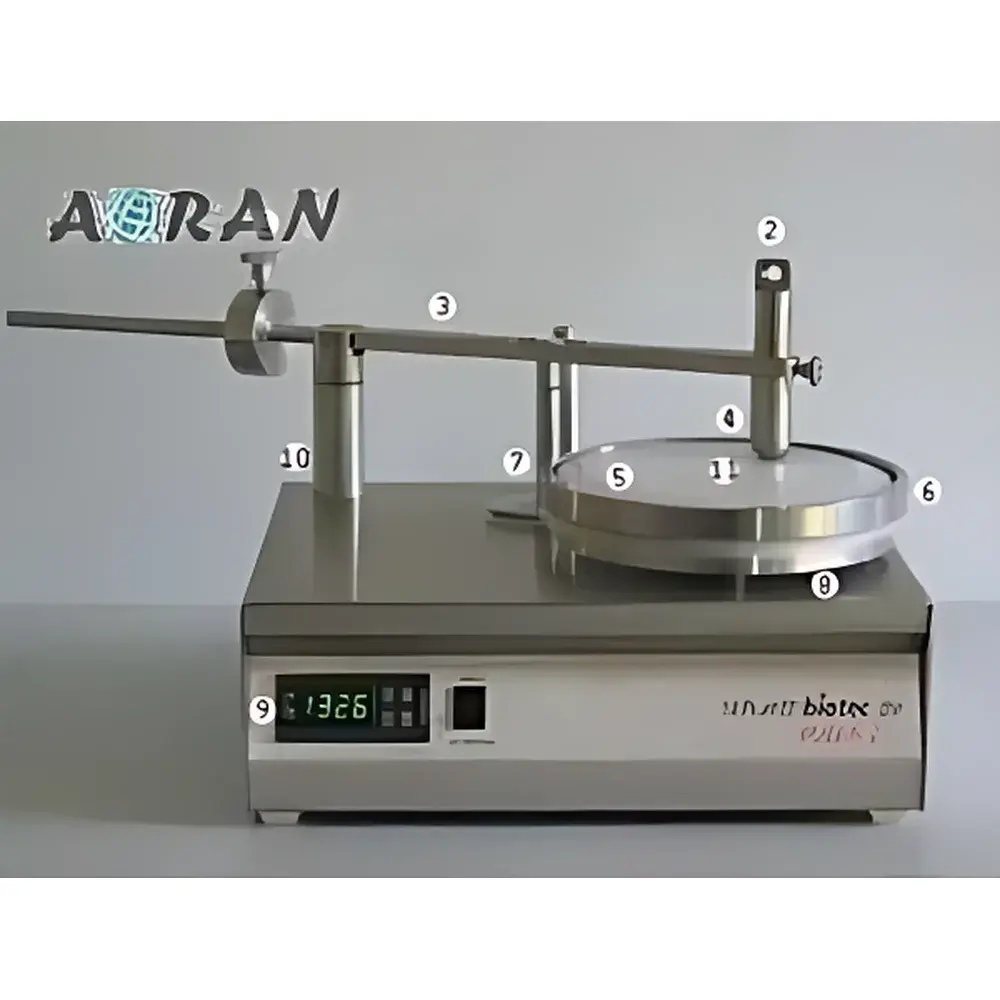
Schuett-Biotec RULLA 2 Wet Microbial Penetration Tester
| Brand | Schuett-Biotec |
|---|---|
| Origin | Germany |
| Model | RULLA 2 |
| Rotational Speed (Turntable) | 60 rpm |
| Oscillation Speed (Eccentric Shaft) | 5.60 rpm |
| Test Finger Force | 3 ± 0.02 N |
| Total Weight of Inner/Outer Steel Rings | 800 ± 1 g |
| Petri Dish Diameter | 140 mm |
| Support Cylinder Dimensions | 90 mm Ø × 40 mm H |
| Compliance | ISO 22610, YY/T 0506.6 |
Overview
The Schuett-Biotec RULLA 2 Wet Microbial Penetration Tester is a precision-engineered instrument designed to evaluate the resistance of medical barrier materials—such as surgical drapes, gowns, and cleanroom garments—to microbial penetration under wet, mechanically stressed conditions. It operates on the principle of controlled mechanical challenge: simultaneous rotation of a culture medium–loaded agar plate and lateral oscillation of a standardized test finger apply reproducible pressure and shear stress across the entire surface of a three-layer test assembly. This dual-motion protocol simulates real-world clinical scenarios where barrier fabrics are subjected to moisture saturation and dynamic contact (e.g., during surgical procedures or patient handling), enabling quantification of microorganism migration through the material into the underlying nutrient agar. The RULLA 2 is explicitly referenced in ISO 22610:2023 “Healthcare products — Evaluation of resistance of protective clothing materials to wet microbial penetration” and fulfills the requirements of YY/T 0506.6–2016, the Chinese national standard for testing microbial barrier performance of surgical drapes and gowns.
Key Features
- Motor-driven turntable rotating at precisely 60 rpm, ensuring uniform radial distribution of mechanical load over the 140 mm diameter agar surface.
- Eccentric shaft mechanism operating at 5.60 rpm, guiding a balanced lever arm equipped with a stainless-steel test finger exerting a calibrated force of 3 ± 0.02 N.
- Integrated electronic timer with programmable cycle duration, supporting standardized test durations per ISO 22610 (typically 30 minutes).
- Dual steel ring system (inner and outer) with total mass of 800 ± 1 g, providing consistent clamping pressure and tension control across layered test specimens.
- Polypropylene support cylinder (90 mm Ø × 40 mm H) ensures planar alignment and uniform tensioning of three-layer assemblies—comprising test material (bottom), inoculated carrier (middle), and HDPE overlay film (top).
- Modular accessory set includes ISO-compliant reference fabric (135 g/m² microfilament polyester, pre-washed per ISO 15707), HDPE safety sheets, PU/PE carrier substrates, and sterile 140 mm × 20 mm Petri dishes.
Sample Compatibility & Compliance
The RULLA 2 accommodates flat, non-stretchable barrier materials up to 140 mm in diameter, including woven and nonwoven textiles, laminates, coated films, and composite surgical fabrics. Test specimens are assembled in strict accordance with ISO 22610 Section 6: a lower layer of test material, a centrally placed inoculated carrier (e.g., polyurethane foam or cellulose membrane seeded with Staphylococcus aureus ATCC 6538 or Klebsiella pneumoniae ATCC 4352), and an upper HDPE film to retain moisture. The device satisfies full mechanical equivalence requirements for wet microbial penetration testing under both ISO 22610 and YY/T 0506.6. Its design enables traceable, auditable execution suitable for GLP-compliant laboratories and regulatory submissions requiring ISO/IEC 17025 validation pathways.
Software & Data Management
The RULLA 2 operates as a stand-alone electromechanical platform without embedded firmware or digital connectivity. All operational parameters—including rotation speed, oscillation frequency, and timing—are hardware-calibrated and mechanically fixed to eliminate variability. For quality assurance and audit readiness, users maintain manual logbooks or integrate timing data into LIMS via external stopwatch synchronization. When used within regulated environments (e.g., ISO 13485-certified manufacturing or FDA-regulated QC labs), the instrument supports 21 CFR Part 11 compliance when paired with validated electronic record systems that capture start/stop timestamps, operator ID, environmental conditions (temperature/humidity), and post-test colony enumeration results from incubated Petri dishes.
Applications
- Validation of liquid barrier integrity in ASTM F1670/F1671–compliant PPE development programs.
- Comparative evaluation of new textile finishes, hydrophobic coatings, or meltblown layer architectures under physiologically relevant wet-shear stress.
- Batch release testing of surgical drapes and gowns per YY/T 0506.6 and EN 13795–2.
- Root cause analysis of field failures involving fluid strike-through and subsequent infection risk assessment.
- Reference material qualification and inter-laboratory method transfer studies aligned with ISO/IEC 17043 proficiency testing schemes.
FAQ
What microorganisms are recommended for use with the RULLA 2?
ISO 22610 specifies Staphylococcus aureus ATCC 6538 or Klebsiella pneumoniae ATCC 4352 at concentrations of 1 × 10⁶ CFU/mL applied to the carrier layer. Alternative challenge organisms may be justified with scientific rationale and validation per ISO 11737–1.
Is calibration of the test finger force required before each test?
Yes. Users must verify the 3 ± 0.02 N load using a certified force gauge at the test finger attachment point prior to each test series, as outlined in ISO 22610 Annex B.
Can the RULLA 2 be used for dry microbial penetration testing?
No. The RULLA 2 is specifically engineered for wet-state evaluation. Dry penetration testing requires alternative apparatuses such as the ASTM F1671–based Phi-X174 bacteriophage challenge system or ISO 22611-compliant dry aerosol testers.
How often should the steel rings and support cylinder be cleaned or replaced?
Stainless steel rings must be cleaned after each use with ethanol and air-dried; visual inspection for deformation or surface corrosion is required weekly. Polypropylene support cylinders are single-use per ISO 22610 Clause 7.2 and must be discarded after each test cycle.
Does Schuett-Biotec provide IQ/OQ documentation for the RULLA 2?
Yes. Factory-issued Installation Qualification (IQ) and Operational Qualification (OQ) protocols—including torque verification of drive components, speed calibration reports, and dimensional inspection records—are available upon request for GMP-regulated installations.




