
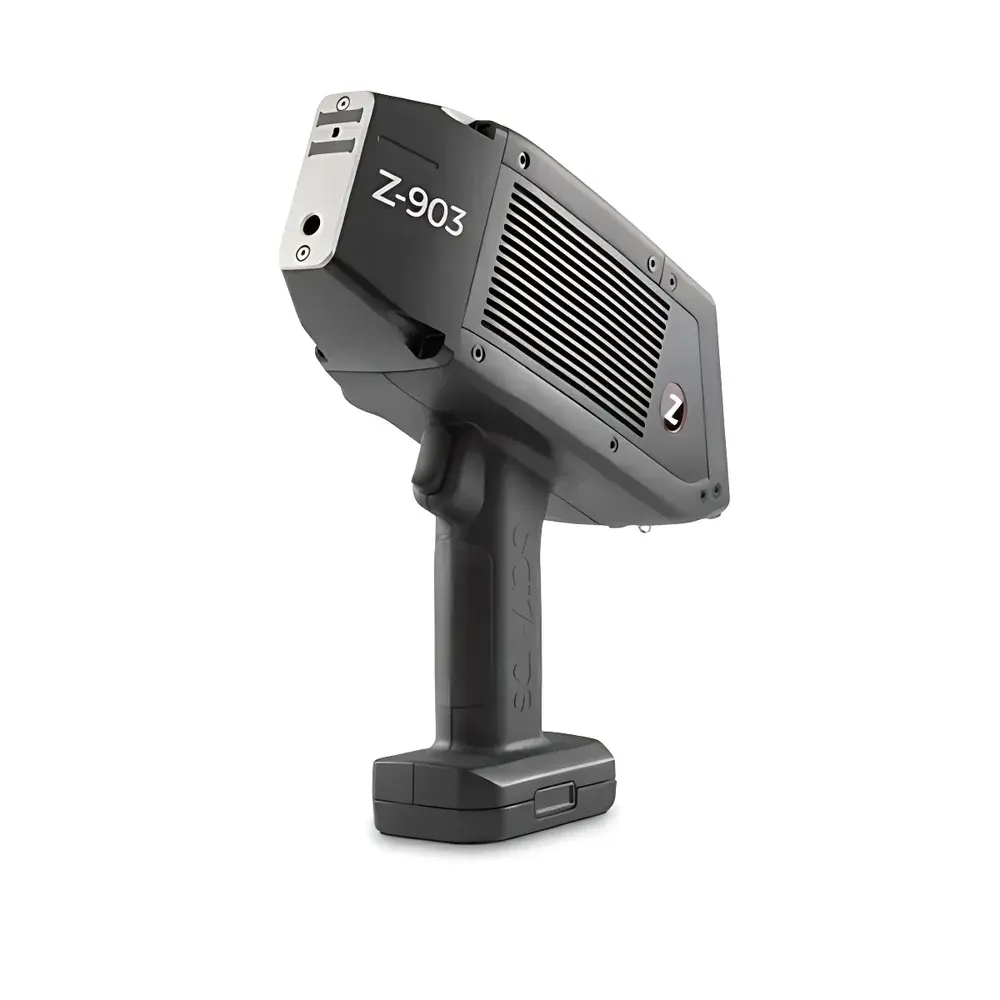
SciAps Z-903 Handheld Laser Induced Breakdown Spectroscopy (LIBS) Analyzer
| Brand | SciAps |
|---|---|
| Origin | USA |
| Manufacturer Type | Authorized Distributor |
| Origin Category | Imported |
| Model | Z-903 |
| Instrument Type | Handheld |
| Integration | Fully Integrated |
| Spectral Range | 190–950 nm |
| Detection Capability | H to U (All Elements) |
| Weight | 1.97 kg (4.35 lb) |
| Dimensions | 273 × 73 × 219 mm (10.75 × 2.875 × 8.625 in) |
| Operating System | Android™ (ARM Quad-Core Cortex-A53, 1.2 GHz) |
| Memory | 2 GB LPDDR3 RAM + 16 GB eMMC internal storage |
| Data Storage | 32 GB microSD card |
| Display | 3.5-inch high-brightness color touchscreen (rear-mounted) |
| Laser Class | Class 3B |
| Safety Compliance | CE, RoHS, US FDA Registered |
| Environmental Control | Integrated Opti-Purge™ argon purge system |
| Calibration Reference | Onboard 316 stainless steel validation standard |
| Grade Libraries | >500 preloaded alloy/geochemical libraries, user-editable and multi-library support |
| Connectivity | Wi-Fi (802.11b/g/n), Bluetooth BR/EDR + BLE, GPS, USB-C |
| Power | Rechargeable Li-ion battery (internal & external charging), AC adapter compatible |
| Sample Alignment | Integrated coaxial laser targeting + dual-camera system (wide-field + macro) |
| Drift Correction | Onboard auto-drift correction using factory or user-defined reference materials |
| Software | SciAps AnalyzAR™ suite with spectral comparison, quantitative calibration curve generation, and full parameter control (laser firing pattern, spectrometer integration time, lens cleaning protocol) |
Overview
The SciAps Z-903 is a field-deployable, handheld Laser Induced Breakdown Spectroscopy (LIBS) analyzer engineered for elemental quantification across the entire periodic table—from hydrogen (H) to uranium (U). Unlike conventional portable LIBS or XRF instruments, the Z-903 leverages a broadened spectral detection range (190–950 nm) to resolve historically challenging emission lines—including those of light elements (H, N, O, F, Cl, Br, S) and alkali metals (Li, Rb, Cs)—that fall outside the operational window of standard 200–800 nm spectrometers. Its core measurement principle relies on pulsed laser ablation (1064 nm Nd:YAG, Q-switched) to generate transient microplasmas on solid, liquid, or powdered surfaces; emitted atomic and ionic line spectra are dispersed via high-resolution Czerny-Turner optics and detected by a back-thinned CCD sensor with thermoelectric cooling. This architecture enables direct, matrix-independent elemental identification without vacuum or helium purging—while the integrated Opti-Purge™ argon environment significantly enhances signal-to-noise ratio (SNR), particularly in the deep UV region (<220 nm), where critical Li I (670.78 nm), K I (766.49 nm), and S I (180.7 nm) lines reside.
Key Features
- Full-periodic-table coverage (H–U) enabled by extended 190–950 nm spectral range—resolving previously inaccessible emission lines for H, F, N, O, Cl, Br, S, Rb, Cs, and low-interference K I at 766.49 nm.
- Sub-ppm detection limits for lithium (2–5 ppm) achieved through optimized plasma excitation and high-SNR acquisition at the 670.78 nm resonance line.
- Dual-camera alignment system: coaxial laser targeting + dedicated macro camera for sample documentation, QR/barcode scanning, and spatial registration of analysis spots.
- Onboard drift correction using factory-calibrated 316 stainless steel reference standard or user-provided certified materials—ensuring long-term measurement stability under variable thermal and environmental conditions.
- Real-time, parameter-level control via Android-based AnalyzAR™ software: adjustable laser pulse energy, shot count per location, integration time, grating position, and automated lens cleaning cycles.
- Ruggedized industrial design compliant with IP54 ingress protection; Class 3B laser operation with onboard safety interlocks and LSO-configurable 1-class operating mode via integrated sampling sensor feedback.
Sample Compatibility & Compliance
The Z-903 analyzes heterogeneous solids (ores, soils, slag, ceramics), pressed pellets, alloys, geological cores, aqueous solutions (via dried residue), and forensic evidence (paint chips, glass fragments, soil traces) without destructive preparation. Its open-beam configuration accommodates irregular topographies and large-volume samples. Regulatory compliance includes CE marking per EU Machinery and EMC Directives, RoHS 2011/65/EU, and US FDA registration as a Class II medical device accessory (21 CFR Part 820). While not inherently GLP/GMP-certified, the instrument supports audit-ready workflows: all analytical parameters, raw spectra, timestamps, GPS coordinates, operator IDs, and calibration logs are embedded in each result file—enabling traceability per ISO/IEC 17025:2017 and ASTM E2926-22 (Standard Test Method for LIBS Analysis of Metals). Argon purge performance is validated against ISO 11885 for low-Z element recovery in environmental matrices.
Software & Data Management
AnalyzAR™ is a native Android application built on a hardened Linux kernel, supporting full spectral visualization, peak deconvolution, multivariate regression (PLS, PCA), and library-driven grade matching. Quantitative calibration curves are generated via linear or polynomial fitting against NIST-traceable reference materials (e.g., SRM 278, 681, 2553). All data exports comply with ASTM E1382-compliant .csv and .spc formats; spectral files include metadata headers conforming to JCAMP-DX v5.01. Cloud synchronization (via optional SciAps Cloud Connect) enables centralized database management, remote firmware updates, and cross-device method sharing. Role-based access control (RBAC) enforces password-protected user tiers (Operator, Supervisor, Administrator), with configurable permissions for method editing, library modification, and report generation—aligning with FDA 21 CFR Part 11 electronic record requirements when deployed with audit trail logging enabled.
Applications
Primary deployment domains include lithium-rich hard-rock exploration (spodumene, petalite) and brine resource assessment, where rapid in-situ Li quantification replaces lab-bound ICP-MS. In petroleum geochemistry, the Z-903 identifies trace vanadium, nickel, and sulfur species in crude oils and reservoir rocks—supporting source rock typing per ASTM D7169. Archaeometric applications leverage its non-contact, low-ablation capability for pigment analysis (e.g., lapis lazuli, cinnabar) and ceramic provenance studies. Forensic labs utilize its ability to distinguish gunshot residue (Ba, Sb, Pb) from environmental contaminants, while nuclear safeguards teams apply it for rapid U/Pu isotopic ratio screening (via U II 409.01 nm / U II 424.17 nm intensity ratios). Additional use cases span scrap metal sorting (Ti, Mg, Be detection), environmental soil screening (As, Cd, Cr, Pb), and battery cathode material verification (Ni, Co, Mn, Al).
FAQ
Does the Z-903 require external gas supply for routine operation?
No—its integrated Opti-Purge™ system uses a sealed, recirculating argon reservoir with catalytic recombination, eliminating the need for disposable cylinders during standard field use. External argon can be connected for extended UV-sensitive analyses.
Can the Z-903 perform depth profiling or layer analysis?
Yes—via sequential laser shots at identical locations with controlled ablation depth per pulse (typically 0.1–0.3 µm), enabling stratigraphic mapping of coatings, corrosion layers, or inclusion distributions.
Is spectral data export compatible with third-party chemometric software?
Yes—raw spectra are exported in ASCII-compatible .spc format with wavelength-intensity pairs and full metadata, supporting import into MATLAB, Python (SciPy), Unscrambler®, and GRAMS/AI.
How is calibration maintained across temperature fluctuations in desert or arctic environments?
Onboard thermal stabilization of the spectrometer housing (+/- 0.1°C) combined with real-time drift correction against the internal 316 SS standard ensures <±2% relative error over −10°C to +50°C ambient ranges.
What regulatory documentation is provided for ISO 17025 accreditation?
SciAps supplies full technical specifications, factory calibration certificates (traceable to NIST), uncertainty budgets per element, and IQ/OQ documentation templates—validated per ASTM E2926 Annex A2 for field-portable LIBS systems.
Related Products





