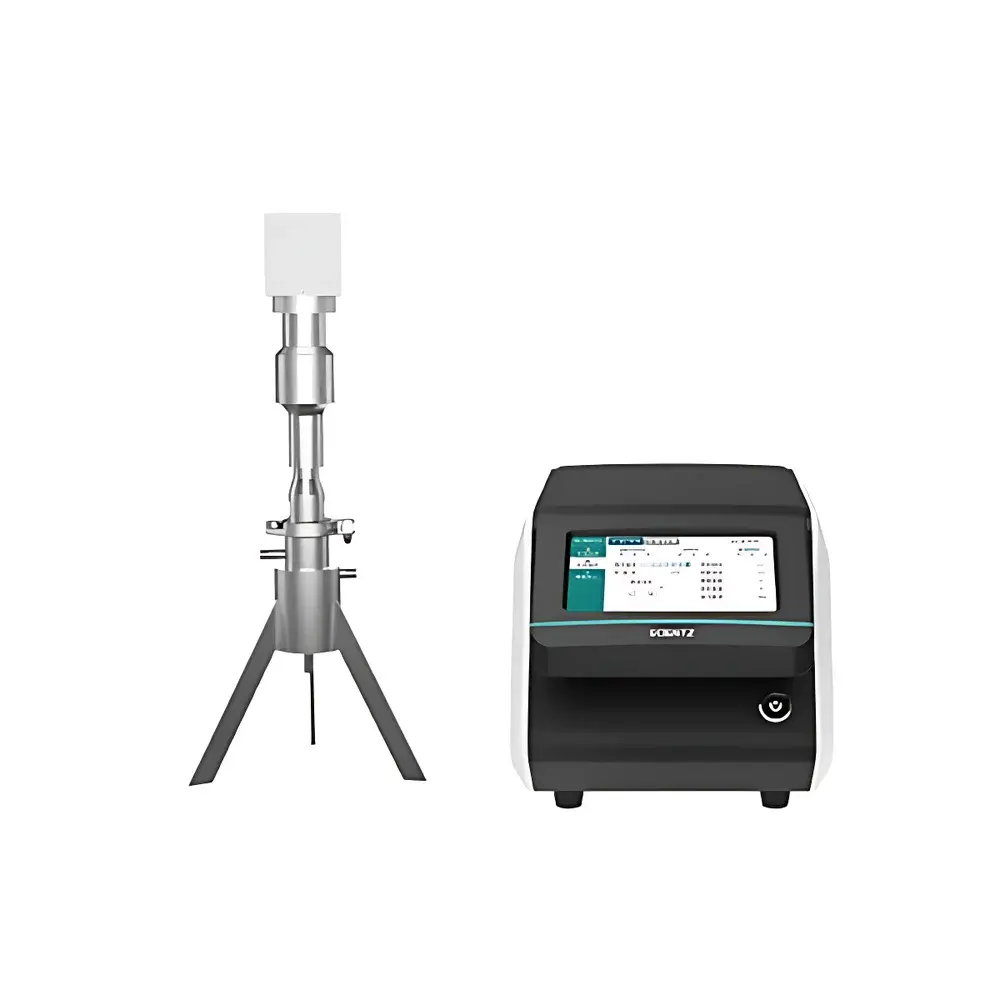
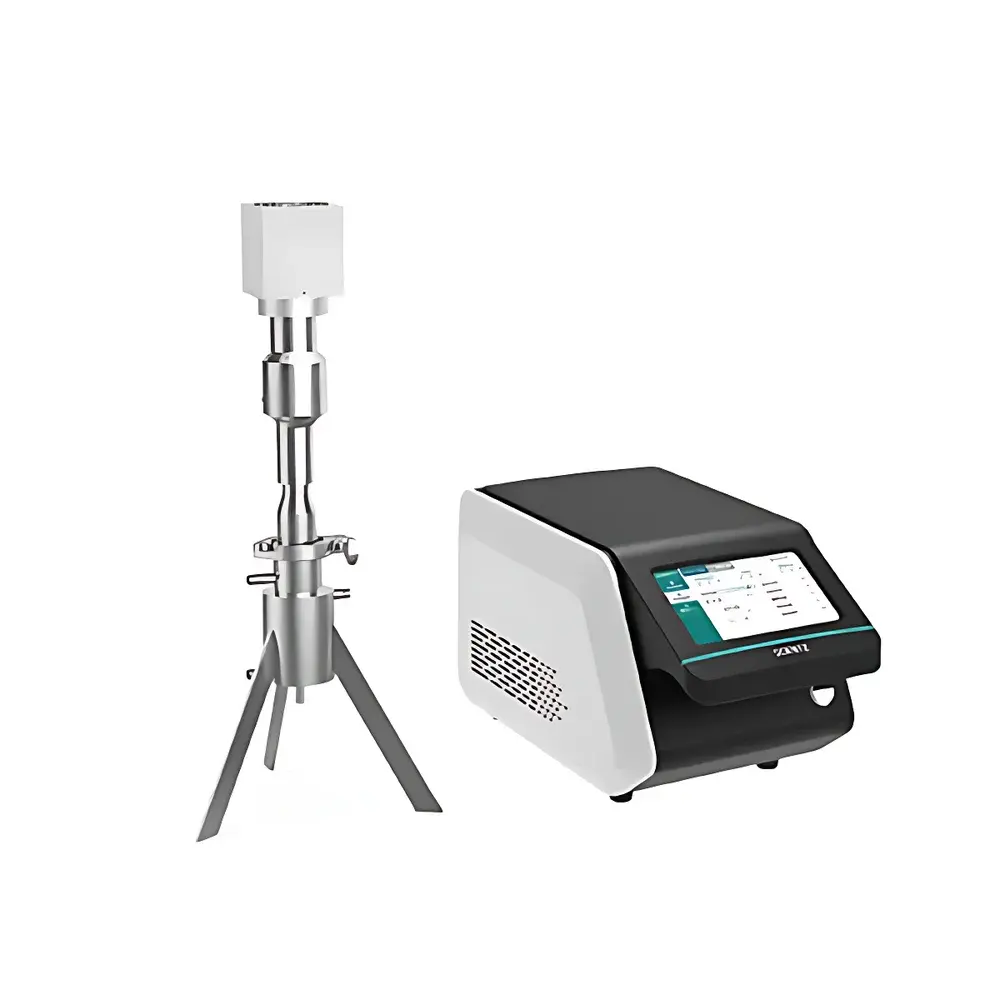
Scientz CFU-750W-1 Continuous-Flow Ultrasonic Cell Disruptor
| Brand | Scientz |
|---|---|
| Origin | Zhejiang, China |
| Manufacturer Type | Direct Manufacturer |
| Instrument Type | Continuous-Flow Ultrasonic Cell Disruptor |
| Operating Frequency | 20 kHz ± 1 kHz |
| Ultrasonic Power Output | 750 W |
| Flow Rate Capacity | 5–50 L/h |
Overview
The Scientz CFU-750W-1 is a purpose-engineered continuous-flow ultrasonic cell disruptor designed for scalable, reproducible, and temperature-controlled processing of biological and colloidal suspensions in biopharmaceutical, nanomaterial, and fine chemical applications. It operates on the physical principle of acoustic cavitation—where high-intensity ultrasound (20 kHz ± 1 kHz) induces transient microbubble formation, growth, and violent collapse within the liquid medium. This process generates localized shockwaves, microstreaming, and shear gradients exceeding 10⁶ s⁻¹, enabling efficient mechanical lysis of microbial, mammalian, or plant cells without thermal denaturation when properly cooled. Unlike batch-mode sonicators, the CFU-750W-1 integrates a recirculating flow path through a jacketed reaction chamber, allowing sustained treatment of large-volume streams (5–50 L/h) while maintaining consistent energy delivery per unit volume. Its dual-layer reactor design incorporates active cooling to stabilize process temperature—critical for preserving labile biomolecules (e.g., monoclonal antibodies, viral vectors) during extended operation.
Key Features
- Continuous-flow architecture with integrated peristaltic or diaphragm circulation pump—enables uninterrupted processing of up to 50 L/h with uniform energy distribution.
- Titanium alloy (Grade 5) ultrasonic horn and transducer assembly—resistant to erosion, corrosion, and fatigue under prolonged high-power operation.
- ARM-based embedded control system with 7-inch capacitive touch interface—supports real-time parameter monitoring (power, frequency, temperature, flow rate) and intuitive workflow navigation.
- Auto-frequency tracking digital generator—dynamically locks onto resonant frequency within ±1 kHz tolerance, eliminating manual tuning and ensuring optimal electroacoustic coupling efficiency.
- Configurable protocol storage—up to 50 user-defined programs with independent settings for power (0–100% of 750 W), duty cycle, total runtime, and temperature setpoint.
- Sanitary reactor design—fully welded, mirror-polished (Ra ≤ 0.4 µm) 316L stainless steel chamber with no dead legs; compatible with SIP (Steam-in-Place) at 121°C/30 min or autoclave sterilization after transducer detachment.
Sample Compatibility & Compliance
The CFU-750W-1 accommodates aqueous, buffered, organic-aqueous, and low-viscosity non-Newtonian suspensions—including E. coli lysates, CHO cell homogenates, lipid nanoparticle precursors, metal oxide colloids (e.g., TiO₂, Fe₃O₄), and emulsion-based formulations. It complies with ISO 13485:2016 design controls for medical device-related manufacturing processes and supports GMP-aligned documentation via optional audit trail logging (meeting FDA 21 CFR Part 11 requirements when paired with validated software). All wetted surfaces meet USP Class VI biocompatibility standards; the system is suitable for use in ISO Class 5–8 cleanrooms when installed with appropriate HVAC integration.
Software & Data Management
The embedded controller logs timestamped operational data—including actual power output (W), instantaneous frequency (kHz), jacket inlet/outlet temperatures (°C), and cumulative run time—to internal flash memory. Data export is supported via USB 2.0 to CSV format for traceability and QC review. Optional Ethernet connectivity enables remote monitoring and integration into MES or SCADA environments using Modbus TCP protocol. All parameter changes are recorded with operator ID and timestamp, fulfilling ALCOA+ (Attributable, Legible, Contemporaneous, Original, Accurate, Complete, Consistent, Enduring, Available) data integrity principles.
Applications
- Vaccine & Biologics Manufacturing: Homogenization of adjuvant-emulsion systems (e.g., MF59-type), disruption of baculovirus-infected insect cells, and dispersion of virus-like particles (VLPs) without aggregation.
- Nanomaterial Synthesis: Deagglomeration and surface functionalization of transition metal oxides, quantum dots, and carbon nanotubes in polar solvents for catalytic or conductive inks.
- Process Chemistry: Acceleration of heterogeneous catalysis (e.g., Pd/C-mediated cross-coupling) by enhancing mass transfer at solid–liquid interfaces.
- Food & Nutraceutical Processing: Cold-phase emulsification of omega-3 oils in dairy matrices or plant-based beverages, achieving droplet size distributions <200 nm with narrow PDI (<0.2).
FAQ
What is the maximum allowable viscosity for continuous processing?
Viscosity should not exceed 50 mPa·s at processing temperature to maintain laminar flow and avoid cavitation shielding.
Can the system be integrated into an existing pilot-scale bioreactor train?
Yes—standard 1/2″–1″ sanitary clamp (DIN 11851) and tri-clamp ports enable direct connection to downstream filtration or chromatography units.
Is temperature control limited to jacket cooling, or does it include inline sensing?
Dual Pt100 sensors monitor both jacket fluid and sample stream temperatures independently; PID-controlled chiller integration is supported.
How is acoustic energy dosage quantified for method transfer?
Energy density (kJ/L) is calculated in real time as (Power × Time) / Total Volume Processed, with automatic logging per batch.
Does the system support IQ/OQ/PQ documentation packages?
Yes—Scientz provides configurable qualification templates aligned with ASTM E2500-13 and Annex 15 guidelines upon request.