
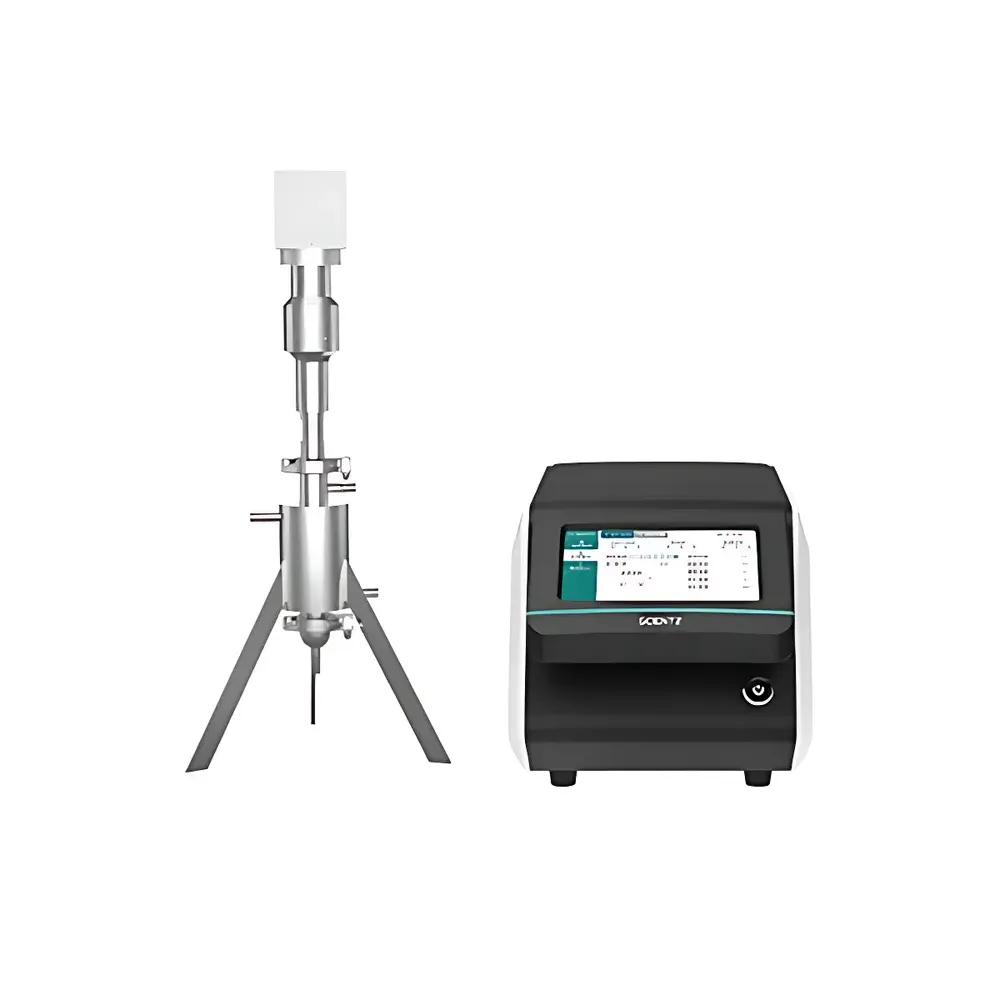
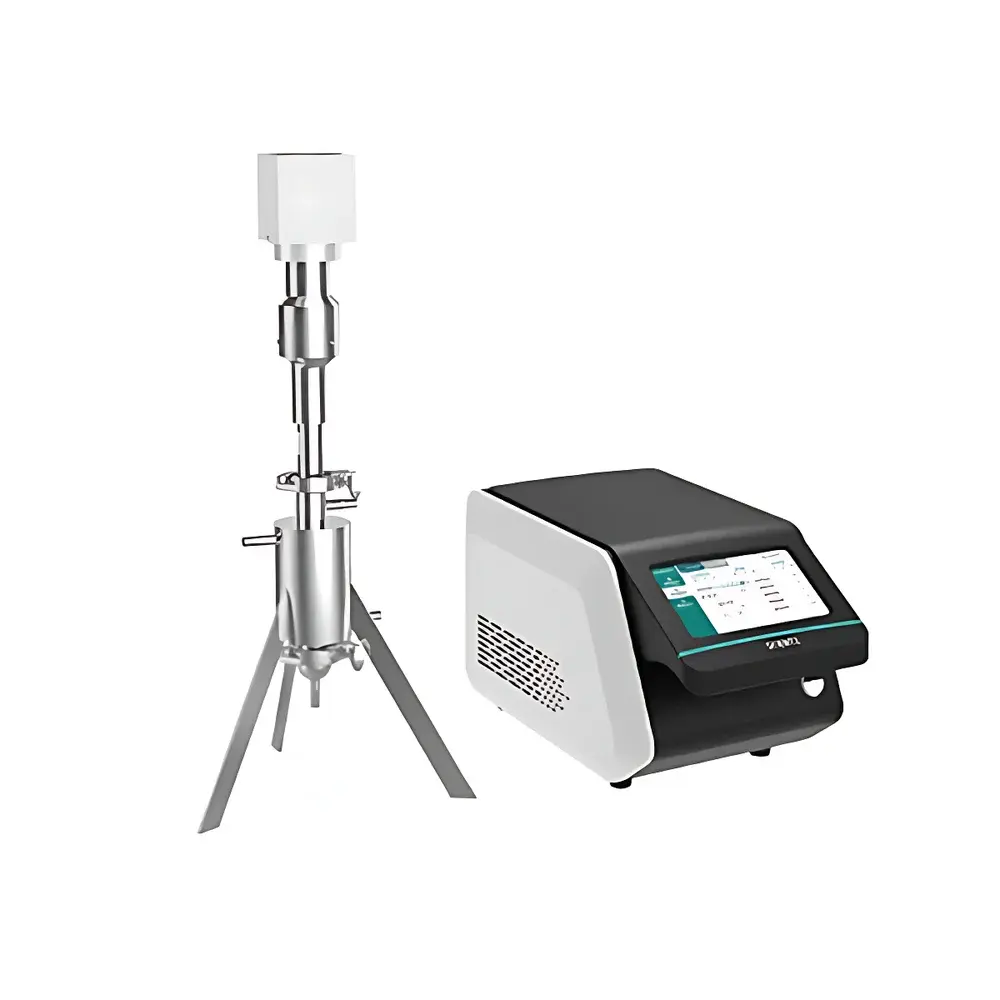
Scientz CFU-750W-2 Continuous-Flow Ultrasonic Cell Disruptor
| Brand | Scientz |
|---|---|
| Origin | Zhejiang, China |
| Manufacturer Type | Direct Manufacturer |
| Instrument Type | Continuous-Flow Ultrasonic Cell Disruptor |
| Operating Frequency | 20 kHz ± 1 kHz |
| Ultrasonic Power Output | 750 W |
| Flow Rate Capacity | 5–50 L/h |
Overview
The Scientz CFU-750W-2 is a purpose-engineered continuous-flow ultrasonic cell disruptor designed for scalable, reproducible, and temperature-controlled processing of biological and chemical suspensions in industrial and pilot-scale applications. It operates on the physical principle of acoustic cavitation: high-intensity ultrasound (20 kHz ± 1 kHz) propagates through liquid media via a titanium alloy sonotrode, generating transient microbubbles that undergo rapid expansion and violent collapse. This implosive energy release produces localized shear forces exceeding 10⁴ m/s², hydrodynamic microjets (>400 m/s), and transient hotspots (~5,000 K), collectively enabling efficient cell lysis, nanoparticle deagglomeration, emulsification, and molecular dispersion without mechanical shearing or thermal degradation when properly cooled. Unlike batch-mode sonicators, the CFU-750W-2 integrates seamlessly into closed-loop fluidic systems—enabling true continuous processing with residence time control, consistent energy delivery per unit volume, and minimized thermal accumulation.
Key Features
- Continuous-flow architecture with integrated circulation pump and jacketed reaction chamber, supporting flow rates from 5 to 50 L/h under stable operational conditions
- Titanium alloy (Grade 5 Ti-6Al-4V) ultrasonic transducer and horn assembly—resistant to corrosion, erosion, and fatigue under prolonged high-power operation
- Dual-wall thermostatically controlled reactor vessel with external coolant loop connection (e.g., chiller or glycol system) to maintain sample temperature within ±2 °C during extended runs
- ARM-based embedded control system with 7-inch capacitive touchscreen interface, offering real-time monitoring of power output, frequency tracking, flow rate input, and elapsed treatment time
- Auto-frequency tracking digital generator: continuously adjusts output frequency to maintain resonance at the optimal point (20 kHz ± 1 kHz), eliminating manual tuning and ensuring maximum electroacoustic conversion efficiency
- Programmable memory for up to 50 user-defined protocols—including power ramping profiles, dwell times, and inter-step cooling intervals—supporting GLP-compliant method reproducibility
- Sanitary design: seamless, electropolished interior surface finish (Ra ≤ 0.4 µm); no dead-legs or crevices; compatible with SIP (Steam-in-Place) at 121 °C/20 min or autoclave sterilization after disassembly of transducer module
Sample Compatibility & Compliance
The CFU-750W-2 accommodates aqueous, organic, and mixed-phase suspensions across diverse viscosities (up to 500 cP) and solid loadings (≤15 wt%). It has been validated for use with mammalian cell lines (CHO, HEK293), bacterial cultures (E. coli, B. subtilis), yeast (S. cerevisiae), plant tissue homogenates, and colloidal metal oxide dispersions (e.g., TiO₂, Fe₃O₄, ZnO). The system conforms to ISO 13485 design controls for medical device manufacturing environments and supports audit-ready documentation for FDA 21 CFR Part 11 compliance when paired with Scientz’s optional data logging software (SC-LMS v3.2). All wetted parts meet USP Class VI biocompatibility requirements and are certified per ASTM F748 for long-term contact with biological fluids.
Software & Data Management
The embedded controller logs timestamped operational parameters—including instantaneous power (W), RMS current (A), frequency deviation (Hz), coolant inlet/outlet temperatures (°C), and cumulative energy dose (kJ/L)—to internal flash memory (16 GB). Export is supported via USB 2.0 or Ethernet (Modbus TCP) to LIMS or MES platforms. Optional Scientz ControlSuite software enables remote configuration, real-time dashboard visualization, automated report generation (PDF/CSV), and electronic signature workflows aligned with ALCOA+ data integrity principles. Audit trails record all parameter modifications, user logins, and calibration events with immutable timestamps.
Applications
- Vaccine manufacturing: continuous emulsification of oil-in-water adjuvant systems (e.g., MF59 analogues) with antigen solutions, achieving droplet size distributions <200 nm (Dv90) and polydispersity index <0.15
- Biopharmaceutical downstream processing: scalable lysis of high-density microbial fermentations prior to chromatographic purification
- Nanomaterial synthesis: deagglomeration and surface functionalization of transition metal oxides for catalytic ink formulation
- Chemical process intensification: enhancing mass transfer in biphasic Suzuki couplings and enzymatic transesterifications
- Food-grade emulsion production: cold-processing of dairy-free creamers and nut-based beverage stabilizers without thermal denaturation
FAQ
What is the maximum allowable inlet pressure for the circulation pump?
The integrated diaphragm pump supports inlet pressures up to 0.3 MPa (3 bar) and is rated for continuous duty at flow rates ≥10 L/h.
Can the system be integrated with existing PLC-controlled bioreactor infrastructure?
Yes—Modbus RTU/TCP and 4–20 mA analog I/O interfaces enable direct integration with DeltaV, PCS7, or Rockwell ControlLogix systems for synchronized start/stop, interlock signaling, and cascade temperature control.
Is validation support available for GMP commissioning?
Scientz provides IQ/OQ protocol templates, factory acceptance test (FAT) documentation, and optional on-site PQ execution by qualified validation engineers.
What maintenance intervals are recommended for the ultrasonic transducer?
Titanium horn inspection and torque verification every 500 operational hours; full transducer recalibration recommended annually or after 2,000 hours of cumulative use.
Does the system comply with electromagnetic compatibility (EMC) standards for laboratory environments?
Yes—certified to IEC 61326-1:2013 (industrial environment) and EN 55011:2016 Class B emission limits.





