
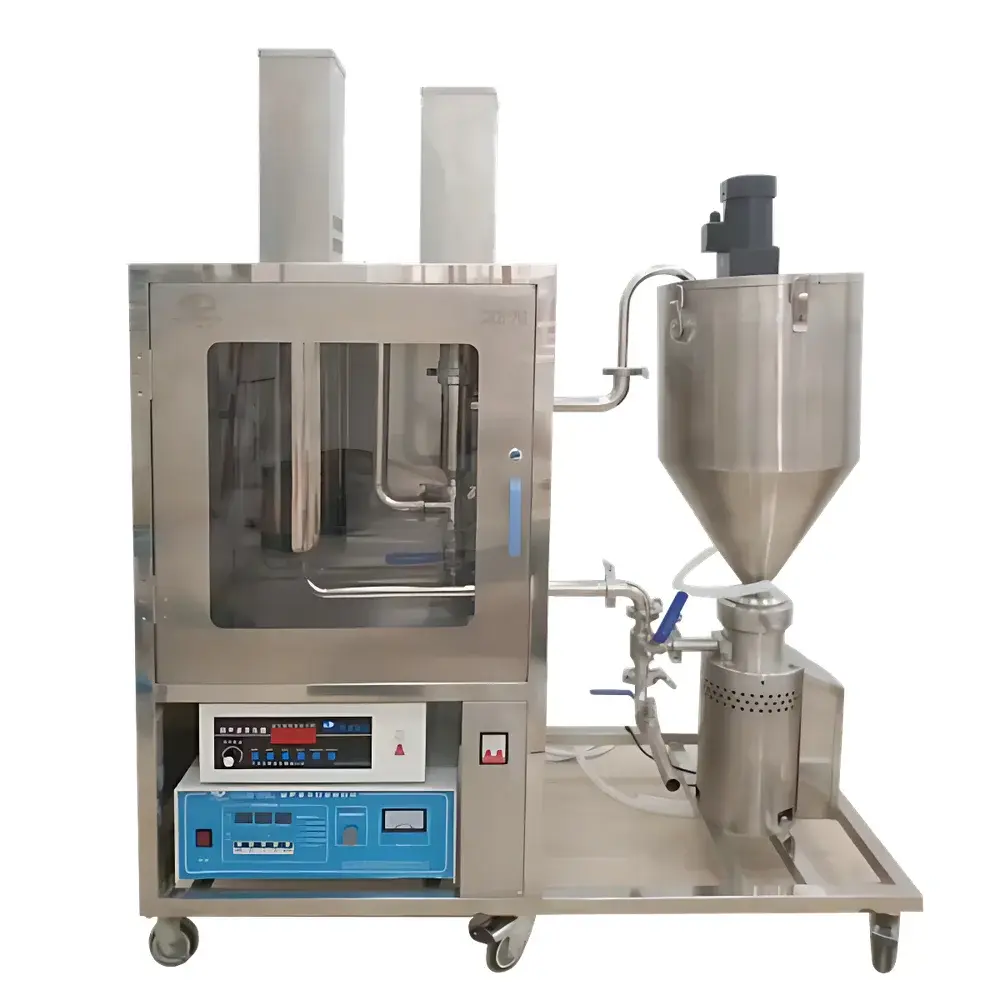
Scientz CSCB-2GL Ultrasonic Graphene Exfoliation System
| Brand | Scientz |
|---|---|
| Origin | Zhejiang, China |
| Manufacturer Type | Original Equipment Manufacturer (OEM) |
| Country of Origin | China |
| Model | CSCB-2GL |
| Pricing | Available upon Request |
Overview
The Scientz CSCB-2GL Ultrasonic Graphene Exfoliation System is a purpose-engineered benchtop platform designed for controlled liquid-phase exfoliation of layered two-dimensional (2D) materials—primarily graphite into monolayer and few-layer graphene—using high-intensity ultrasonic cavitation. Unlike general-purpose ultrasonicators, the CSCB-2GL integrates precision temperature regulation, programmable power delivery, and synchronized mechanical agitation to optimize shear stress distribution and minimize structural damage during delamination. Its operational principle relies on transient acoustic cavitation: when high-frequency ultrasound (typically 20–40 kHz) propagates through a graphite suspension, microbubbles nucleate, grow, and asymmetrically collapse near graphite flakes. This collapse generates localized microjets (>100 m/s) and shockwaves that exert directional mechanical shear at flake edges and interlayer interfaces—effectively overcoming van der Waals forces without introducing covalent defects. The system’s architecture supports both batch-mode operation and scalable multi-unit parallel configurations, making it suitable for method development in academic labs and early-stage process validation in material synthesis facilities.
Key Features
- Modular ultrasonic generator and piezoelectric transducer assembly—enabling field-replaceable core components and long-term signal stability
- Integrated digital temperature control (range: 0–80 °C, ±0.5 °C accuracy) with real-time monitoring via large-backlit LCD interface
- Adjustable ultrasonic output (20–100% full power, 0–500 W nominal), frequency-stabilized at 25 kHz ±0.3 kHz
- Simultaneous ultrasonic irradiation and magnetic stirring (0–1200 rpm)—ensuring homogeneous particle suspension and uniform energy distribution
- Intelligent safety protocol suite: automatic shutdown on overtemperature, overcurrent, or overvoltage conditions; parameter retention after power interruption
- Non-destructive processing profile—preserves crystallinity and lattice integrity of exfoliated products, as confirmed by Raman spectroscopy (ID/IG < 0.2) and XRD analysis
Sample Compatibility & Compliance
The CSCB-2GL demonstrates broad compatibility across layered inorganic and carbon-based precursors, including natural and synthetic graphite, MoS2, WS2, hexagonal boron nitride (h-BN), and carbon nanotubes. It has been validated for dispersion stabilization in common solvents (NMP, DMF, IPA/water mixtures) and aqueous surfactant systems (e.g., SDS, SC). While not certified to ISO/IEC 17025 or GLP standards out-of-the-box, its programmable protocols, audit-ready parameter logging (via optional RS-232/USB export), and reproducible energy input (J/mL) align with method transfer requirements under ASTM D7851 (Standard Guide for Ultrasonic Processing of Nanomaterials) and support documentation for internal QC/QA workflows compliant with ISO 9001 and GMP-aligned lab practices.
Software & Data Management
The system operates via embedded firmware with no external PC dependency; however, optional USB data logging enables timestamped export of all operational parameters—including ultrasonic duty cycle, real-time temperature, elapsed time, and power level—to CSV format. This facilitates traceability for experimental replication, DOE (Design of Experiments) optimization, and regulatory documentation. All user-defined protocols are stored in non-volatile memory and retain settings across power cycles. For laboratories requiring electronic records compliance, the logged datasets meet foundational criteria for ALCOA+ principles (Attributable, Legible, Contemporaneous, Original, Accurate) when paired with validated file management procedures.
Applications
- Controlled top-down exfoliation of graphite to produce graphene dispersions for conductive inks, transparent electrodes, and composite reinforcement
- Deagglomeration and stable dispersion of transition metal dichalcogenides (TMDs) for optoelectronic device prototyping
- Preparation of h-BN nanosheets for thermal interface materials and dielectric layers
- Disruption of geological samples (soils, rock powders) and metallurgical matrices (rare earth oxides, non-ferrous alloys) for elemental analysis sample prep
- Emulsification and nano-sizing of hydrophobic active ingredients in pharmaceutical nanocarrier development
FAQ
What is the maximum recommended working volume per cycle?
The standard probe configuration supports 50–500 mL suspensions; optimal exfoliation efficiency is achieved between 100–300 mL using the supplied titanium alloy horn (Φ6 mm tip diameter).
Can the system be integrated into a larger automation workflow?
Yes—digital I/O ports (TTL-compatible) allow synchronization with peristaltic pumps, cooling circulators, or robotic liquid handlers for semi-automated multi-step protocols.
Is the ultrasonic frequency fixed or tunable?
The CSCB-2GL operates at a factory-calibrated center frequency of 25 kHz; frequency sweeping is not supported, ensuring consistent cavitation threshold and reproducible energy coupling.
Does the system comply with electromagnetic compatibility (EMC) directives for laboratory use?
It meets CISPR 11 Group 1, Class B emission limits and IEC 61326-1 immunity requirements for professional laboratory environments.
What maintenance is required for long-term reliability?
Routine inspection of the ultrasonic horn tip for pitting or erosion every 200 operating hours; replacement recommended after 1000 h cumulative use or visible surface degradation.



