
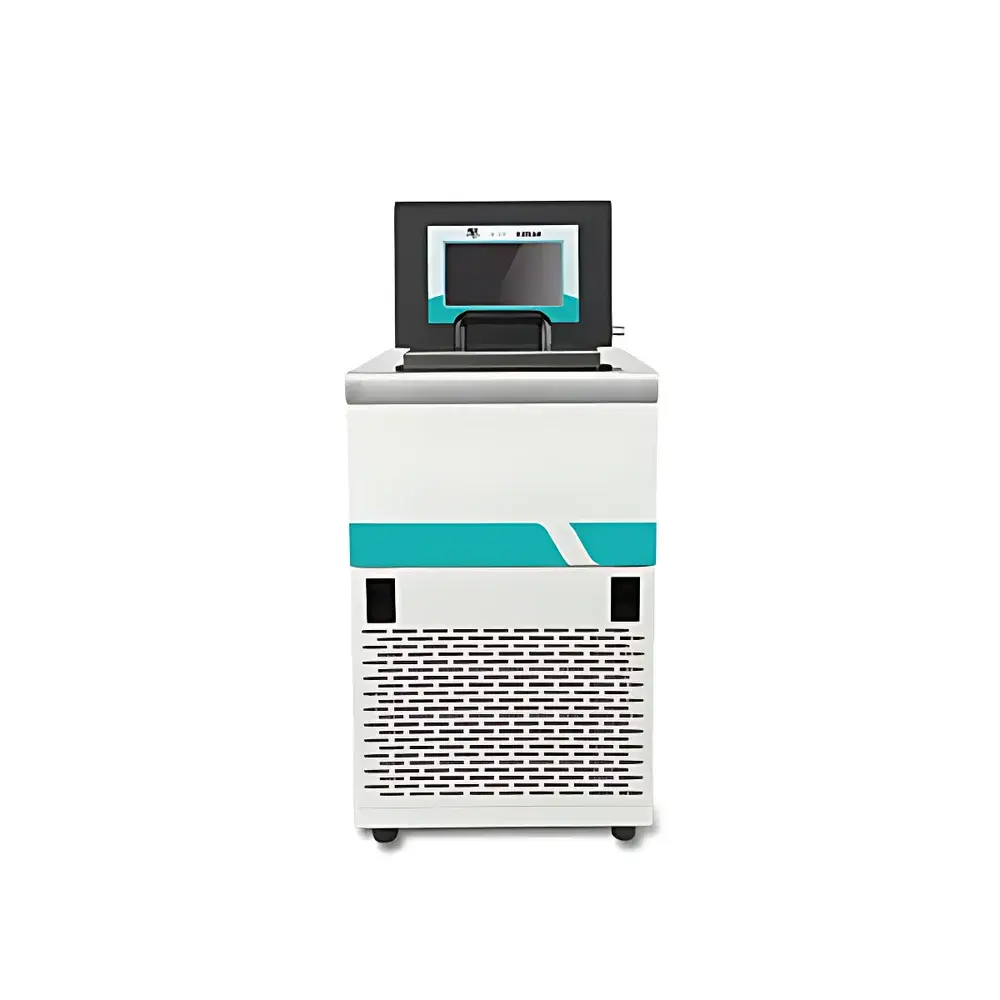
Scientz DC-2015 Low-Temperature Circulating Bath (Heating & Cooling)
| Brand | Scientz |
|---|---|
| Origin | Zhejiang, China |
| Manufacturer Type | Direct Manufacturer |
| Product Category | Domestic |
| Model | DC-2015 |
| Instrument Type | Constant-Temperature Bath |
| Circulation Mode | Internal & External Circulation |
| Temperature Control | Dual-mode (Heating & Refrigeration) |
| Bath Dimensions (L×W×H) | 300 × 250 × 200 mm |
| Temperature Range | −20 °C to +100 °C |
| Temperature Stability | ±0.05 °C |
| Display | 7-inch Tilted Touchscreen |
| Compressor | Secop (Germany) Hermetic Scroll Compressor |
| Refrigerant | R-134a (ODP = 0, GWP = 1430) |
| Safety Features | Compressor Overheat & Overload Protection, Auto-Restart After Power Recovery, Timed Shutdown |
| Pump Flow Rate | Adjustable (0–20 L/min), Max. Head: 6 m |
| External Load Compatibility | Yes (via external circulation port) |
Overview
The Scientz DC-2015 Low-Temperature Circulating Bath is an engineered precision temperature control system designed for laboratory and industrial applications requiring stable, bidirectional thermal regulation of liquid media. Utilizing a closed-loop refrigeration cycle based on the vapor-compression principle—integrated with resistive heating elements—the DC-2015 delivers accurate, repeatable temperature control across a broad operational range from −20 °C to +100 °C. Its core architecture centers on a high-efficiency Secop (Germany) hermetic scroll compressor, paired with environmentally compliant R-134a refrigerant (zero ozone depletion potential), ensuring low acoustic emission (<52 dB(A)) and long-term reliability under continuous operation. The bath’s stainless-steel tank (300 × 250 × 200 mm internal volume) supports both internal immersion and external circulation modes, enabling direct thermal coupling to auxiliary equipment such as rotary evaporator condensers, ultrasonic probe systems, jacketed reactors, or semiconductor test fixtures. PID-based microprocessor control—implemented via a dedicated embedded controller—not only maintains temperature stability within ±0.05 °C but also enables programmable ramp/soak profiles, real-time deviation monitoring, and event-triggered actions including automatic shutdown upon completion of user-defined time intervals.
Key Features
- High-stability dual-mode thermal regulation: simultaneous heating and refrigeration with independent power modulation for minimal overshoot and rapid equilibration.
- 7-inch tilted capacitive touchscreen interface with intuitive icon-driven navigation; displays real-time bath temperature, setpoint, elapsed time, pump status, and alarm history.
- Adjustable external circulation pump (0–20 L/min flow rate, max. head 6 m) with pressure-balanced outlet for consistent delivery to external loads—even at elevated backpressure conditions.
- Intelligent power recovery logic: retains all user settings—including setpoint, timer, and circulation mode—after mains interruption; configurable auto-restart or standby-on-power-up behavior.
- Comprehensive safety architecture: compressor thermal cutoff, current-sensing overload protection, dry-run detection, and overtemperature lockout compliant with IEC 61010-1:2010 Class II requirements.
- Low-noise operation enabled by vibration-isolated mounting, optimized refrigerant circuit design, and acoustically damped compressor housing.
Sample Compatibility & Compliance
The DC-2015 accommodates aqueous solutions, silicone oils (up to 100 cSt), ethylene glycol/water mixtures, and other non-corrosive heat-transfer fluids compatible with 304 stainless steel and EPDM seals. It is routinely deployed in environments governed by GLP and ISO/IEC 17025 frameworks, supporting temperature validation protocols per ASTM E2251 (Standard Practice for Calibration of Liquid-in-Glass Thermometers) and ISO 17034 (Reference Material Producers). While not certified for medical device manufacturing under FDA 21 CFR Part 11, its audit-trail-capable logging function (timestamped temperature records stored internally for ≥30 days) meets baseline data integrity expectations for QC laboratories performing method qualification or equipment verification per USP .
Software & Data Management
The DC-2015 operates autonomously without PC dependency; however, optional RS485 (Modbus RTU) or USB-to-serial interfaces enable integration into centralized lab management systems. Logged data—including temperature readings at 1-second intervals, pump runtime, and fault codes—can be exported in CSV format via USB flash drive. Firmware updates are performed offline using signed binary packages verified via SHA-256 checksums. No cloud connectivity or remote access capabilities are implemented, preserving network security boundaries required in regulated research facilities.
Applications
- Condenser cooling for rotary evaporation systems, maintaining optimal solvent recovery efficiency across volatile compound libraries.
- Temperature stabilization of non-contact ultrasonic homogenizers during cell lysis or nanoparticle dispersion, preventing thermal denaturation of sensitive biomolecules.
- Controlled exothermic/endothermic reaction profiling in jacketed glass reactors, where precise thermal inertia compensation ensures stoichiometric fidelity.
- Calibration of thermocouples, RTDs, and infrared pyrometers against NIST-traceable reference standards in metrology labs.
- Thermal stress testing of electronic components and PCB assemblies under defined thermal cycling regimes (−20 °C ↔ +85 °C).
- Cell culture incubation support, particularly for cryopreservation workflows requiring stepwise thawing or controlled-rate freezing pre-conditioning.
FAQ
What is the maximum recommended viscosity for external circulation?
The pump is rated for fluids up to 100 cSt at 25 °C; higher viscosities require reduced flow rates and may impact temperature uniformity.
Can the DC-2015 maintain temperature stability during extended external load operation?
Yes—when properly sized for thermal load (≤1.2 kW cooling capacity), it sustains ±0.05 °C stability even with continuous external circulation at 15 L/min.
Is the unit suitable for use with flammable solvents?
No—it is not explosion-proof; operation with flammable liquids requires additional engineering controls per NFPA 45 and local hazardous area classification.
Does the device support external PT100 probe input for chamber temperature feedback?
No—temperature sensing is internal only, using a calibrated Pt100 sensor immersed directly in the bath fluid.
What maintenance intervals are recommended for optimal performance?
Compressor oil inspection every 24 months; refrigerant leak check annually; bath fluid replacement every 6–12 months depending on usage frequency and contamination risk.



