
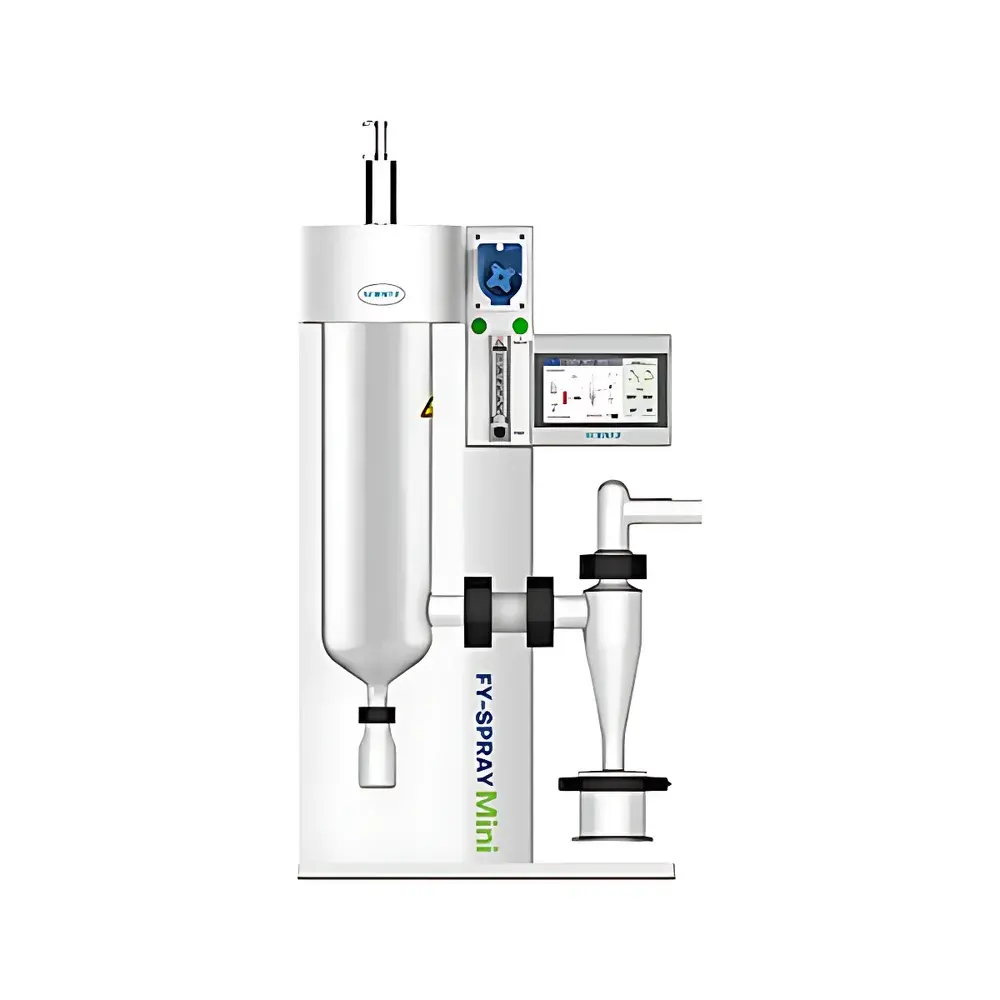
Scientz FY-SPRAY Mini Benchtop Spray Dryer
| Brand | Scientz |
|---|---|
| Origin | Zhejiang, China |
| Manufacturer Type | Direct Manufacturer |
| Country of Origin | China |
| Model | FY-SPRAY Mini |
| Sample Throughput | 1800 mL/h (water) |
| Maximum Feed Rate | 0–72 mL/min |
| Inlet Temperature Range | 30–250 °C ±1 °C |
| Nozzle Orifice Diameter | 0.7 mm (standard dual-fluid atomizer) |
Overview
The Scientz FY-SPRAY Mini is a compact, benchtop-scale spray dryer engineered for precision drying of heat-sensitive and high-value liquid feedstocks in research and development laboratories. It operates on the principle of concurrent-flow spray drying: liquid samples are atomized into fine droplets via a dual-fluid (air-assisted) nozzle, then rapidly dried by controlled hot air in a borosilicate glass drying chamber. This process enables continuous conversion of solutions, suspensions, or emulsions into free-flowing, spherical micro-powders within seconds—preserving thermal labiles, minimizing degradation, and delivering high batch-to-batch reproducibility. Designed specifically for R&D workflows in pharmaceuticals, functional foods, nanomaterials, and specialty chemicals, the FY-SPRAY Mini bridges the gap between analytical-scale lyophilization and pilot-scale production systems.
Key Features
- Benchtop footprint (W × D × H ≈ 450 × 400 × 650 mm) with integrated air compressor and exhaust filtration—no external utilities required.
- High-temperature-resistant borosilicate glass drying tower (max. operating temp. 250 °C), coupled with AISI 316L stainless steel collection components for corrosion resistance and cleanability.
- Precision dual-fluid atomizer with standardized 0.7 mm orifice—enabling consistent droplet size distribution and scalable process parameters toward larger spray dryers.
- Intuitive touchscreen interface with programmable temperature ramps, feed rate control, and real-time monitoring of inlet/outlet temperatures and airflow.
- Multi-stage sealing architecture—including O-ring gaskets, labyrinth seals, and vacuum-tight cyclone collection—to minimize powder leakage and ensure operator safety and environmental compliance.
- Four-layer automotive-grade enamel coating on housing for chemical resistance, scratch durability, and long-term aesthetic integrity in shared lab environments.
Sample Compatibility & Compliance
The FY-SPRAY Mini accommodates aqueous and organic solvent-based feeds (e.g., ethanol, acetone, ethyl acetate) with viscosities up to 200 cP. It supports formulation development of amorphous solid dispersions (ASDs), nanostructured silica, protein-loaded microparticles, herbal extracts, and functional food ingredients. The system complies with general laboratory safety standards (IEC 61010-1) and is compatible with GLP documentation practices. While not certified for GMP manufacturing, its design facilitates audit-ready operation: all critical process parameters (inlet temp., feed rate, outlet temp.) are logged with timestamps; data export supports CSV format for traceability. Optional integration with LIMS or ELN platforms is available via RS-232/USB serial output.
Software & Data Management
The embedded controller records time-synchronized datasets at 1-second intervals—including inlet temperature, outlet temperature, feed pump speed (mL/min), and air flow rate (m³/h). Historical runs are stored onboard (≥1000 sessions) with user-defined naming and password-protected access. Exported logs include metadata (date, operator ID, method name) and support statistical analysis in MATLAB, JMP, or Python pandas. For regulated environments, optional firmware upgrade enables 21 CFR Part 11-compliant electronic signatures, audit trails, and role-based user permissions—fully aligned with FDA expectations for analytical instrument qualification (IQ/OQ/PQ).
Applications
- Pharmaceutical R&D: Production of amorphous solid dispersions (e.g., deucravacitinib HCl with HPMCAS) to enhance solubility, dissolution rate, and oral bioavailability—validated in clinical-stage formulations achieving >99% absolute bioavailability.
- Inorganic Nanomaterials: Controlled drying of precipitated silica (white carbon black) to yield non-agglomerated, high-surface-area particles (BET ≥180 m²/g) meeting ASTM D1799 and ISO 5725 specifications for rubber reinforcement.
- Natural Product Stabilization: Encapsulation of thermolabile phytochemicals (e.g., curcumin, anthocyanins) using maltodextrin or gum arabic carriers—retaining >92% antioxidant activity post-drying.
- Functional Food Powders: Conversion of probiotic suspensions, enzyme solutions, or omega-3 emulsions into stable, re-dispersible powders suitable for capsule filling or beverage fortification.
- Materials Science: Synthesis of metal oxide precursors (e.g., LiFePO₄, TiO₂) from aqueous sol-gel feeds—yielding submicron, phase-pure powders for battery cathode or photocatalytic applications.
FAQ
What is the minimum sample volume required for a valid run?
Typical method development starts at 30–50 mL total feed volume; however, the system achieves stable atomization and thermal equilibrium from ~15 mL with optimized nozzle and airflow settings.
Can organic solvents be processed safely?
Yes—when used with optional explosion-proof accessories (ATEX-rated air compressor, inert gas purge kit), the FY-SPRAY Mini supports Class I, Division 1 solvent handling per NFPA 30 and IEC 60079 guidelines.
Is the drying chamber interchangeable with larger Scientz models?
No—the FY-SPRAY Mini uses a proprietary 120 mm ID borosilicate tower; however, atomization parameters (e.g., air-to-liquid ratio, pressure drop) are directly transferable to Scientz’s FY-SPRAY Pro series for seamless scale-up.
How is particle morphology controlled?
Morphology is governed by feed solids content, inlet temperature, and atomization energy—users routinely achieve hollow spheres, dense granules, or wrinkled microcapsules by tuning these three variables within validated ranges.
Does the system support automated cleaning-in-place (CIP)?
Not natively; however, the fully disassemblable glass tower, 316L cyclone, and quick-release nozzle enable manual CIP in <15 minutes using ultrasonic bath + 0.1 M NaOH rinse—validated per USP for analytical equipment.



