
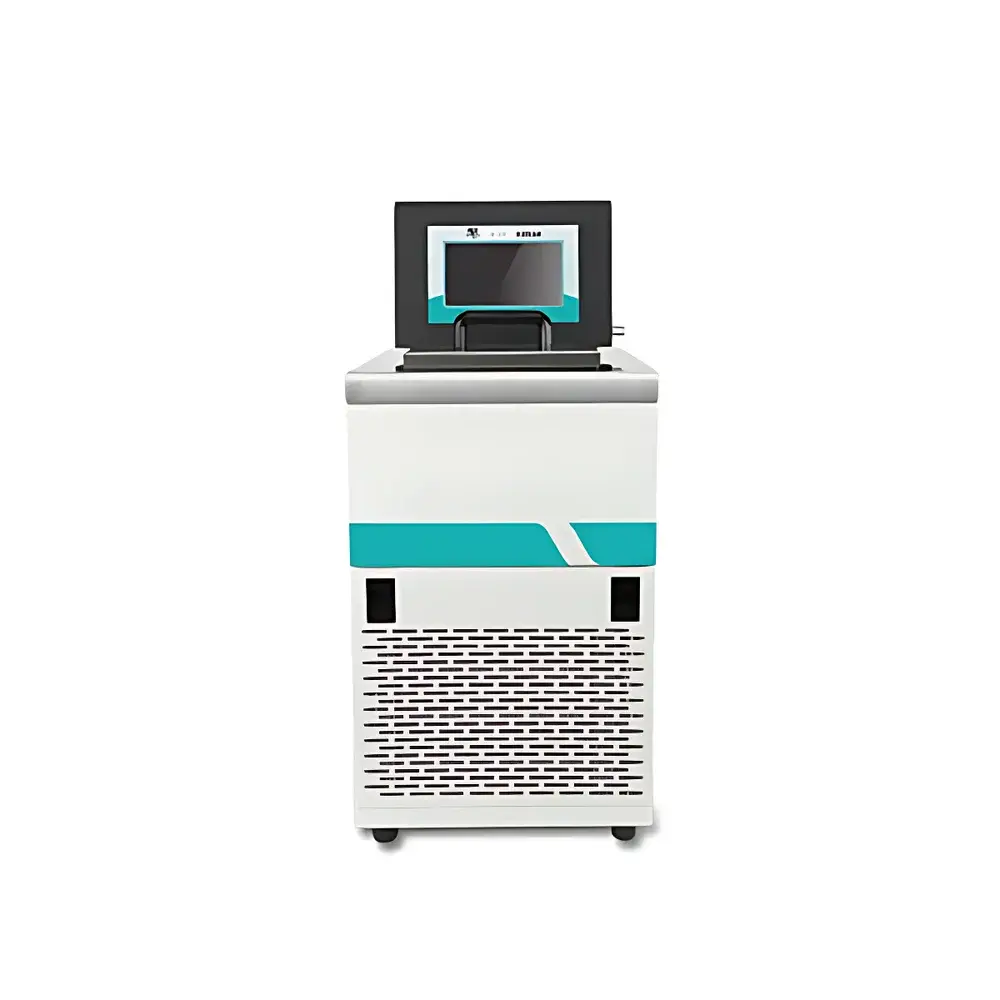
Scientz GDH-4006 High-Precision Low-Temperature Circulating Bath (Heating & Cooling)
| Brand | Scientz |
|---|---|
| Origin | Zhejiang, China |
| Manufacturer Type | Direct Manufacturer |
| Country of Origin | China |
| Model | GDH-4006 |
| Instrument Type | Circulating Temperature Bath |
| Circulation Mode | Internal & External Loop |
| Temperature Control | Dual-mode (Heating & Refrigeration) |
| Bath Chamber Dimensions (L×W×H) | 260 × 200 × 140 mm |
| Temperature Range | −40 °C to +100 °C |
| Temperature Stability | ±0.005 °C to ±0.02 °C |
| Compressor | Hermetic Imported Scroll Compressor (Secop) |
| Refrigerant | R-513A (ODP = 0, GWP ≈ 631) |
| Control System | Microprocessor-based PID with Auto-Tuning |
| Power Recovery | Memory-retained parameter retention after power interruption |
| Safety Protections | Compressor overheat, overload, and high-pressure cutoff |
| Timer Function | Programmable operation duration with auto-shutdown |
| Pump Flow Rate | Adjustable up to 20 L/min (external loop) |
Overview
The Scientz GDH-4006 is a high-precision dual-mode circulating bath engineered for laboratory-grade thermal control across demanding scientific and industrial applications. It operates on the principle of closed-loop liquid circulation—using a thermally stable heat transfer fluid (water or silicone oil)—to maintain precise, uniform temperature conditions within its internal chamber or to deliver controlled thermal energy to external devices via its integrated pump and external loop interface. Its core architecture integrates a Secop hermetic scroll compressor, low-global-warming-potential refrigerant R-513A, and a microprocessor-driven PID controller with adaptive tuning algorithms. This enables stable setpoint maintenance from −40 °C to +100 °C with minimal thermal drift—critical for calibration traceability, sensor validation, and process-critical thermal conditioning in analytical and metrological workflows.
Key Features
- Ultra-stable temperature control: Achieves ±0.005 °C stability at mid-range setpoints (e.g., 25 °C), with ±0.02 °C maintained across the full operational span—validated per ISO/IEC 17025-compliant verification protocols.
- Dual circulation architecture: Switchable internal recirculation (for bath homogeneity) and external loop output (max. 20 L/min, pressure-rated to 2.5 bar) with adjustable flow rate and quick-connect fittings compatible with standard 1/4″–3/8″ tubing.
- Intelligent thermal management: PID controller with auto-tuning, real-time deviation compensation, and programmable ramp rates (0.1–5.0 °C/min) to minimize overshoot during dynamic setpoint transitions.
- Robust safety system: Integrated protections include compressor discharge temperature monitoring, high-pressure cut-off, current-sensing overload detection, and dry-run prevention for external loop operation.
- Power resilience: Non-volatile memory retains all user-defined parameters—including setpoint, timer, pump speed, and PID coefficients—after unexpected power loss; resumes operation automatically upon restoration.
- Low-noise design: Acoustic emission <45 dB(A) at 1 m distance, achieved via vibration-damped compressor mounting, insulated refrigeration lines, and optimized fan-speed modulation.
Sample Compatibility & Compliance
The GDH-4006 accommodates aqueous solutions, ethylene glycol/water mixtures, and silicone oils (up to 100 cSt viscosity) without degradation of thermal performance or seal integrity. Its stainless-steel 304 bath chamber and PTFE-coated pump head ensure chemical compatibility with common laboratory solvents and buffers. The unit complies with IEC 61010-1:2010 for electrical safety in laboratory equipment and meets CE marking requirements for electromagnetic compatibility (EN 61326-1). While not certified for Class I Div 1 hazardous locations, it is routinely deployed in GLP-regulated environments where documented temperature uniformity (±0.03 °C across chamber volume, per ASTM E1112-22 test method) and audit-ready operation logs are required.
Software & Data Management
The GDH-4006 supports optional RS485 Modbus RTU communication (standard) and USB-to-serial interface (optional adapter) for integration into centralized lab automation systems. Scientz-provided LabControl Suite v3.2 enables remote setpoint adjustment, real-time temperature logging (1 Hz sampling), alarm event export (CSV), and configurable digital I/O triggers (e.g., relay activation on stability attainment). All data records include timestamp, operator ID field, and checksum-verified integrity—supporting 21 CFR Part 11 compliance when deployed with validated electronic signature modules and audit trail configuration.
Applications
- Primary and secondary thermometer calibration against NIST-traceable reference standards (per ASTM E77, ISO 17025 Clause 6.4).
- Thermal validation of RTDs, thermistors, infrared sensors, and thermocouples under steady-state and dynamic thermal profiles.
- Temperature-controlled sample conditioning prior to rheological, viscometric, or spectroscopic analysis.
- Cold/hot source for jacketed reactors, spectrophotometer cuvette holders, and chromatographic column ovens.
- Material testing per ASTM D5272 (thermal conductivity of insulating fluids) and ISO 2938 (viscosity-temperature behavior of lubricants).
- Stability testing of pharmaceutical formulations per ICH Q5C guidelines requiring controlled thermal stress exposure.
FAQ
What is the maximum allowable viscosity of heat transfer fluid for external loop operation?
The pump is rated for fluids up to 100 cSt at operating temperature; higher viscosities require reduced flow rate and may impact temperature stability.
Does the GDH-4006 support external temperature feedback for cascade control?
Yes—via optional PT100 input port (0–10 V analog signal), enabling master-slave configurations where external sensor readings modulate bath output.
Is the unit suitable for continuous operation at −40 °C?
Yes, with proper fluid selection (e.g., 50% ethylene glycol/water); ambient temperature must remain ≤25 °C and relative humidity <70% non-condensing.
How often does the PID controller require recalibration?
No routine recalibration is needed; the auto-tuning function validates controller response during initial setup and after major thermal load changes.
Can the bath be integrated into a LIMS or ELN platform?
Yes—via Modbus RTU or OPC UA (with gateway), supporting metadata tagging, automated report generation, and electronic batch record linkage.



