
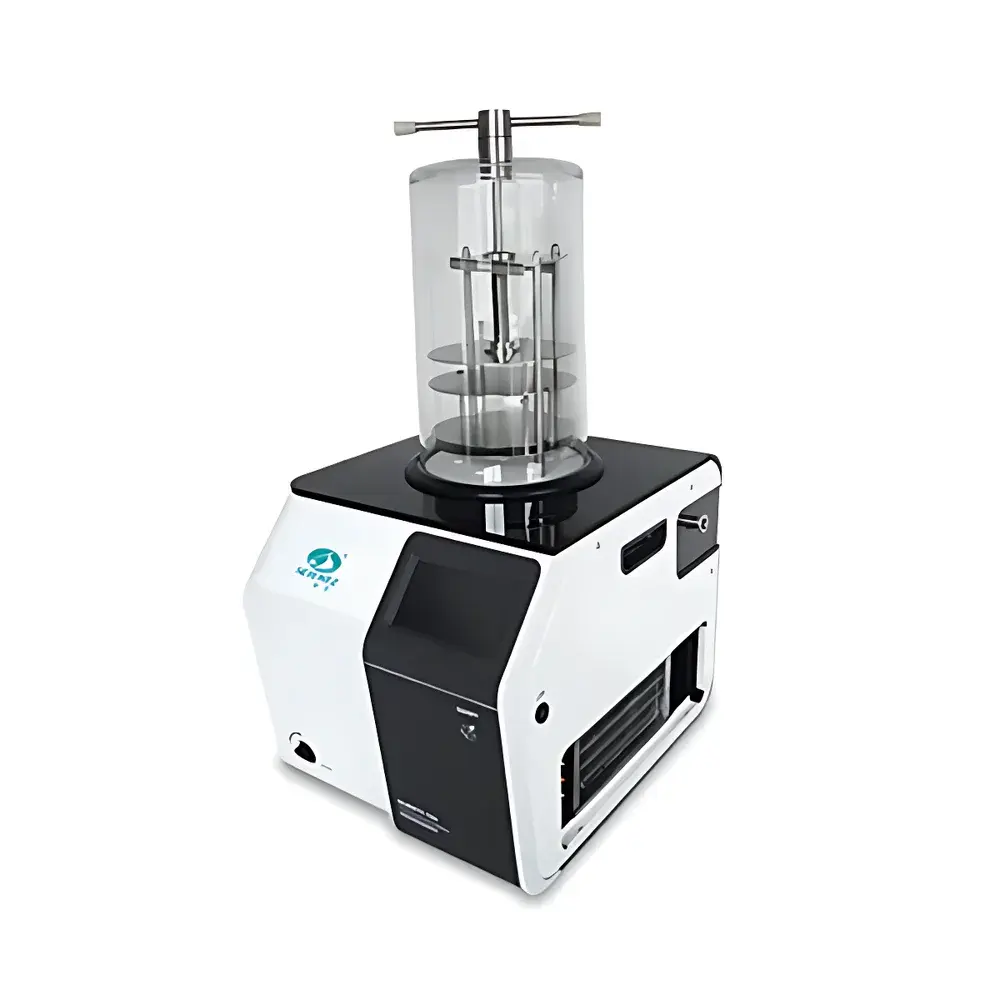
Scientz SCIENTZ-10N/B Stoppering Bell-Jar Freeze Dryer
| Brand | Scientz |
|---|---|
| Origin | Zhejiang, China |
| Manufacturer Type | Direct Manufacturer |
| Instrument Type | Stoppering (Hydraulic or Manual Press-on Lid) Bell-Jar Freeze Dryer |
| Application Scope | Laboratory-Scale Lyophilization |
| Shelf Area | 0.08 m² |
| Ultimate Vacuum | ≤5 Pa |
| Condensate Capacity (24 h) | 3 kg/batch |
| Cold Trap Temperature | ≤−56 °C (optional −80 °C with cascade refrigeration) |
| Dimensions (L×W×H) | 590 × 460 × 450 mm + 440 mm (bell jar height) |
Overview
The Scientz SCIENTZ-10N/B Stoppering Bell-Jar Freeze Dryer is an engineered solution for laboratory-scale lyophilization of heat-sensitive biological, pharmaceutical, and material science samples. It operates on the principle of sublimation under controlled low-pressure and cryogenic conditions: frozen water in the sample transitions directly from solid to vapor without passing through the liquid phase—preserving structural integrity, bioactivity, and chemical stability. Designed for precision batch processing, the system integrates a high-efficiency cold trap, intelligent vacuum management, and a transparent polycarbonate bell-jar chamber enabling real-time visual monitoring of ice sublimation and cake formation. Its compact footprint (590 × 460 × 450 mm base + 440 mm bell height) meets space-constrained lab environments while maintaining ≥0.08 m² effective drying area and 3 kg/batch condensate capacity—ideal for R&D workflows requiring reproducible small-batch lyophilization of vaccines, proteins, nucleic acids, plant tissues, nanomaterials, and food matrices.
Key Features
- Stoppering-capable bell-jar configuration with manual or optional hydraulic lid press mechanism for sterile vial sealing post-drying
- Imported high-reliability compressor with dual-stage or cascade refrigeration architecture (standard ≤−56 °C; optional −80 °C cold trap)
- 7-inch true-color TFT touchscreen interface with industrial-grade embedded OS—supporting multi-step program editing, real-time parameter overlay (cold trap temp, chamber pressure, shelf temp), and >10,000-cycle data logging
- Optically clear, one-piece injection-molded polycarbonate drying chamber—chemically inert, impact-resistant, and fully sealable with integrated inert gas inlet valve (N₂ or Ar compatible)
- Intelligent vacuum control logic: vacuum pump activation delayed until cold trap reaches setpoint temperature, extending pump service life and minimizing oil backstreaming
- Configurable safety protocols including ambient temperature over-limit alarm, vacuum leak detection, and automatic shutdown on critical fault
Sample Compatibility & Compliance
The SCIENTZ-10N/B accommodates diverse sample formats—including open petri dishes, scintillation vials, serum bottles, and standard 13–22 mm OD lyophilization vials—via its wide-mouth manifold (8-port standard). It supports lyophilization of aqueous, buffer-based, and low-viscosity formulations common in biopharmaceutical development (e.g., monoclonal antibodies, recombinant enzymes, viral vectors), as well as botanical extracts, microbial cultures, soil suspensions, and nanoparticle colloids. The system’s operational parameters align with core lyophilization validation frameworks: vacuum stability meets ASTM F2476-20 requirements for residual moisture assessment; cold trap performance enables compliance with USP lyophilization process controls; and data integrity features—including timestamped audit trails, user-access levels, and encrypted USB export—support adherence to FDA 21 CFR Part 11 and GLP/GMP documentation standards when deployed in regulated QC labs.
Software & Data Management
Data acquisition and process traceability are central to the SCIENTZ-10N/B’s architecture. All critical process variables—including cold trap temperature, chamber pressure (via Pirani/capacitance gauge), time-stamped freeze-dry cycle phases, and user-defined setpoints—are logged automatically at configurable intervals (1–60 sec). Historical cycles are stored onboard with ≥1 year retention (expandable via external USB drive). Exported .CSV files are compatible with industry-standard analysis platforms (e.g., MATLAB, Python pandas, JMP) for statistical process control (SPC) and cycle comparison. Optional PC-based upper-computer software provides remote monitoring, curve overlay, deviation alerts, and PDF report generation—including metadata on operator ID, calibration status, and environmental conditions. Firmware updates maintain alignment with evolving ICH Q5C stability guidelines and ISO 20933:2020 lyophilizer qualification protocols.
Applications
This freeze dryer serves cross-disciplinary research and pilot-scale production needs:
- Biopharma: Stabilization of labile therapeutics (mRNA-LNPs, cytokines, live attenuated vaccines) and preparation of reference standards for potency assays
- Agricultural science: Preservation of fungal isolates, seed priming agents, and phytochemical extracts without thermal degradation
- Materials chemistry: Drying of aerogels, MOFs, and catalyst precursors to prevent particle agglomeration and pore collapse
- Environmental analytics: Lyophilization of sediment, sludge, and water filter extracts prior to heavy metal or organic contaminant quantification (EPA Method 1694)
- Food science: Dehydration of probiotic cultures, functional peptides, and volatile aroma compounds while retaining sensory and nutritional profiles
- Academic training: Hands-on instruction in freeze-drying thermodynamics, mass transfer modeling, and formulation optimization per ICH Q5C principles
FAQ
What types of vials are compatible with the SCIENTZ-10N/B’s stoppering function?
Standard 13 mm, 20 mm, and 22 mm OD glass vials with crimp-seal compatibility; custom hydraulic press fixtures available upon request.
Can the system operate unattended overnight?
Yes—equipped with auto-shutdown on cycle completion, power-fail recovery mode (with optional UPS), and continuous vacuum/temperature monitoring with audible/visual alarms.
Is co-manufacturing or OEM integration supported?
Scientz provides full mechanical and electrical interface documentation (CAD models, I/O pinouts, Modbus RTU protocol) for seamless integration into automated lab platforms or GMP cleanroom utilities.
How is calibration verified for regulatory submissions?
Cold trap and chamber sensors are NIST-traceable; annual verification kits and IQ/OQ documentation templates are supplied with purchase.
What maintenance intervals are recommended for the vacuum pump and refrigeration system?
Vacuum pump oil replacement every 500 operating hours; compressor refrigerant charge inspection every 24 months; cold trap cleaning after each 10 batches or visible ice buildup.



