
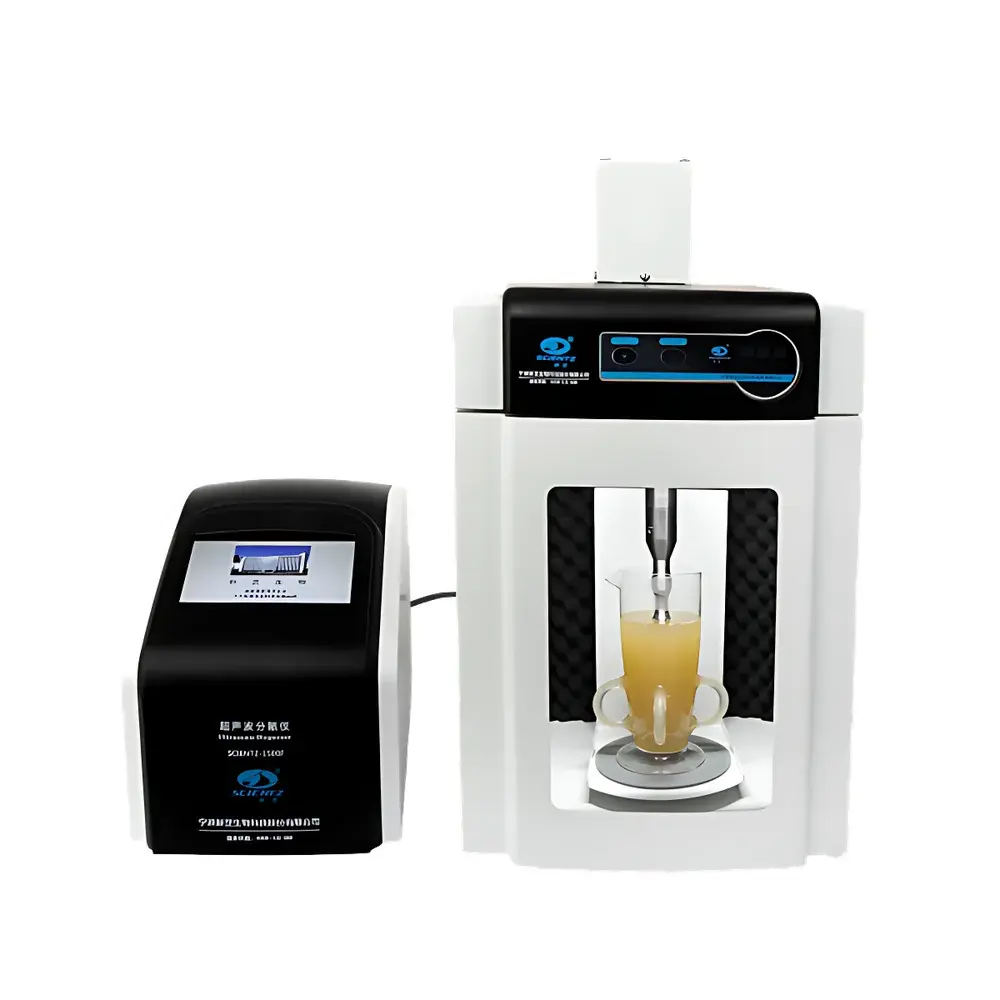
Scientz SCIENTZ-750F Ultrasonic Homogenizer
| Brand | Scientz |
|---|---|
| Origin | Zhejiang, China |
| Manufacturer Type | Direct Manufacturer |
| Product Category | Domestic |
| Model | SCIENTZ-750F |
| Instrument Type | Ultrasonic Probe Homogenizer |
| Dimensions (W×D×H) | 416 × 244 × 300 mm |
| Sample Volume Range | 10–40,000 mL |
Overview
The Scientz SCIENTZ-750F Ultrasonic Homogenizer is an industrial-grade probe-type ultrasonic dispersion system engineered for high-efficiency deagglomeration, emulsification, and cell disruption across research and production laboratories. It operates on the principle of acoustic cavitation: high-frequency mechanical vibrations (20–25 kHz) generated by a piezoelectric transducer are transmitted through a titanium alloy probe (horn), inducing rapid pressure fluctuations in the liquid medium. These fluctuations generate transient microbubbles that collapse violently—releasing localized energy in the form of shockwaves, microstreaming, and shear forces—thereby disrupting particle aggregates, lipid bilayers, or interfacial films. Unlike rotor-stator or high-pressure homogenizers, this system delivers scalable, non-thermal energy input with precise spatial control, making it particularly suitable for heat-sensitive nanomaterials and biological samples.
Key Features
- High-power ultrasonic output with continuous and pulsed operation modes—enabling controlled energy delivery to minimize thermal degradation during extended processing.
- Digitally adjustable amplitude (power) and time parameters, ensuring reproducible process conditions across batch-to-batch operations.
- Titanium alloy probe (standard 20 mm diameter tip) optimized for mechanical durability, corrosion resistance, and efficient acoustic coupling in aqueous and organic media.
- Integrated safety protocols including over-temperature cutoff, overload protection, and real-time timer alarm—compliant with IEC 61000-6-2/6-4 electromagnetic compatibility standards.
- Horn geometry features a proprietary “gourd-shaped” radiating surface, engineered to enhance omnidirectional acoustic wave propagation—improving dispersion uniformity in both axial and radial directions within the vessel.
- Stable frequency tracking circuitry maintains resonant operation under variable load conditions (e.g., viscosity changes, volume shifts), preserving energy transfer efficiency.
Sample Compatibility & Compliance
The SCIENTZ-750F accommodates sample volumes from 10 mL (microscale vials) up to 40 L (using external jacketed reactors with flow-through adapters), supporting glass, stainless steel, and polypropylene vessels. It is routinely employed in applications requiring adherence to ASTM D7854 (nanomaterial dispersion stability testing), ISO 13320 (laser diffraction particle sizing pre-treatment), and USP (liposome size distribution analysis). When operated under documented SOPs—including calibrated power verification, temperature monitoring, and probe immersion depth control—the system supports GLP-compliant data generation. While not FDA-cleared as a medical device, its operational parameters align with 21 CFR Part 11 requirements when integrated with validated LIMS or ELN platforms supporting electronic signatures and audit trails.
Software & Data Management
The SCIENTZ-750F operates via front-panel digital interface with real-time display of elapsed time, set power (% amplitude), and operating frequency. For traceable process documentation, optional RS-232/USB connectivity enables integration with third-party laboratory software (e.g., LabVIEW, MATLAB, or custom Python-based acquisition scripts) for timestamped logging of operational parameters. All user-defined protocols—including pulse-on/pulse-off intervals, ramp profiles, and safety thresholds—are stored locally in non-volatile memory (up to 100 methods). Data export supports CSV format for post-processing in statistical analysis tools (e.g., JMP, Minitab) used in DOE-driven optimization of dispersion processes.
Applications
- Nanomaterial processing: Stable dispersion of carbon nanotubes, graphene oxide, SiO₂, TiO₂, and Fe₃O₄ nanoparticles in aqueous and non-aqueous solvents for ink formulation, coating development, and composite precursor synthesis.
- Pharmaceutical R&D: Preparation of nanoemulsions, liposomal suspensions, and injectable colloidal drug carriers; reduction of particle size in active pharmaceutical ingredient (API) suspensions per ICH Q5A guidelines.
- Food science: Homogenization of dairy emulsions, plant-based protein dispersions, and functional ingredient suspensions—meeting ISO 8587 sensory panel sample preparation criteria.
- Biotechnology: Lysis of bacterial, yeast, and mammalian cells for protein extraction; fragmentation of chromatin in ChIP-seq workflows; and preparation of subcellular organelle fractions.
- Materials chemistry: Exfoliation of layered materials (e.g., MoS₂, BN), dispersion of conductive fillers in polymer matrices, and stabilization of catalytic nanoparticle suspensions for electrode ink fabrication.
FAQ
What is the recommended immersion depth for the probe during operation?
Maintain a minimum immersion depth of 10–15 mm below the liquid surface, with the probe tip positioned centrally and at least 20 mm from vessel walls to ensure uniform cavitation field distribution and prevent acoustic erosion.
Can the SCIENTZ-750F be used with flammable solvents?
Yes—when operated inside certified fume hoods with explosion-proof electrical infrastructure and using cooled jacketed vessels to maintain solvent temperature below flash point; always consult local EHS regulations prior to use.
Is probe replacement required after a certain number of operating hours?
Titanium probes exhibit fatigue-dependent wear; inspect visually for pitting or tip deformation every 200 hours of cumulative operation—replace if tip diameter deviation exceeds ±0.2 mm or if amplitude attenuation exceeds 15% at nominal setting.
Does the system support external temperature feedback control?
No built-in PT100 port, but third-party temperature sensors can be interfaced via analog input modules connected to optional PLC controllers for closed-loop cooling coordination.
How is calibration verified for regulatory submissions?
Power output is validated using calorimetric methods per ASTM E2471; amplitude is confirmed with laser vibrometry against NIST-traceable reference standards—documentation must include uncertainty budgets per ISO/IEC 17025.



