
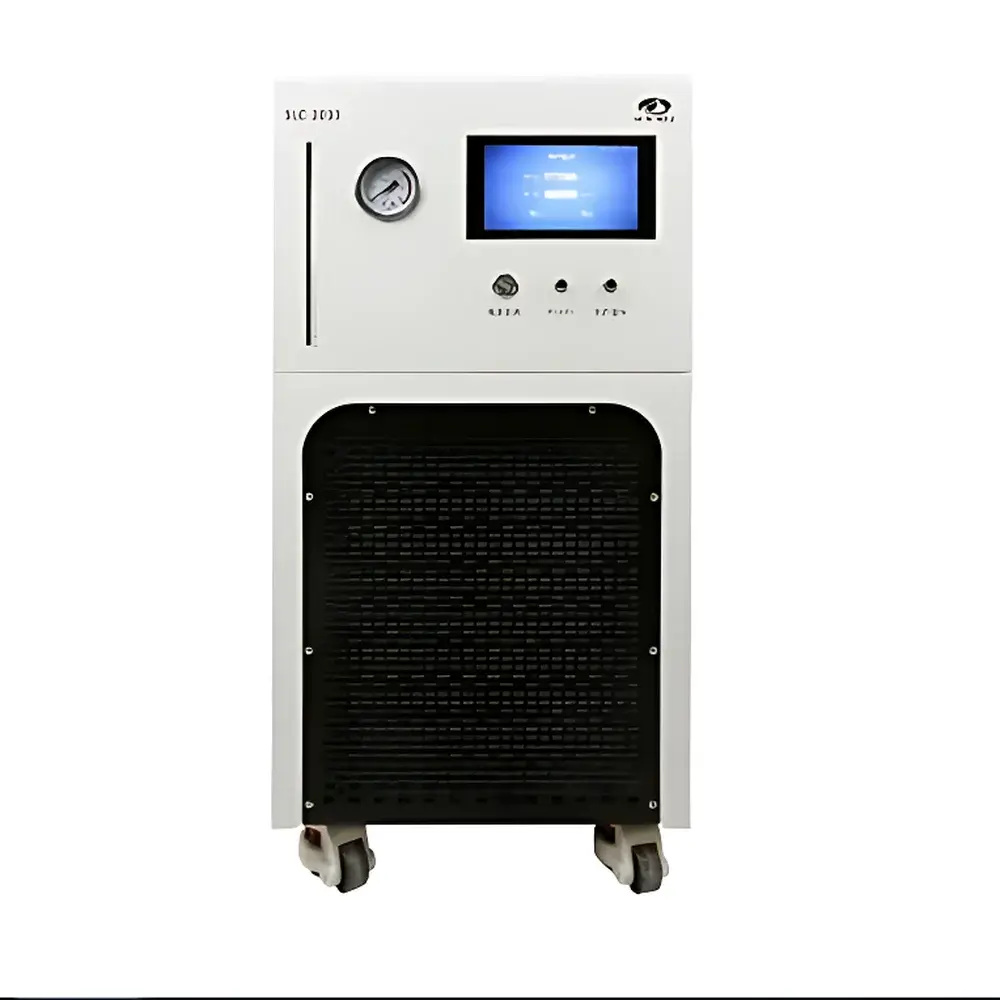
Scientz SLC-2030 Circulating Chiller/Heater
| Brand | Scientz |
|---|---|
| Origin | Zhejiang, China |
| Manufacturer Type | Direct Manufacturer |
| Product Category | Domestic |
| Model | SLC-2030 |
| Instrument Type | Constant-Temperature Bath Circulator |
| Circulation Mode | External Circulation |
| Temperature Control | Refrigeration & Heating Combined |
| Bath Volume | 8–15 L |
| Temperature Range | −25 °C to +45 °C |
| Temperature Stability | ±0.1 °C |
Overview
The Scientz SLC-2030 Circulating Chiller/Heater is an engineered thermal management system designed for precise, bidirectional temperature control of external analytical instruments and process loops. Unlike conventional single-mode chillers, the SLC-2030 integrates refrigeration and resistive heating within a single compact architecture, enabling seamless transition across its full operating range (−25 °C to +45 °C) without manual intervention or auxiliary heaters. Its core thermodynamic design employs a closed-loop vapor-compression refrigeration cycle with electronic expansion valve (EEV) modulation, allowing real-time adaptation of refrigerant mass flow rate in response to dynamic thermal load changes — a critical capability when coupled to instruments with variable heat dissipation profiles, such as ICP-MS plasma sources or TEM cooling stages. The unit operates on a dual-control principle: PID-based bath temperature regulation combined with proportional pump pressure feedback ensures stable setpoint maintenance even under fluctuating flow resistance or ambient conditions.
Key Features
- High-precision temperature stability of ±0.1 °C across the entire operational range, validated per ISO 17025 traceable calibration protocols.
- Stainless steel evaporator and bath reservoir resistant to corrosion from aqueous, organic, and mildly acidic coolant mixtures; compatible with 30% ethylene glycol/water solutions.
- Externally adjustable circulation pressure (0–6 bar) and flow rate (up to 30 L/min), supporting both low-flow microfluidic interfaces and high-demand instrument cooling circuits.
- Maintenance-free condenser assembly utilizing hydrophobic nano-coated fin surfaces to inhibit dust accumulation and sustain long-term heat transfer efficiency.
- Parallel-flow microchannel heat exchanger design enhances thermal exchange surface area per unit volume, reducing overall footprint while maintaining >92% coefficient of performance (COP) at nominal load.
- Low-power operation mode with adaptive EEV control minimizes energy consumption during partial-load conditions, aligning with ISO 50001 energy management principles.
Sample Compatibility & Compliance
The SLC-2030 is intended for use with externally connected laboratory instrumentation requiring stable thermal conditioning of optical paths, detectors, plasma sources, or sample introduction systems. It meets mechanical and electrical safety requirements per IEC 61010-1:2010 (Edition 3.1) for laboratory equipment. Its coolant loop design supports compatibility with ASTM D1384 corrosion testing standards when operated with certified heat-transfer fluids. While not intrinsically rated for hazardous locations, the unit complies with CE marking directives (EMC 2014/30/EU, LVD 2014/35/EU) and conforms to RoHS 2011/65/EU material restrictions. For regulated environments (e.g., GLP/GMP labs), optional audit-trail-enabled firmware supports 21 CFR Part 11–compliant user access logs and parameter change records.
Software & Data Management
The integrated digital controller features a backlit LCD interface with intuitive menu navigation and real-time display of bath temperature, outlet temperature, flow pressure, compressor status, and system fault codes. RS-485 Modbus RTU communication enables integration into centralized lab monitoring platforms (e.g., LabVantage, Thermo Fisher SampleManager). Optional Scientz Link™ PC software provides remote configuration, scheduled setpoint ramping, data logging at configurable intervals (1 s–60 min), and CSV export for post-acquisition analysis. All logged parameters are time-stamped with NTP-synchronized UTC timestamps, ensuring temporal integrity for method validation documentation.
Applications
- Thermal stabilization of nebulizers and spray chambers in ICP-OES and ICP-MS systems to reduce polyatomic interferences and improve signal-to-noise ratio.
- Cooling of CCD/CMOS detectors in atomic absorption spectrometers (AAS) and scanning electron microscopes (SEM) to suppress dark current and enhance spectral resolution.
- Temperature-controlled condensation in Kjeldahl digestion modules to ensure consistent reflux rates and nitrogen recovery accuracy.
- Active thermal management of laser sources and interferometric optical benches in FTIR and Raman spectrometers.
- Process cooling of high-voltage power supplies and vacuum pumps in transmission electron microscopy (TEM) facilities.
FAQ
What coolant types are compatible with the SLC-2030?
Deionized water, 30% ethylene glycol/water mixtures, and commercially formulated heat-transfer fluids meeting ASTM D3306 specifications are approved. Avoid chlorinated solvents or glycerol-based solutions due to viscosity and degradation risks.
Does the unit support external temperature feedback control?
Yes — via optional PT100 input port, enabling cascade control where the SLC-2030 regulates based on sensor readings placed directly at the instrument’s critical component (e.g., plasma torch jacket).
Is the bath volume adjustable or fixed?
The internal reservoir volume is fixed at 12 L nominal (range 8–15 L depending on fill level and expansion margin); external expansion tanks may be added for larger loop volumes.
How is temperature stability maintained during rapid load changes?
Through coordinated action of the EEV, dual-stage PID algorithm, and pressure-compensated circulation pump — minimizing thermal lag and overshoot during transient events such as plasma ignition or laser pulsing.
Can the SLC-2030 be integrated into a building management system (BMS)?
Yes — via Modbus TCP gateway (sold separately) or analog 4–20 mA output for temperature and fault status signals, compliant with BACnet MS/TP and LonWorks interoperability frameworks.



