
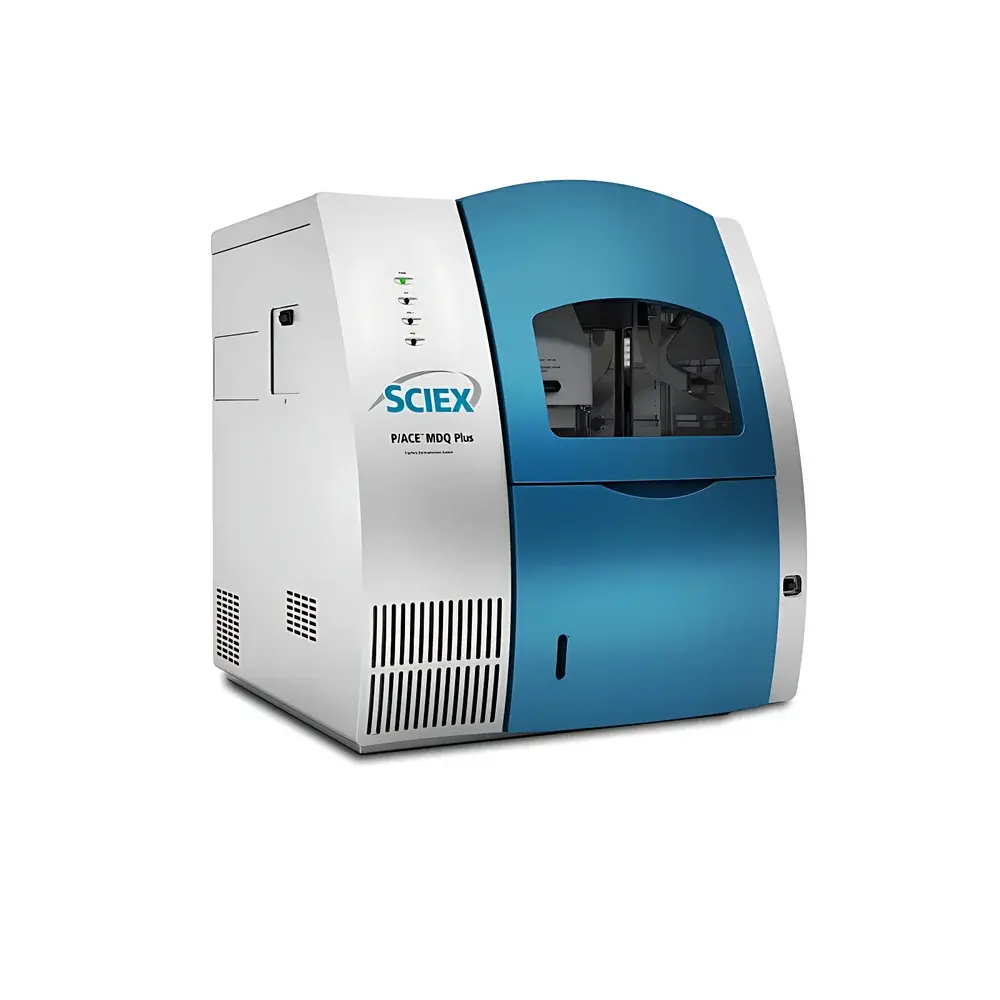
SCIEX P/ACE™ MDQ Plus Capillary Electrophoresis System
| Brand | SCIEX |
|---|---|
| Origin | USA |
| Model | P/ACE™ MDQ Plus |
| Instrument Type | Capillary Electrophoresis (CE) |
| Sample Type | Organic Analysis |
| Cooling Method | Liquid Cooling |
| Detectors | UV, Laser-Induced Fluorescence (LIF), Diode Array Detector (DAD) |
| Injection Mode | Electrokinetic |
| Pressure Range | 5–100 psi |
| Temperature Control | Liquid-Cooled Capillary Thermostat |
| Vendor Type | Authorized Distributor |
| Import Status | Imported |
Overview
The SCIEX P/ACE™ MDQ Plus Capillary Electrophoresis System is a fully automated, programmable platform engineered for high-resolution separation and quantitative analysis of charged and polar analytes—including small molecules, peptides, proteins, nucleic acids, and chiral compounds. Based on the fundamental principle of capillary electrophoresis—where analytes migrate under an applied electric field through a fused-silica capillary filled with electrolyte buffer—the system achieves rapid, efficient separations driven by differences in charge-to-size ratio. Its design emphasizes method robustness, thermal stability, and operational reproducibility, making it suitable for regulated environments such as pharmaceutical QC laboratories, academic proteomics facilities, and contract research organizations conducting method development per ICH Q5A, Q5B, and USP . The integrated liquid-cooled capillary thermostat enables stable operation at elevated field strengths and with high-conductivity buffers—critical for resolving complex biological matrices without Joule heating-induced band broadening.
Key Features
- Modular, field-replaceable detector cartridges supporting UV absorbance (190–400 nm), laser-induced fluorescence (LIF) with 488 nm excitation, and diode array detection (DAD) for spectral confirmation.
- Patented closed-loop liquid cooling system maintaining capillary temperature within ±0.1 °C across 15–60 °C operating range—enabling use of wide-bore capillaries (up to 100 µm ID) and high-ionic-strength buffers.
- Integrated semiconductor-based sample tray thermostat (4–40 °C) for precise control of injection vial temperature during autosampling.
- Programmable electrokinetic and pressure-assisted injection modes, with volume selection from 0.1 nL to 100 nL via standard vials, microvials, or 96-well plate formats.
- Onboard high-pressure gas source (N₂ or air) delivering stable, pulse-free pressure/vacuum (5–100 psi) for reproducible hydrodynamic injection and capillary flushing.
- 36-position buffer reservoir carousel with independent level sensing and automatic buffer replenishment logic to minimize downtime during unattended runs.
- Full method scripting capability—including voltage ramping, polarity switching, dynamic current monitoring, and real-time conductivity feedback—via SCIEX’s P/ACE™ 32 Karat™ Software.
Sample Compatibility & Compliance
The P/ACE™ MDQ Plus accommodates diverse organic and biomolecular samples: acidic/basic small molecules, oligonucleotides, monoclonal antibody fragments (e.g., Fc/ Fab), glycoprotein isoforms, and enantiomeric pairs resolved via chiral selectors (e.g., cyclodextrins, sulfated polysaccharides). It supports CE-SDS, CZE, MEKC, CGE, and cIEF applications compliant with ASTM D7221 (electrophoretic purity), ISO 13844 (capillary electrophoresis performance verification), and FDA 21 CFR Part 11 requirements when deployed with audit-trail-enabled software configurations. All hardware modules meet IEC 61010-1 safety standards for laboratory electrical equipment.
Software & Data Management
Controlled exclusively through SCIEX’s validated P/ACE™ 32 Karat™ Software (v10.4 or later), the system provides full GLP/GMP-aligned data acquisition, processing, and reporting. Features include electronic signatures, role-based user access control, secure audit trails with immutable timestamps, and raw data export in ASTM E1381-compliant .cdf format. Integration with LIMS platforms (e.g., LabVantage, Thermo Fisher SampleManager) is supported via OPC UA and HL7 interfaces. Batch processing, peak purity assessment using spectral deconvolution (DAD mode), and automated system suitability testing (SST) templates are embedded for routine compliance workflows.
Applications
- Pharmaceutical impurity profiling and stability-indicating assays per ICH Q1–Q5 guidelines.
- Charge variant analysis of therapeutic proteins and ADCs using cIEF and CE-SDS.
- High-throughput genotyping and SNP screening via fragment analysis in CE-LIF mode.
- Metabolite identification in biofluids (urine, plasma) following LC-CE hyphenation workflows.
- Quality control of heparin and low-molecular-weight heparins (LMWHs) per USP .
- Chiral purity assessment of synthetic intermediates in asymmetric synthesis R&D.
FAQ
Does the P/ACE™ MDQ Plus support method transfer from older P/ACE™ systems?
Yes—backward compatibility with legacy P/ACE™ MDQ and MDQ+ methods is maintained through firmware-level protocol emulation and identical capillary cartridge geometry.
Can the system be operated under 21 CFR Part 11-compliant conditions?
Yes, when configured with P/ACE™ 32 Karat™ Software v10.4+ in “validated mode”, including electronic signatures, audit trail logging, and data integrity controls.
What maintenance intervals are recommended for the liquid cooling system?
Coolant replacement is required every 12 months; capillary cartridge cleaning and detector lamp calibration are scheduled every 2000 hours or per SST failure.
Is remote monitoring supported?
Yes—via Ethernet-connected instrument status dashboard and SNMP-based alerts for pressure, temperature, and current deviations.
How is capillary lifetime extended in high-salt applications?
The liquid-cooled thermostat minimizes localized thermal degradation, while programmable rinse cycles and pressure-assisted buffer exchange reduce salt crystallization at the capillary inlet.




