
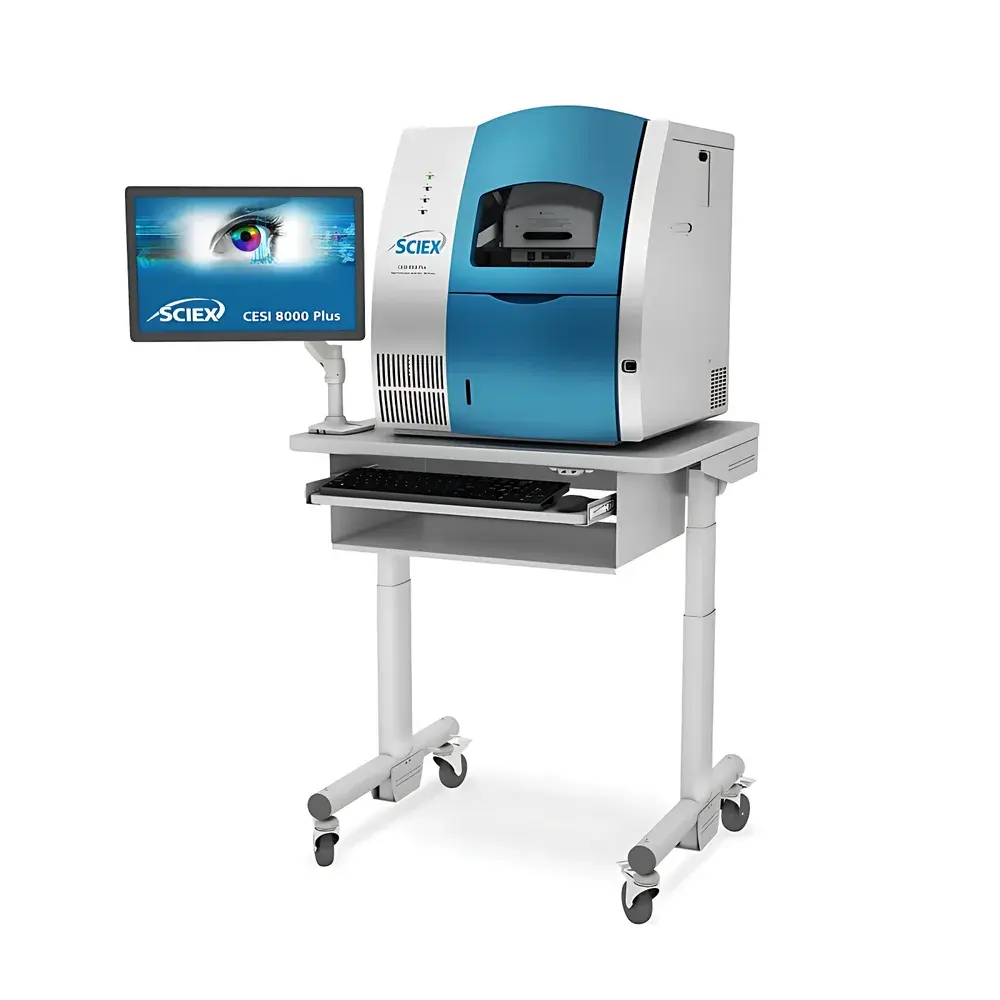
SCIEX CESI 8000 High-Performance Capillary Electrophoresis–Electrospray Ionization (CE-ESI) Interface System
| Brand | SCIEX |
|---|---|
| Origin | USA |
| Model | CESI 8000 |
| Instrument Type | Capillary Electrophoresis (CE) System |
| Sample Type | Organic Analysis |
| Detector Options | UV and Laser-Induced Fluorescence (LIF) |
| Operating Mode | Current-Controlled |
| Injection Method | Electrokinetic |
| Pressure Range | 5–100 psi |
| Cooling System | Liquid-Cooled Temperature Control |
Overview
The SCIEX CESI 8000 is a purpose-engineered capillary electrophoresis–electrospray ionization (CE-ESI) interface system designed to maximize analytical sensitivity and reproducibility for charged and highly polar analytes in mass spectrometry workflows. Unlike conventional LC-MS interfaces, the CESI 8000 integrates high-efficiency capillary electrophoretic separation with on-capillary nanoflow ESI ionization—eliminating post-separation dilution, dead volume, and inter-analyte carryover. Its core architecture leverages free-solution CE in fused-silica capillaries without stationary phases, enabling unbiased resolution of peptides across a broad molecular weight range—including small metabolites and large, labile post-translational modification (PTM)-bearing proteins. The system operates at stable sub-100 nL/min flow rates, delivering optimal desolvation efficiency and ion transmission to the mass spectrometer while minimizing matrix-induced ion suppression—a critical limitation in complex biological matrices such as plasma, cell lysates, and tissue digests.
Key Features
- Integrated CE-ESI interface with monolithic spray tip aligned coaxially to the capillary outlet—zero dead volume, no alignment drift, and full preservation of CE resolution
- Current-controlled electrophoretic separation with programmable voltage ramping and polarity switching for enhanced peak capacity and method robustness
- OptiMS cartridge-based platform: pre-assembled, factory-calibrated CE capillaries with integrated ESI emitters—enabling rapid system reconfiguration and reduced method development time
- Liquid-cooled thermal management system maintaining capillary temperature stability within ±0.1 °C—critical for reproducible migration times and electrophoretic mobility calibration
- Modular benchtop design with motorized height adjustment, facilitating seamless transition between LC-MS and CE-MS configurations on shared MS platforms
- Pressure-assisted injection and flushing (5–100 psi) for precise sample loading and capillary conditioning without compromising electroosmotic flow integrity
Sample Compatibility & Compliance
The CESI 8000 is validated for analysis of intact proteins, enzymatically digested peptides, glycans, organic acids, nucleotides, and other highly polar or zwitterionic species that exhibit poor retention or peak broadening in reversed-phase LC. It supports both UV and LIF detection for orthogonal validation prior to MS coupling. From a regulatory standpoint, the system’s deterministic current control, audit-trail-enabled method storage, and hardware-level calibration traceability align with GLP and GMP requirements for biotherapeutic characterization. When paired with SCIEX TripleTOF® or QTRAP® systems, full compliance with FDA 21 CFR Part 11 is achievable through secure user authentication, electronic signatures, and immutable acquisition logs.
Software & Data Management
Control and data acquisition are managed via SCIEX OS software, which provides synchronized CE voltage programming, pressure actuation, and MS trigger signaling in a single workflow environment. Method templates support automated calibration with internal standards (e.g., dextran sulfate or polyacrylamide ladder), migration time normalization, and mobility-based peak annotation. Raw data files adhere to open mzML format, ensuring compatibility with third-party processing tools including Skyline, MaxQuant, and PEAKS. All instrument parameters—including applied voltage, current, temperature, and pressure—are embedded in metadata headers, satisfying FAIR (Findable, Accessible, Interoperable, Reusable) data principles for proteomics and metabolomics repositories.
Applications
- Top-down and middle-down characterization of monoclonal antibodies and biosimilars—including charge variant profiling, deamidation, oxidation, and C-terminal lysine clipping
- Deep phosphoproteomics and glycoproteomics: resolving isomeric PTMs with mobility-resolved selectivity unattainable by LC alone
- Metabolite fingerprinting in polar extracts from plant, microbial, or mammalian systems—without derivatization
- Quality control of oligonucleotide therapeutics (ASOs, siRNAs), where CE remains the compendial method per USP and EP 2.2.47
- High-resolution peptide mapping of disulfide-bonded proteins under non-reducing conditions
FAQ
How does CESI-MS differ fundamentally from nanoLC-MS for polar analyte analysis?
CESI-MS separates analytes based on charge-to-size ratio in free solution, avoiding hydrophobic interaction artifacts and stationary-phase adsorption losses common in nanoLC—especially for acidic, basic, or highly hydrated molecules.
Can CESI 8000 be used with non-SCIEX mass spectrometers?
Yes—the system outputs standard ESI-compatible voltage and current signals and features configurable analog/digital I/O for synchronization with Thermo, Waters, and Bruker instruments via external trigger protocols.
What capillary formats are supported beyond standard fused silica?
SCIEX offers coated capillaries (e.g., neutral hydrophilic polymer) for extended run-to-run stability with complex biological samples; all are pre-installed in OptiMS cartridges.
Is method transfer between labs feasible?
With standardized OptiMS cartridges, documented voltage/pressure gradients, and embedded mobility calibration standards, inter-laboratory RSDs for migration time are typically <0.8% (n = 12 across three sites).
Does the liquid cooling system require external chillers?
No—the integrated thermoelectric cooler and recirculating coolant loop operate autonomously; ambient air exhaust suffices for heat dissipation under standard lab conditions.






