
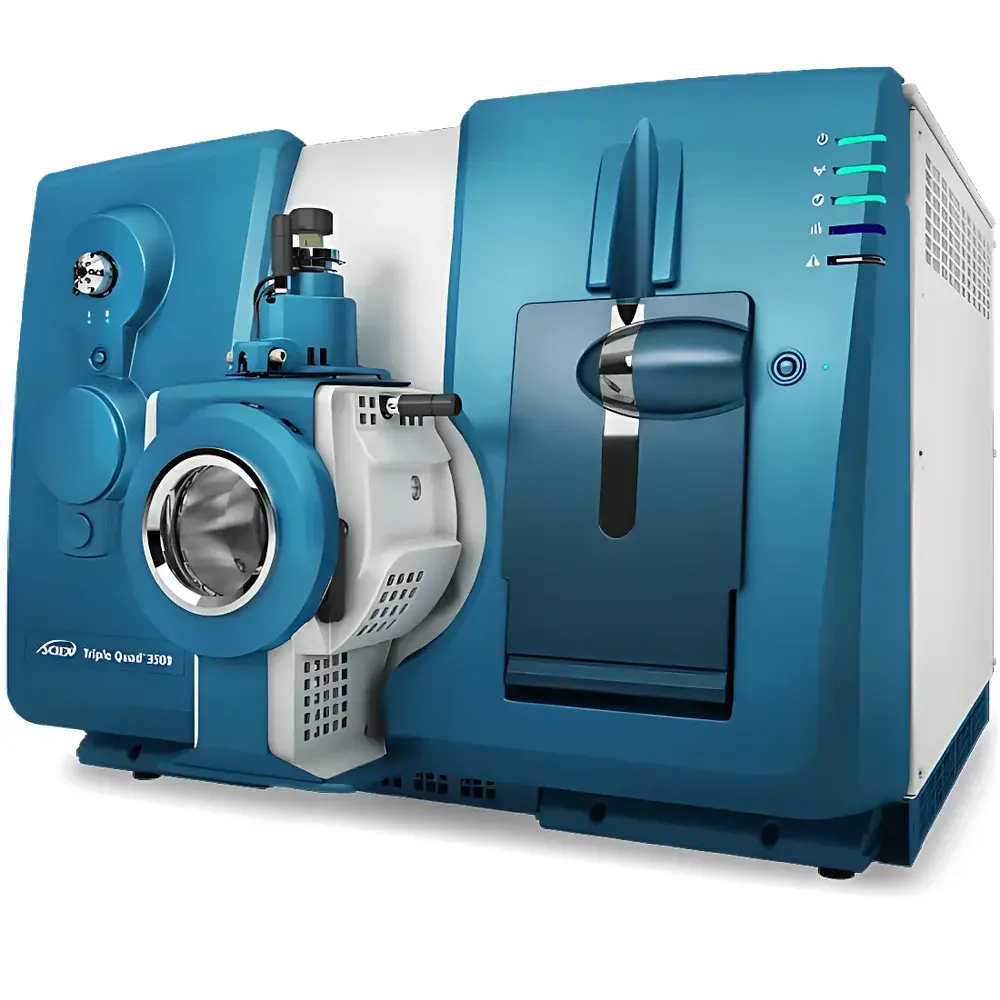
SCIEX Triple Quad™ 3500 LC-MS/MS System
| Brand | SCIEX |
|---|---|
| Origin | USA |
| Model | Triple Quad™ 3500 |
| Configuration | ESI/APCI Turbo V™ Ion Source |
| Collision Cell | Curved LINAC™ |
| Regulatory Compliance | Designed for GLP/GMP and FDA 21 CFR Part 11–ready workflows (software-dependent) |
| Application Scope | Small-molecule quantitation in pharmaceutical, clinical research, forensic, food safety, and environmental laboratories |
Overview
The SCIEX Triple Quad™ 3500 LC-MS/MS System is a robust, high-performance triple quadrupole mass spectrometer engineered for routine quantitative analysis of small molecules in complex matrices. Operating on the principle of tandem mass spectrometry (MS/MS) with selected reaction monitoring (SRM) or multiple reaction monitoring (MRM), the system delivers exceptional sensitivity, specificity, and reproducibility across diverse analytical workflows. Its core architecture integrates a curved LINAC™ collision cell—designed to minimize ion loss and improve transmission efficiency—alongside the proven Turbo V™ ion source, which supports both electrospray ionization (ESI) and atmospheric pressure chemical ionization (APCI) in a single, interchangeable platform. Unlike earlier generations such as the API 3200™ system, the 3500 incorporates refined RF electronics, optimized vacuum staging, and enhanced signal-to-noise architecture—resulting in faster polarity switching (<20 ms), higher duty cycle MRM acquisition, and improved long-term stability under sustained operation.
Key Features
- Triple quadrupole mass analyzer with curved LINAC™ collision cell for superior ion transmission and reduced cross-talk between MRM transitions
- Turbo V™ dual-mode ion source enabling seamless ESI/APCI method switching without hardware reconfiguration
- CurtainGas™ interface technology to suppress chemical noise and enhance robustness against matrix-induced suppression
- High-speed polarity switching (positive/negative) within a single injection, supporting comprehensive multi-analyte assays
- Compact footprint (64 cm × 71 cm × 66 cm) designed for space-constrained laboratory environments without compromising vacuum integrity or thermal management
- Optimized RF drive electronics and detector design delivering stable gain response over extended calibration intervals
Sample Compatibility & Compliance
The Triple Quad™ 3500 is validated for use with standard reversed-phase, HILIC, and ion-pairing LC methods compatible with 2–4.6 mm ID columns and flow rates from 0.2 to 1.0 mL/min. It accepts samples prepared via protein precipitation, solid-phase extraction (SPE), or dilute-and-shoot protocols common in bioanalysis, residue testing, and impurity profiling. While not registered as a medical device in China, the system meets international design standards aligned with ISO/IEC 17025 requirements for testing laboratories. When paired with compliant software (e.g., Analyst® 1.7.2 or later), it supports audit trails, electronic signatures, and data integrity controls consistent with FDA 21 CFR Part 11 and EU Annex 11 expectations. Routine operation adheres to ASTM D7595 (petroleum), USP (method validation), and ICH M10 (bioanalytical method validation) frameworks.
Software & Data Management
Data acquisition and processing are managed through SCIEX Analyst® software—a validated platform offering method editor, real-time MRM optimization tools, automated calibration, and integrated peak integration algorithms. The software supports structured data export (CSV, .txt, .xls) and direct import into LIMS via ODBC or secure RESTful API interfaces. All raw data files (.wiff) are stored with embedded metadata—including instrument parameters, sequence logs, and user authentication timestamps—to ensure traceability. Optional Sciex OS software provides extended workflow automation, including scheduled calibration, QC failure alerts, and trend reporting for key performance indicators (KPIs) such as retention time shift, peak area RSD, and dwell time consistency.
Applications
The Triple Quad™ 3500 serves as a foundational platform for regulated and non-regulated quantitative applications requiring high selectivity and low detection limits. Typical use cases include pharmacokinetic (PK) and toxicokinetic (TK) studies in preclinical development; pesticide residue screening in fruits, vegetables, and drinking water per EPA Method 541 and EU SANTE/11312/2021 guidelines; mycotoxin and veterinary drug quantification in animal feed; forensic toxicology screening for opioids, stimulants, and novel psychoactive substances (NPS); and clinical research assays for vitamin D metabolites, steroids, and immunosuppressants. Its reliability in high-throughput environments makes it suitable for contract research organizations (CROs) and central laboratories performing batched sample analysis under GLP conditions.
FAQ
Is the Triple Quad™ 3500 suitable for regulated bioanalysis under FDA or EMA guidelines?
Yes—when operated with validated Analyst® software, documented SOPs, and appropriate system suitability testing, it fulfills technical requirements for GLP-compliant PK studies and GCP-aligned clinical trial support.
Can the system be upgraded to support newer software versions or add-on modules?
Hardware compatibility with Analyst® 1.8+ and Sciex OS is confirmed; firmware updates and optional modules (e.g., Auto Calibration Kit, Extended Dynamic Range Detector) are available through authorized SCIEX service channels.
What maintenance intervals are recommended for optimal performance?
Ion source cleaning every 2–4 weeks (depending on sample load), turbo pump oil replacement annually, and quarterly mass calibration using tuning compounds (e.g., reserpine, caffeine) are standard practice.
Does the system support isotopic internal standard calibration?
Yes—fully supported in Analyst® for both single-point and multi-point calibration curves using stable isotope-labeled analogs.
Is remote monitoring or troubleshooting possible?
With optional Secure Remote Access (SRA) licensing and IT-approved network configuration, engineers can perform diagnostics and log review without physical presence.
Related Products







