
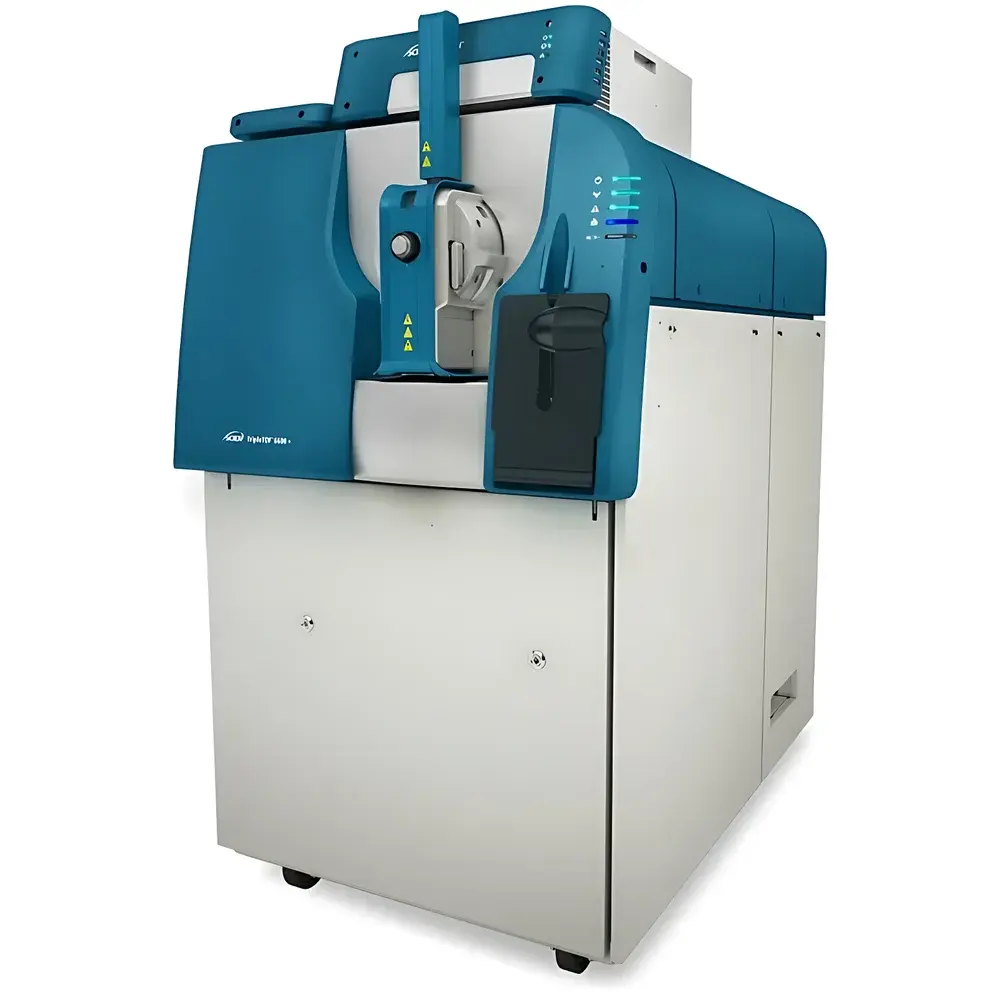
SCIEX TripleTOF® 6600+ LC-MS/MS System
| Brand | SCIEX |
|---|---|
| Origin | Singapore |
| Model | TripleTOF® 6600+ LC-MS/MS System |
| Instrument Type | Quadrupole-Time-of-Flight (Q-TOF) |
| Category | Liquid Chromatography Tandem Mass Spectrometry System |
| Compliance | Designed for GLP/GMP, FDA 21 CFR Part 11–ready workflows |
| Software Platform | Analyst® TF 1.8 with SWATH® Acquisition support |
| Ion Source Flexibility | OptiFlow® Pro Micro/Nano ESI and SelexION® Differential Mobility Separation (DMS) compatible |
| Data Acquisition Mode | Data-Independent Acquisition (DIA) via SWATH® technology |
| Architecture | High-stability TOF ion optics with segmented ion entrance lens and windowed ionization control |
Overview
The SCIEX TripleTOF® 6600+ LC-MS/MS System is a high-performance quadrupole-time-of-flight mass spectrometer engineered for large-scale, high-resolution quantitative and qualitative analysis in complex biological and chemical matrices. Leveraging orthogonal acceleration time-of-flight (oa-TOF) physics, the system delivers accurate mass measurement (≤ 2 ppm mass accuracy over calibration range), high-speed full-spectrum acquisition (up to 100 Hz), and robust isotopic fidelity—critical for confident compound identification and reproducible quantitation. Its architecture integrates a triple-quadrupole front-end for precursor selection and collision-induced dissociation (CID), coupled with a high-transmission TOF analyzer optimized for sensitivity and dynamic range across wide mass ranges (m/z 50–2000). Designed specifically for data-independent acquisition (DIA), the TripleTOF 6600+ enables comprehensive, unbiased fragmentation of all detectable precursors within user-defined m/z windows—eliminating stochastic sampling bias inherent in traditional data-dependent acquisition (DDA) methods.
Key Features
- OptiFlow® Pro Ion Source Platform: Enables seamless switching between microflow (1–50 µL/min), nanoflow (50–500 nL/min), and conventional flow (200–1000 µL/min) LC configurations without hardware reconfiguration—supporting method transfer and multi-tiered assay development.
- Enhanced TOF Ion Optics: Newly engineered segmented ion entrance lens improves ion transmission efficiency, reduces space-charge effects, and extends detector lifetime—contributing to >95% instrument uptime in routine 24/7 operation environments.
- SWATH® Acquisition 2.0: A mature, vendor-supported DIA implementation that combines intelligent window scheduling, real-time spectral deconvolution, and library-free quantification—fully compatible with open-source and commercial spectral libraries (e.g., Spectronaut™, Skyline, DIA-NN).
- Analyst® TF 1.8 Software: Provides unified control for LC, MS, and data processing; includes automated calibration, QC monitoring dashboards, audit-trail-enabled method management, and built-in compliance tools aligned with FDA 21 CFR Part 11 and ISO/IEC 17025 requirements.
- SelexION® Differential Mobility Interface (optional): Adds an orthogonal gas-phase separation dimension prior to MS detection—improving selectivity for isobaric and structurally similar analytes (e.g., lipids, glycans, metabolites) without chromatographic re-optimization.
Sample Compatibility & Compliance
The TripleTOF 6600+ accommodates diverse sample types—from plasma, tissue homogenates, and cell lysates to environmental extracts, food digests, and forensic toxicology specimens—across proteomics, metabolomics, lipidomics, and small-molecule bioanalysis workflows. It supports direct infusion, nanoLC, microLC, UHPLC, and CE-MS coupling. Regulatory alignment includes design-level readiness for GLP-compliant studies (OECD 407, 453), clinical assay validation per CLIA/CAP guidelines, and pharmaceutical bioanalysis adhering to FDA Bioanalytical Method Validation Guidance. Full electronic records, role-based access control, and tamper-evident audit trails meet 21 CFR Part 11 Subpart B requirements for electronic signatures and data integrity.
Software & Data Management
Data acquisition, processing, and reporting are unified under the Analyst® TF 1.8 platform, which supports raw data export in open formats (mzML, mzXML) and integrates with third-party informatics ecosystems including Proteome Discoverer™, PeakView®, MasterView™, and cloud-based platforms such as SCIEX OS Cloud. The software implements automated QC checks (retention time stability, peak area CV, lock-mass drift), batch-level metadata tagging, and version-controlled method archiving. All processing steps—including peak picking, alignment, normalization, and statistical testing—are traceable and repeatable, fulfilling ALCOA+ (Attributable, Legible, Contemporaneous, Original, Accurate, Complete, Consistent, Enduring, Available) data governance principles.
Applications
This system serves as a core platform for discovery-phase and targeted quantitative workflows across multiple domains: large-cohort proteomic profiling (e.g., plasma biomarker screening), untargeted metabolite identification in disease models, residue analysis in food safety (multi-residue pesticides, mycotoxins), environmental contaminant surveillance (PFAS, pharmaceuticals in wastewater), forensic toxicology (broad-spectrum drug screening), and biopharmaceutical characterization (intact mass, peptide mapping, PTM analysis). Its DIA architecture ensures longitudinal data compatibility—enabling retrospective interrogation of archived datasets as new hypotheses emerge.
FAQ
What distinguishes SWATH® Acquisition from traditional DDA?
SWATH® is a systematic DIA method that fragments all precursors in sequential, fixed m/z windows—ensuring consistent coverage across runs and enabling retrospective data mining without re-acquisition.
Is the TripleTOF 6600+ compliant with FDA 21 CFR Part 11?
Yes—the Analyst® TF 1.8 software includes electronic signature capability, audit trail generation, and secure user authentication required for regulated environments.
Can the system interface with non-SCIEX liquid chromatography systems?
Yes—it supports standard analog/digital I/O protocols (e.g., TTL triggers, RS-232, Ethernet) for synchronization with third-party HPLC/UHPLC systems.
What maintenance intervals are recommended for routine operation?
Source cleaning every 7–14 days (depending on sample load); TOF detector calibration monthly; full system performance verification quarterly per manufacturer-recommended PQ protocol.
Does SCIEX provide application support for method development?
Yes—SCIEX Application Scientists offer remote and on-site assistance for assay optimization, DIA library generation, and regulatory documentation preparation.
Related Products




