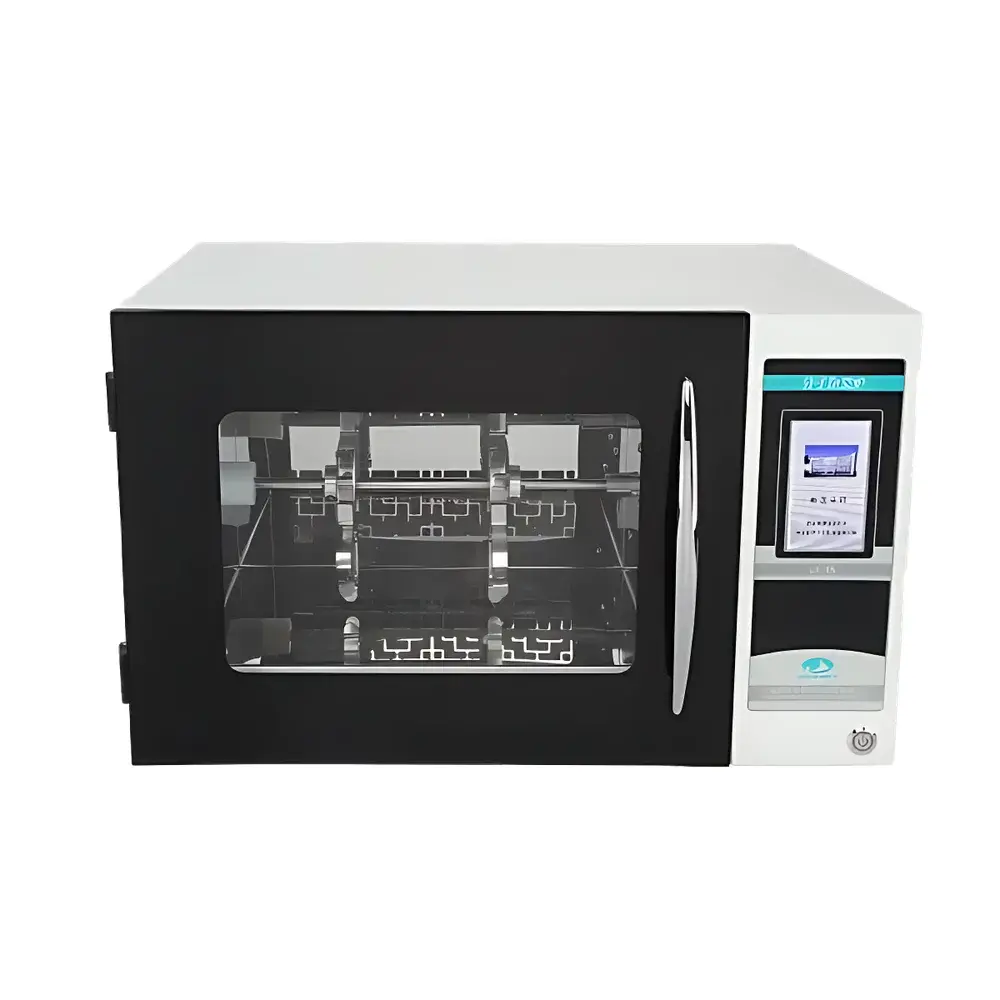
SciLogix LF-IA Molecular Hybridization Oven
| Brand | SciLogix |
|---|---|
| Origin | Zhejiang, China |
| Manufacturer Type | Direct Manufacturer |
| Instrument Category | Domestic |
| Model | LF-IA |
| Instrument Type | Nucleic Acid Molecular Hybridization Oven |
| Temperature Control Range | Room Temperature + 5 °C to 100 °C |
| Temperature Uniformity | ±0.03 °C |
| Rotation Speed | 6–25 rpm (adjustable) |
| Capacity | Up to 6 membranes/slides/plates |
| Buffer Chamber Dimensions | 340 × 220 × 220 mm |
Overview
The SciLogix LF-IA Molecular Hybridization Oven is an engineered platform for controlled nucleic acid hybridization, designed to support reproducible and standardized DNA–DNA, DNA–RNA, and RNA–RNA annealing under precisely regulated thermal and mechanical conditions. Its operational principle relies on the integration of a high-stability vertical rotation system with a microprocessor-driven temperature control architecture based on fuzzy PID algorithm—enabling rapid thermal equilibration, minimal overshoot, and long-term thermal homogeneity across the hybridization chamber. The device facilitates the full workflow of membrane-based nucleic acid hybridization: pre-hybridization, hybridization, post-hybridization washing, and membrane baking—all programmable and executed without manual intervention. Engineered for routine use in molecular biology core facilities, diagnostic laboratories, and academic research settings, the LF-IA complies with foundational requirements for GLP-aligned experimental traceability when paired with validated SOPs.
Key Features
- High-precision temperature regulation: Achieves ±0.03 °C uniformity across the entire chamber volume, critical for stringent hybridization stringency control during probe-target binding.
- Stable vertical-axis rotation mechanism: Delivers consistent 6–25 rpm speed range with low-voltage immunity—ensuring uninterrupted agitation even under fluctuating power supply conditions typical in shared lab environments.
- Modular, service-oriented design: All major components—including the stainless-steel inner chamber, corrosion-resistant rotor assembly, and reinforced UV-blocking tempered glass door—are field-replaceable and compatible with standard decontamination protocols (e.g., 70% ethanol, 10% bleach).
- Intuitive human-machine interface: 7-inch capacitive touchscreen with multilingual OS support (English, Spanish, Chinese), real-time parameter visualization, and programmable multi-step temperature/rotation profiles.
- Dual-mode operation: Supports both tube-based hybridization (using supplied rotating racks) and flat-surface incubation (e.g., hybridization bags placed on the oscillating base plate), extending utility beyond traditional blotting applications to include antibody incubation and protein–nucleic acid interaction studies.
Sample Compatibility & Compliance
The LF-IA accommodates standard hybridization formats including nitrocellulose and nylon membranes (up to 6 per run), microscope slides, and custom-printed microarrays. Its chamber dimensions (340 × 220 × 220 mm) allow for buffer volumes up to 1.5 L, supporting large-format blots or parallel sample processing. All wetted surfaces are constructed from electropolished 316 stainless steel, ensuring resistance to common hybridization buffers (e.g., SSC, SSPE, Denhardt’s solution) and organic solvents used in stripping protocols. While the instrument itself does not carry CE IVD or FDA 510(k) certification, its design adheres to ISO 13485-aligned manufacturing practices and supports compliance with ISO/IEC 17025 method validation requirements when integrated into accredited laboratory quality systems.
Software & Data Management
The embedded firmware enables storage of up to 99 user-defined hybridization protocols, each with independent time–temperature–rotation profiles and automatic step transitions. Audit trail functionality logs all parameter changes, start/stop timestamps, and operator IDs (via optional RFID badge integration). Exportable CSV log files include temperature setpoints, actual chamber readings (sampled at 2 Hz), and rotational speed history—facilitating retrospective analysis and alignment with 21 CFR Part 11 data integrity expectations when deployed within regulated QC/QA environments. No cloud connectivity is implemented; all data remains local unless manually exported via USB 2.0 port.
Applications
- Membrane-based Southern, Northern, and dot-blot hybridization for gene expression profiling and pathogen detection.
- Microarray hybridization in genotyping and transcriptome screening workflows.
- Pre-hybridization blocking and post-hybridization wash optimization under controlled stringency conditions.
- Non-nucleic acid applications requiring gentle, temperature-controlled agitation: e.g., antigen–antibody incubation on ELISA plates, in situ hybridization slide processing, and chromatin immunoprecipitation (ChIP) wash steps.
- Method development for LAMP, RPA, or CRISPR-based detection assays where hybridization kinetics must be decoupled from ambient thermal drift.
FAQ
What is the maximum recommended buffer volume for optimal thermal uniformity?
The chamber maintains ±0.03 °C uniformity with buffer volumes between 800 mL and 1.5 L. Volumes below 500 mL may exhibit localized thermal gradients near chamber walls.
Can the LF-IA be validated for GMP-compliant production environments?
Yes—its deterministic thermal response, non-volatile protocol storage, and timestamped event logging support IQ/OQ/PQ execution per ASTM E2500 and EU Annex 15 guidelines when accompanied by site-specific risk assessment and calibration against NIST-traceable references.
Is third-party software integration supported?
No native API or Ethernet interface is provided; however, RS-232 serial output allows basic status polling (temperature, rpm, status code) for integration into custom LIMS or SCADA systems using Modbus RTU emulation.
What maintenance intervals are recommended?
Biannual verification of temperature sensor accuracy (using calibrated PT100 reference probe) and annual inspection of drive belt tension and door gasket integrity are advised per manufacturer service bulletin SB-LF-2023-01.