
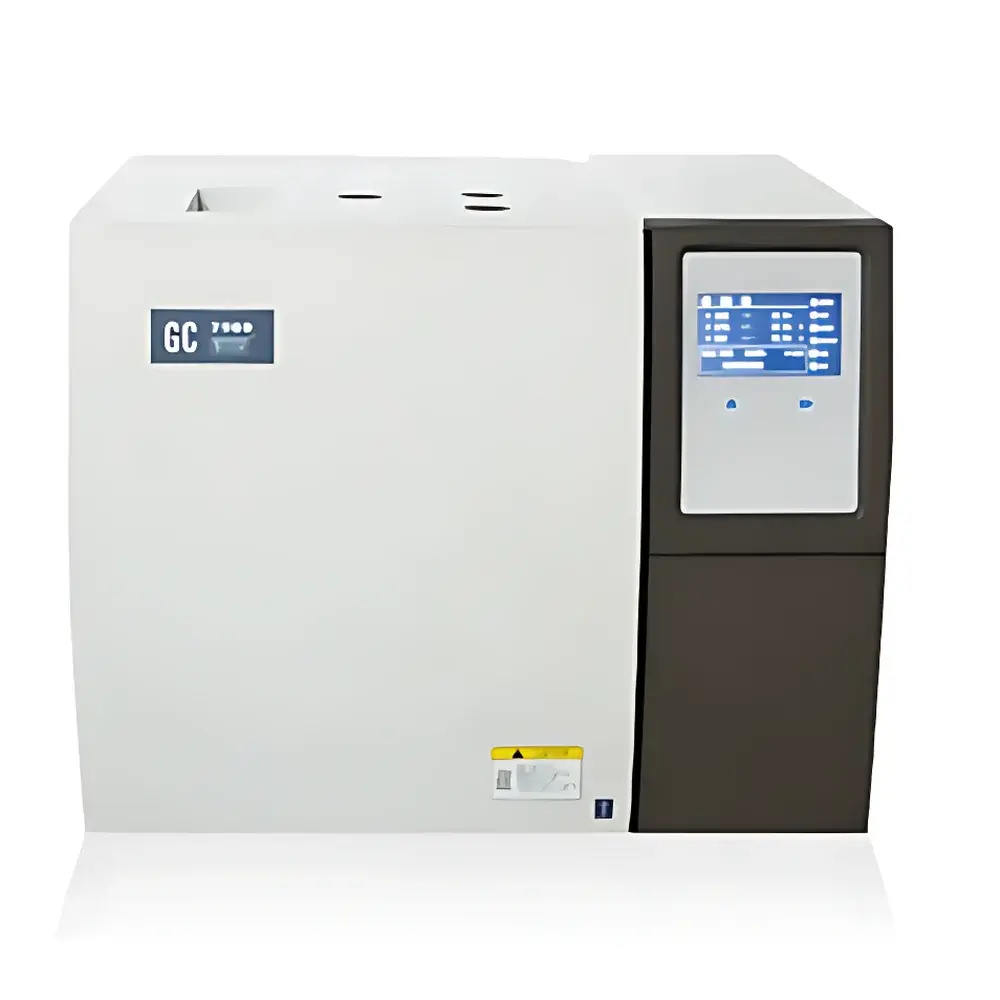
Scion GC7900II Laboratory Gas Chromatograph
| Brand | Scion |
|---|---|
| Origin | Beijing, China |
| Manufacturer Type | Authorized Distributor |
| Instrument Type | Benchtop Laboratory Gas Chromatograph |
| Model | GC7900II |
| Application Scope | General-Purpose Analytical GC |
| User Interface | 7-inch Full-Color Touchscreen Display |
| Injector Configuration | Up to 3 Simultaneous Inlet Ports |
| Detector Capacity | Up to 3 Detectors Installed Concurrently |
| Detector Options | FID, TCD, ECD, NPD, FPD, PID, and u-ECD (7 types) |
| Oven Temperature Control | Programmable Multi-Step Ramp with Active Air-Cooled Cooling |
| Software | Native Scion Chromatography Data System (CDS) with Dual-Language (English/Chinese) Support and Remote Instrument Control |
| Compliance | Designed to Support GLP/GMP workflows |
Overview
The Scion GC7900II is a benchtop laboratory gas chromatograph engineered for precision, operational flexibility, and long-term reliability in routine and method-development environments. Built upon the proven architecture of the GC7900 platform and enhanced in 2015 with a modernized user interface and expanded pneumatic control visibility, the GC7900II implements classical capillary gas chromatography principles—separation based on differential partitioning of analytes between a mobile phase (inert carrier gas) and a stationary phase (capillary column coating). Its design emphasizes thermal stability, reproducible retention time alignment, and robustness under continuous operation across diverse sample matrices. The instrument supports both split/splitless, on-column, and PTV (programmed temperature vaporizing) injection techniques, enabling method transfer compatibility with widely adopted ASTM, ISO, and USP chromatographic protocols.
Key Features
- 7-inch high-resolution color touchscreen interface with intuitive icon-driven navigation and real-time system status visualization—including pressure, flow, and temperature readouts at key pneumatic nodes.
- Front-panel gas control module with tactile rotary knobs and digital feedback, allowing rapid manual adjustment of inlet pressures and flows without software intervention.
- Modular detector bay accommodating up to three detectors simultaneously, with hot-swappable electrical and pneumatic connections for minimal downtime during configuration changes.
- Thermally optimized oven with dual-zone air circulation, programmable ramp rates up to 60 °C/min (dependent on column dimensions and carrier gas), and active forced-air cooling to reduce cycle time between runs.
- Standard inclusion of Scion Chromatography Data System (CDS) v3.x, supporting 21 CFR Part 11–compliant configurations including user role management, audit trail logging, and electronic signature workflows when deployed in regulated laboratories.
- Native support for industry-standard column formats (0.1–0.53 mm ID fused silica), with column oven compatibility extending to lengths up to 60 m and maximum operating temperatures of 450 °C.
Sample Compatibility & Compliance
The GC7900II is validated for use with volatile and semi-volatile organic compounds across aqueous, organic, gaseous, and solid-phase extracted samples. It meets essential performance criteria outlined in ASTM D3612 (dissolved gas analysis in transformer oil), ASTM D5504 (sulfur compounds in natural gas), ISO 11843-2 (detection capability estimation), and USP (chromatography system suitability). All hardware and firmware components are manufactured and tested under ISO 9001-certified quality management systems. When configured with optional CDS security modules, the system supports full GLP and GMP documentation requirements—including instrument qualification (IQ/OQ/PQ), calibration traceability, and data integrity assurance per ALCOA+ principles.
Software & Data Management
Scion CDS provides integrated acquisition, processing, reporting, and archive functions. Raw data files (.scd) are stored in a proprietary but fully exportable binary format compatible with third-party spectral libraries and chemometric tools. Batch processing supports automatic integration parameter inheritance, peak purity assessment via spectral deconvolution (when coupled with optional mass spectrometric detection), and customizable report templates compliant with LIMS interfaces. Data backup and version control are managed through configurable network drive mapping or local encrypted storage. Audit trail records capture all user actions—including method edits, sequence modifications, and result approvals—with timestamps, operator IDs, and contextual metadata preserved immutably.
Applications
- Food safety testing: Quantification of pesticide residues (e.g., organophosphates, pyrethroids) and food additives (e.g., BHA, BHT, sorbates) using FID or ECD detection following QuEChERS extraction.
- Volatile organic compound (VOC) monitoring in indoor air, ambient emissions, and industrial hygiene samples per EPA Method TO-17 and ISO 16000-6.
- Residual solvent analysis in pharmaceutical intermediates and final dosage forms according to ICH Q3C guidelines, typically employing headspace-GC/FID.
- Dissolved gas analysis (DGA) in power transformer oils per IEEE C57.104 and ASTM D3612, utilizing TCD and FID in parallel detection mode.
- Gas composition profiling in refinery streams, biogas, and syngas applications using multi-valve switching and dual-column TCD/FID configurations.
- Oxygenated gasoline additives (e.g., MTBE, ETBE, ethanol) quantification per ASTM D4815 and D5599 using polar capillary columns and FID detection.
FAQ
Is the GC7900II compatible with third-party GC-MS systems?
Yes—the instrument’s analog and digital I/O ports support synchronization signals and external trigger inputs required for hybrid GC-MS coupling. Column effluent transfer must be implemented via appropriate interface hardware (e.g., transfer line, splitter, or jet separator).
Does the system support unattended overnight operation?
Yes—full sequence control, auto-shutdown, and leak detection alerts are embedded in the CDS. Optional UPS integration and remote monitoring via Ethernet enable extended autonomous runs.
What column oven specifications are available for validation documentation?
The oven delivers ±0.1 °C temperature accuracy from 5 °C above ambient to 450 °C, with ramp reproducibility of ±0.5 % over 10 consecutive 10–200 °C ramps.
Can the GC7900II be upgraded to include mass spectrometric detection later?
Yes—mechanical and electrical interfaces for Scion 456C MS are pre-engineered into the detector bay; only vacuum pump, interface hardware, and software license activation are required for retrofit.
Is regulatory compliance documentation provided with shipment?
Each unit ships with Factory Acceptance Test (FAT) reports, calibration certificates traceable to NIST standards, and a complete set of technical drawings and electrical schematics for IQ/OQ protocol development.
Related Products



