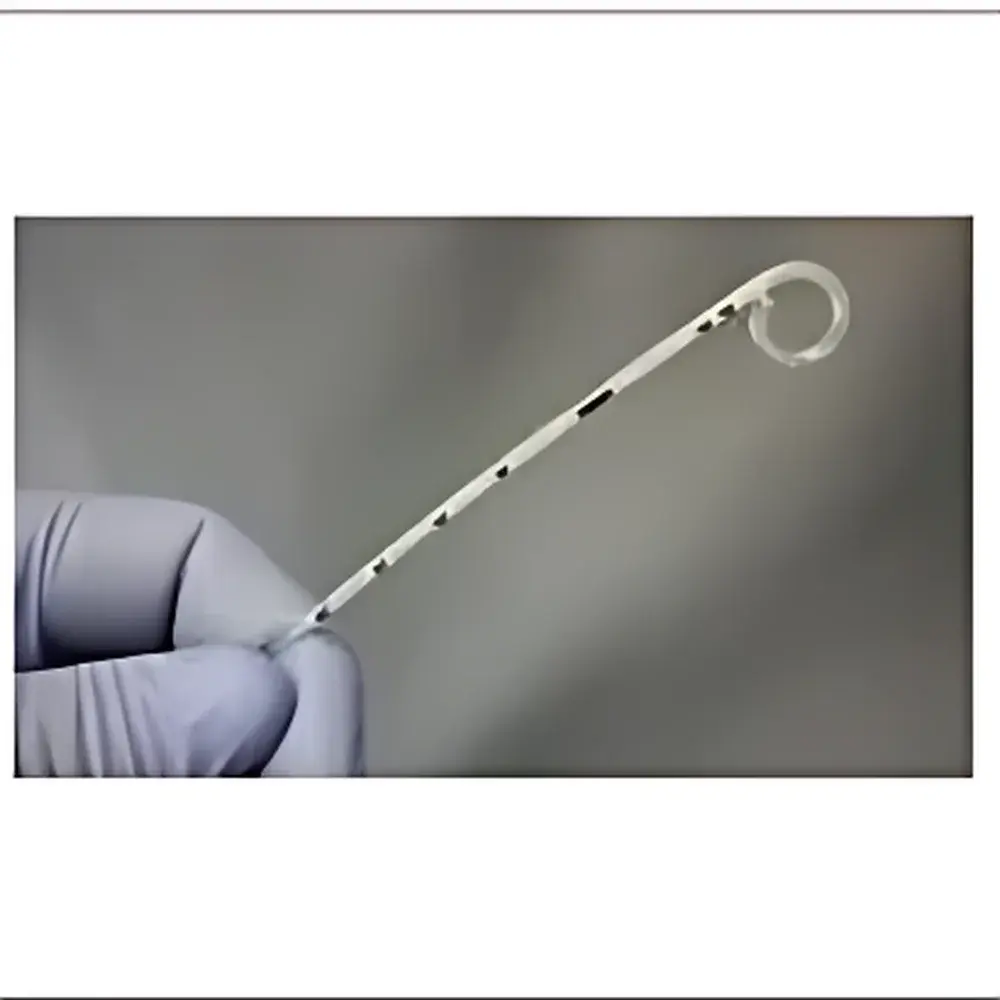
Scisense Large-Animal Pressure-Volume Catheter System
| Origin | USA |
|---|---|
| Manufacturer Type | Authorized Distributor |
| Origin Category | Imported |
| Model | Scisense PV Catheter Series (3F, 5F, 7F) |
| Pricing | Available Upon Request |
Overview
The Scisense Large-Animal Pressure-Volume (PV) Catheter System is a rigorously validated, minimally invasive intracardiac measurement platform engineered for high-fidelity, simultaneous acquisition of left ventricular pressure and volume signals in large-animal models—including dogs, sheep, pigs, and rabbits. Based on the well-established conductance catheter principle, the system quantifies real-time ventricular volume by measuring intra-chamber blood conductivity across multiple axial segments, while integrating a high-stability, miniaturized solid-state pressure sensor at the catheter tip. This dual-modality architecture enables construction of beat-to-beat pressure-volume loops—the gold-standard physiological representation of cardiac contractility, lusitropy, preload-recruitable stroke work, ventricular-arterial coupling, and myocardial energetics. Unlike fluid-filled catheters, Scisense catheters eliminate pressure waveform distortion, overshoot, and resonance artifacts due to their intrinsic high-frequency response (>100 Hz bandwidth) and optimized mechanical compliance. The system adheres to fundamental biophysical principles described in Baan’s equation (V = α × (L² / (G − Gp))), where volume (V) is derived from electrode spacing (L), measured conductance (G), parallel conductance (Gp), and empirically determined field correction factor (α). All Scisense PV catheters undergo ISO 10993-compliant biocompatibility testing and are CE-marked for preclinical research use.
Key Features
- Multi-segment conductance architecture: 5-segment configuration for canine, porcine, and ovine models; 3-segment for rabbit models—enabling spatially resolved volumetric partitioning along the ventricular long axis
- Integrated solid-state pressure sensor with 10 V/V/mmHg sensitivity, sub-0.5 mmHg resolution, and recessed diaphragm design for mechanical protection and hemodynamic stability
- Patented “Adjustable Segment” field compensation technology: dynamically calibrates inter-electrode gain and offset per segment to correct for non-uniform electric field distribution, catheter bending, and inter-operator variability in positioning
- Two pressure-sensing options: single-tip configuration for LV-only measurement; dual-pressure configuration (LV + ascending aorta) via add-on proximal pressure sensor
- Flexible catheter shafts with tunable stiffness profiles: available in straight-tip and pigtail configurations to accommodate anatomical variation and reduce endocardial trauma during transvascular insertion
- Standardized electrode spacing (2.5 mm or custom intervals) ensures reproducible calibration across laboratories and longitudinal studies
Sample Compatibility & Compliance
The Scisense PV catheter series supports acute and chronic hemodynamic studies in anesthetized or conscious large-animal preparations. Catheter sizes (3F, 5F, 7F) are selected based on arterial access vessel diameter and target species anatomy—3F for rabbits (carotid/femoral approach), 5F for dogs and sheep, and 7F for adult pigs. All catheters are compatible with standard 0.014″–0.035″ guidewires and deployable via standard Seldinger technique. The system meets ASTM F2182-22 (RF-induced heating) and IEC 60601-1 third edition safety requirements for active implantable devices used in preclinical settings. Data acquisition workflows support GLP-aligned documentation practices, including audit-trail-enabled software logging, timestamped raw signal export (MAT, HDF5), and traceable calibration records compliant with FDA 21 CFR Part 11 Annex 11 expectations for regulated nonclinical studies.
Software & Data Management
Scisense PV data acquisition is performed using the proprietary Scisense PV Software Suite (v5.x), which provides real-time loop visualization, automated Gp determination via hypertonic saline bolus or vena cava occlusion, and batch processing of >100 beat-level indices—including Ees, PRSW, dP/dtmax, dP/dtmin, Tau (Glantz method), stroke work, and mechanical efficiency. Raw analog outputs (±10 V) for each conductance segment and pressure channel are digitized at ≥1 kHz sampling rate using 16-bit ADC hardware. Export formats include ASCII, MATLAB (.mat), and HDF5 for integration with MATLAB, Python (NumPy/Pandas), or LabVIEW-based secondary analysis pipelines. The software supports synchronized input from external triggers (ECG, respiration, pacing pulses) and integrates with third-party DAQ systems (e.g., ADInstruments PowerLab, National Instruments PXI) via TTL and analog I/O interfaces.
Applications
- Heart failure progression modeling and therapeutic intervention assessment (e.g., pharmacologic inotropes, device-based CRT)
- Myocardial remodeling evaluation in pressure/volume overload models (aortic banding, AV fistula)
- Ischemia-reperfusion injury quantification—including post-ischemic stunning, infarct size correlation, and mitochondrial uncoupling metrics
- Cardiovascular regeneration studies: stem cell engraftment efficacy, exosome-mediated functional recovery, and tissue-engineered patch integration
- Preclinical pharmacology and toxicology: detection of drug-induced diastolic dysfunction, afterload mismatch, or contractile reserve impairment
- Surgical validation: cardiopulmonary bypass effects, valve replacement hemodynamics, and ventricular assist device unloading characterization
FAQ
How is parallel conductance (Gp) measured and corrected?
Gp is determined either via transient hypertonic saline injection (measuring conductance shift) or inferior vena cava occlusion (measuring end-systolic volume intercept), both automated within the Scisense software. The system applies segment-specific α-correction factors derived from in vitro calibration phantoms.
Can Scisense catheters be used chronically?
Yes—7F and 5F catheters are validated for up to 72-hour continuous monitoring in instrumented swine and canine models under sterile surgical conditions with appropriate vascular access management.
Is the system compatible with rodent PV catheters?
The Scisense GX5 acquisition platform supports simultaneous connection of large-animal PV catheters and Scisense’s rodent-specific single-segment catheters, enabling cross-species comparative studies without hardware reconfiguration.
What validation data are available for the conductance-to-volume conversion?
All catheters ship with NIST-traceable pressure calibration certificates and in vitro volume phantom validation reports demonstrating linearity (R² > 0.999) over 10–120 mL ranges and inter-catheter CV < 2.1% at physiological hematocrit (35–45%).
Does Scisense provide technical support for experimental protocol design?
Yes—Scisense offers application engineering consultation, SOP development support, and on-site or remote training for surgical implantation, signal optimization, and advanced PV loop interpretation aligned with AHA/ACC consensus guidelines for preclinical cardiovascular phenotyping.