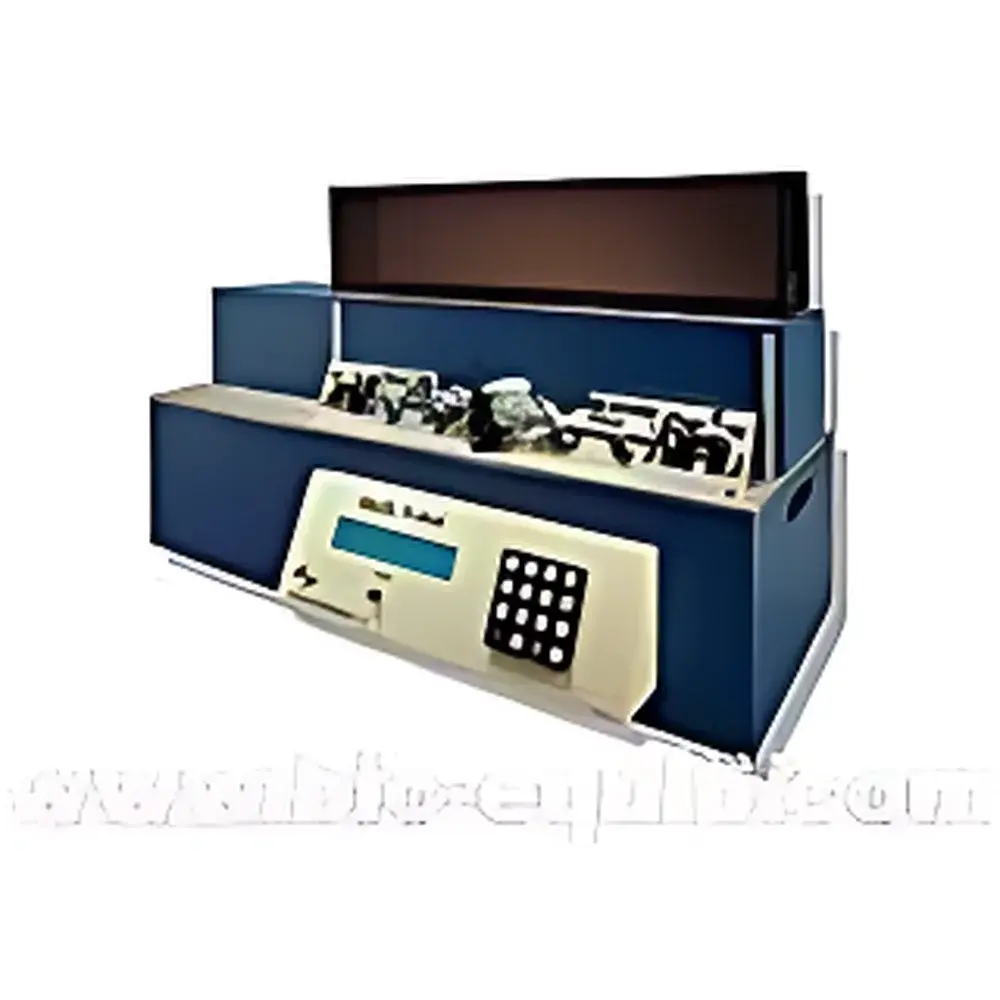
Sutter P-2000 Laser-Based Micropipette Puller
| Brand | Sutter |
|---|---|
| Origin | USA |
| Model | P-2000 |
| Heating Source | CO₂ Laser |
| Max Capillary OD | Glass 1.5 mm / Quartz 1.8 mm |
| Min Capillary OD | Glass 0.125 mm / Quartz 0.6 mm |
| Tip Diameter Range | 5–10 µm (reproducible down to ≤0.03 µm) |
| Programmable Protocols | 100 |
| Laser Lifetime | >10 years |
| Control System | Microprocessor-based with write-protected timestamp logging |
| Symmetry | Dual-symmetric pull per cycle |
| Compliance | GLP-compliant audit trail capability (timestamped protocol execution logs) |
Overview
The Sutter P-2000 Laser-Based Micropipette Puller is an advanced, microprocessor-controlled instrument engineered for high-precision fabrication of glass, borosilicate, and fused quartz micropipettes used in electrophysiological, neurophysiological, and electrochemical applications. Unlike conventional resistive-heating pullers—whether vertical (gravity-driven) or horizontal (spring- or motor-assisted)—the P-2000 employs a focused CO₂ laser as its heating source. This enables precise, localized thermal softening of capillaries with minimal thermal diffusion, critical for processing high-melting-point materials such as fused quartz (melting point ≈ 1650 °C). The laser’s spatial and temporal control allows reproducible tapering without mechanical stress-induced deformation, yielding electrodes with sub-100 nm tip symmetry and consistent wall thickness profiles. Designed for integration into core electrophysiology facilities—including patch-clamp, intracellular recording, and single-cell biosensing labs—the P-2000 meets the stringent demands of modern neuroscience and ion channel research where electrode geometry directly governs seal resistance, access resistance, and signal-to-noise ratio.
Key Features
- CO₂ laser heating system with >10-year operational lifetime and stable output power calibration
- Microprocessor-controlled dual-stage pull mechanism ensuring symmetrical, matched-pair pipette generation per cycle
- 100 user-programmable protocols with write-protected timestamp logging for GLP/GMP traceability
- Capillary compatibility spanning borosilicate glass (OD: 0.125–1.5 mm) and fused quartz (OD: 0.6–1.8 mm)
- Tip diameter reproducibility ≤0.03 µm (verified via SEM metrology; typical deviation <0.06 µm across batches)
- Optimized velocity feedback loop for real-time tension regulation during draw, minimizing tip breakage and taper irregularity
- No ambient temperature dependency—laser heating eliminates drift from filament aging or convection effects inherent in resistive systems
Sample Compatibility & Compliance
The P-2000 accommodates standard thin-walled and thick-walled capillaries made from borosilicate (e.g., BF150-86-10, GC150TF-10), aluminosilicate, and fused quartz (e.g., QF100-78-15). Its laser-based thermal profile supports multi-step ramp-and-hold protocols ideal for fabricating patch pipettes with fire-polished tips, theta-style dual-barrel electrodes, and pulled optical fibers for combined optogenetic-electrophysiological interrogation. From a regulatory standpoint, the instrument’s embedded timestamped execution logs, protocol version control, and non-volatile parameter storage support compliance with FDA 21 CFR Part 11 requirements for electronic records in preclinical research environments. All firmware operations adhere to ISO/IEC 17025-aligned quality assurance frameworks applicable to laboratory equipment validation.
Software & Data Management
The P-2000 operates via an integrated front-panel interface with tactile membrane keys and LED status indicators—no external PC required for routine operation. Protocols are configured using a hierarchical menu system supporting independent adjustment of laser power (0–100% in 0.1% increments), heating duration (1–9999 ms), pull speed (1–500 µm/ms), delay timing, and acceleration profiles. Each protocol stores full parameter sets including operator ID, date/time stamp, and capillary lot reference. Optional RS-232 or USB serial output enables integration with LIMS or custom Python/Matlab scripts for automated batch logging, statistical process control (SPC) charting, and long-term reproducibility trending. Audit trails are exportable as CSV files with SHA-256 checksums for integrity verification.
Applications
- Whole-cell and cell-attached patch-clamp recordings in acute brain slices and cultured neurons
- Intracellular sharp-electrode recordings requiring rigid, low-noise quartz electrodes
- Fabrication of nanopipettes for single-molecule sensing and ion current blockade assays
- Pulling of double-barrel or triple-barrel pipettes for simultaneous iontophoresis and recording
- Preparation of tapered optical fibers for photostimulation-coupled electrophysiology
- Manufacturing of microfluidic probe tips for scanning ion conductance microscopy (SICM)
FAQ
What types of capillaries can the P-2000 pull?
The P-2000 pulls borosilicate glass (OD 0.125–1.5 mm), aluminosilicate, and fused quartz capillaries (OD 0.6–1.8 mm), including those with internal filament or coating structures.
Is laser alignment required by the user?
No—optical alignment is factory-performed and sealed; the CO₂ laser beam path is maintenance-free under normal operating conditions.
How is protocol reproducibility validated?
Each protocol execution generates a timestamped log entry; tip geometry consistency is verified using scanning electron microscopy (SEM) with calibrated stage navigation and image-based diameter measurement algorithms.
Does the P-2000 support GMP/GLP documentation standards?
Yes—write-protected protocol logs with embedded timestamps, operator IDs, and firmware version stamps satisfy audit requirements for regulated preclinical laboratories.
Can the P-2000 produce asymmetric tapers?
No—it is optimized for symmetric dual-pipette generation; asymmetric pulling requires post-fabrication manual bevelling or laser-assisted trimming using auxiliary tools.