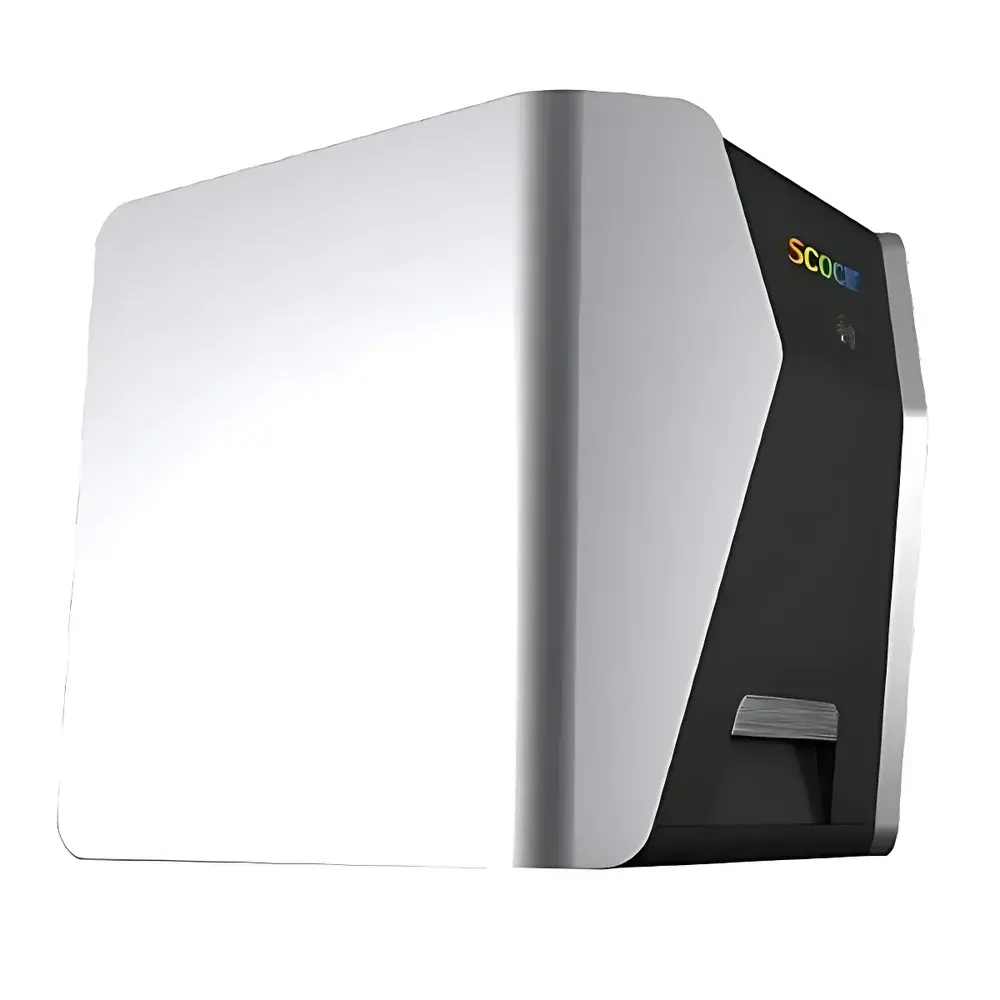
SCOSIE Digieye Digicolor Desktop Spectrophotometric Color Imaging System
| Brand | SCOSIE |
|---|---|
| Origin | Shanghai, China |
| Model | Digieye Digicolor |
| Product Type | Spectrophotometric Color Measurement System |
| Instrument Form Factor | Benchtop |
| Optical Geometry | 0°/45° Integrating Sphere |
| Illuminant | Standard D65 |
| Spectral Range | 400–700 nm |
| Repeatability | ΔE*ab ≤ 0.03 |
| Color Spaces | CIELAB, CIELCH, CIELUV, Hunter Lab, Munsell |
| Observer Angles | 2° and 10° Standard Observer |
| Color Difference Formulas | CIE L*a*b*, CMC (l:c), CIE94, CIEDE2000 |
| Data Output Formats | CSV, QTX, TXT, DAT, Print |
| Compliance | ASTM E308, ISO/CIE 11664, ISO 13655, ISO 28178, GB/T 3978–2008, GB/T 7921–2008 |
Overview
The SCOSIE Digieye Digicolor is a benchtop spectrophotometric color imaging system engineered for high-fidelity, non-contact color and appearance evaluation across heterogeneous, textured, or geometrically complex surfaces. Unlike conventional tristimulus colorimeters or handheld spectrophotometers constrained by spot measurement geometry and limited field-of-view, the Digicolor integrates a calibrated multispectral imaging sensor with an optimized 0°/45° integrating sphere optical architecture. This configuration ensures uniform illumination and diffuse viewing—mimicking human visual perception under standardized CIE illuminants—while capturing full spatial color distribution across the entire sample area. The system operates within the visible spectrum (400–700 nm) at high wavelength resolution, enabling precise reflectance spectral acquisition and subsequent transformation into industry-standard color spaces (CIELAB, CIELCH, CIELUV, Hunter Lab, Munsell) using CIE 2° and 10° standard observer functions. Its core design objective is metrological traceability: delivering repeatable ΔE*ab values ≤ 0.03 under controlled conditions, supporting quantitative color quality assurance in production-critical environments.
Key Features
- Non-contact, full-field imaging—eliminates pressure-induced surface deformation and operator variability inherent in contact-based probes
- 0°/45° integrating sphere illumination and detection geometry compliant with ISO 13655 and ASTM E308 for accurate diffuse reflectance measurement
- Standardized illuminant support including D65, A, D50, F11, F02, and F07—enabling metamerism assessment and multi-illuminant pass/fail evaluation
- Comprehensive color difference calculation suite: CIE L*a*b*, CMC (2:1), CIE94 (graphic arts & textiles), and CIEDE2000 (industrial tolerance control)
- Multi-parameter output: chromaticity coordinates, K/S dye strength, opacity, whiteness (CIE, Ganz), yellowness (ASTM E313), ISO A11 staining and colorfastness indices, and spectral reflectance/transmittance curves
- Built-in audit trail functionality supporting GLP/GMP-aligned workflows, including user authentication, timestamped measurement logs, and version-controlled calibration records
Sample Compatibility & Compliance
The Digicolor accommodates samples of variable size, texture, and optical behavior—including woven and knitted textiles, metallic coatings, matte and glossy plastics, translucent packaging films, ceramic glazes, printed substrates, and biological specimens such as food surfaces or botanical samples. Its large-area imaging capability overcomes limitations of traditional spot-measurement devices when evaluating mottled, speckled, or patterned materials. The system conforms to international standards governing color measurement practice: ISO/CIE 11664 (colorimetry fundamentals), ISO 13655 (spectral measurement geometry), ISO 28178 (multi-angle color imaging), ASTM E308 (computing color tolerances), and GB/T 3978–2008 and GB/T 7921–2008 (Chinese national standards for colorimetric instrumentation). It supports FDA 21 CFR Part 11 readiness through optional electronic signature and data integrity modules.
Software & Data Management
The Digicolor operates via SCOSIE’s proprietary ColorVision Suite—a Windows-based application designed for laboratory and factory-floor deployment. The software provides real-time spectral visualization, spatial color mapping (ΔL*, Δa*, Δb* heatmaps), batch statistical analysis (mean, SD, CPK), and automated pass/fail reporting against user-defined tolerances. All raw spectral data, metadata (operator ID, timestamp, illuminant, observer angle), and processed colorimetric outputs are stored in a structured SQLite database. Export options include CSV (for Excel and statistical packages), QTX (for textile ERP integration), TXT (ASCII-compatible), DAT (binary spectral format), and direct printer output. Audit trails meet GLP requirements, with immutable log entries recording calibration events, user actions, and instrument diagnostics.
Applications
The Digicolor serves as a primary color verification tool across vertically regulated industries. In textiles and apparel, it quantifies dye lot consistency, assesses ISO A11 staining and change-in-color ratings, and validates shade matching across fabric batches. In coatings and automotive OEM supply chains, it verifies gloss-independent color fidelity on curved or brushed metal surfaces. Packaging converters use it to validate print consistency across flexographic, gravure, and digital substrates—including metallized films and embossed cartons. Food manufacturers apply it for objective surface color grading of produce, baked goods, and confectionery; pharmaceutical firms deploy it for tablet coating uniformity and capsule shell color release testing. Additional use cases span cosmetics (foundation shade matching), archaeology (pigment stability monitoring), and additive manufacturing (polymer filament color batch certification).
FAQ
What distinguishes the Digicolor from conventional handheld colorimeters?
It combines full-field spectral imaging with integrating sphere optics—enabling spatially resolved, geometry-insensitive color analysis unattainable with single-spot instruments.
Does the system support regulatory compliance for pharmaceutical or food-grade applications?
Yes—when configured with optional 21 CFR Part 11 modules and validated IQ/OQ protocols, it meets FDA, EMA, and ICH Q5C requirements for color-related release testing.
Can the Digicolor measure transparent or translucent materials?
Yes—via configurable transmission mode using dual-port illumination, supporting reflectance/transmittance duality per ISO 13655 Annex B.
Is spectral data export available in vendor-neutral formats?
Yes—raw reflectance spectra are exportable as ASCII CSV or binary DAT files, compatible with third-party analysis tools including MATLAB, R, and Python-based color science libraries.
What calibration and maintenance protocols are recommended?
Annual NIST-traceable recalibration is advised; daily verification using supplied white and black ceramic tiles ensures ongoing photometric stability per ISO 13655 Section 7.3.