
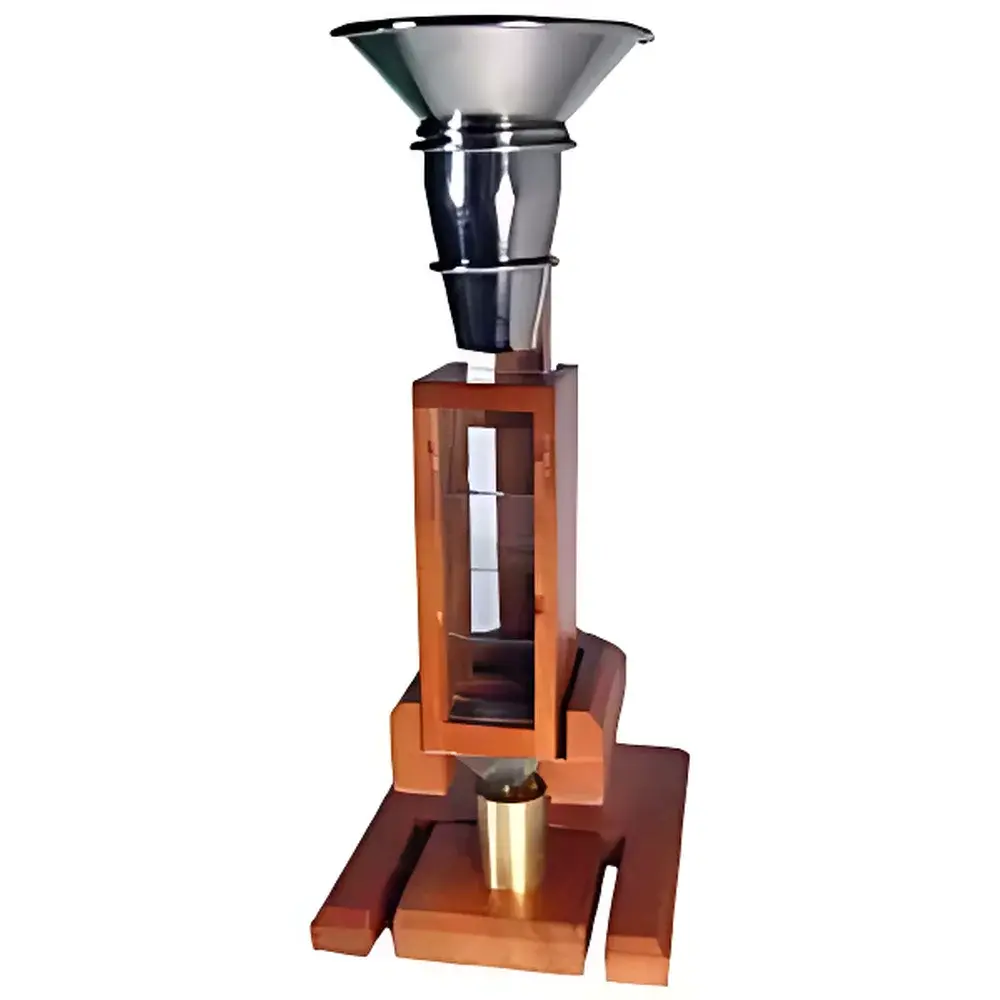
Scott Volumeter Model S6498516 (ASTM B329-90 Compliant)
| Origin | USA |
|---|---|
| Manufacturer Type | Authorized Distributor |
| Origin Category | Imported |
| Model | Scott Volumeter |
| Pricing | Available Upon Request |
| Standards Compliance | ASTM B329-90, USP <616>, NF 18 |
| Funnel Mesh Options | 10, 16, 18, or 40 mesh |
| Density Cup | Certified 25 cm³ brass cup (standard) |
Overview
The Scott Volumeter is a precision gravity-fed powder density measurement instrument engineered for the standardized determination of apparent (bulk) density of free-flowing particulate materials. It operates on the principle of controlled gravitational flow through calibrated funnels—typically stainless steel or brass—into a fixed-volume, certified density cup (25 cm³ brass cup, NIST-traceable calibration certificate available). The apparatus conforms to the fundamental design and procedural requirements specified in ASTM B329-90, “Standard Test Method for Apparent Density of Metal Powders Using the Scott Volumeter,” as well as USP and National Formulary 18 for microcrystalline cellulose and other pharmaceutical excipients. Its robust mechanical architecture eliminates reliance on vibration, air pressure, or electronic actuation—ensuring high inter-laboratory reproducibility and method transparency essential for regulatory submissions and quality control documentation.
Key Features
- Modular funnel system with interchangeable mesh configurations (10, 16, 18, and 40 mesh) to accommodate varying particle size distributions across material classes—from coarse refractory metal powders to submicron dry pigments.
- Factory-certified 25 cm³ brass density cup with dimensional verification per ASTM E542 and traceable calibration documentation; optional 1-inch volumetric measure and counterpoise assembly for specialized pigment testing per historical paint industry protocols.
- Stable base-and-stand construction fabricated from anodized aluminum and tempered glass components—including upper and lower funnels, vertical glass baffles, and alignment collars—to minimize airflow disturbance and ensure consistent powder trajectory during flow.
- No moving parts or power requirement: fully manual, operator-controlled operation supports GLP-compliant SOP execution and eliminates electronic validation burden in regulated environments.
- Compliance-ready configuration: pre-aligned geometry meets dimensional tolerances defined in ASTM B329-90 Annex A1, including funnel height, orifice diameter, and cup placement relative to funnel exit plane.
Sample Compatibility & Compliance
The Scott Volumeter is validated for use with free-flowing, non-cohesive powders exhibiting Hausner ratio ≤ 1.25 and Carr Index ≤ 15%. Primary application domains include: refractory metal powders (e.g., tungsten, molybdenum), fine elemental metal powders (e.g., nickel, cobalt), pharmaceutical excipients (microcrystalline cellulose, lactose monohydrate), ceramic precursors, and dry organic pigments. It satisfies mandatory testing requirements under USP for apparent density of microcrystalline cellulose in solid dosage form development and release testing. For metallurgical QC, it fulfills ASTM B329-90 acceptance criteria for batch-to-batch consistency evaluation prior to sintering or additive manufacturing feedstock qualification. Instrument setup and operator technique are documented in accordance with ISO/IEC 17025:2017 clause 7.2.2 for method validation and personnel competence assessment.
Software & Data Management
As a purely mechanical, analog measurement device, the Scott Volumeter does not incorporate embedded electronics, firmware, or proprietary software. All data acquisition is performed manually: mass of powder collected in the 25 cm³ cup is measured using an analytical balance (Class I, readability ≤ 0.1 mg, calibrated per ISO/IEC 17025), and apparent density is calculated as ρ = m/V (g/cm³). Laboratories implementing computerized systems may integrate results into LIMS or ELN platforms via structured CSV import or direct entry. For FDA-regulated facilities, manual records must include operator ID, balance calibration status, environmental conditions (temperature/humidity logged per USP ), and raw mass values—supporting full audit trail compliance under 21 CFR Part 11 when paired with secure electronic record practices.
Applications
- Pharmaceutical formulation: QC release testing of excipient bulk density to ensure consistent die filling during tablet compression.
- Powder metallurgy: Feedstock qualification for MIM (metal injection molding) and binder jetting AM processes where apparent density correlates with green strength and sintered density uniformity.
- Quality assurance in pigment manufacturing: Verification of dispersion stability and particle aggregation state via comparative bulk density shifts before and after surface treatment.
- Regulatory dossier support: Generation of method-validated apparent density data required for ANDA, NDA, and DMF submissions to FDA, EMA, and PMDA.
- Material specification conformance: Verification against supplier technical data sheets referencing ASTM B329-90 or internal corporate standards for powder handling and storage design.
FAQ
What standards does the Scott Volumeter comply with?
ASTM B329-90, USP , NF 18, and ISO 3953:1993 (for general bulk density of metal powders).
Is the 25 cm³ density cup NIST-traceable?
Yes—certified brass cups are supplied with dimensional verification reports traceable to NIST SRM 2192, valid for 12 months from date of issue.
Can the same instrument be used for both pharmaceutical and metallurgical powders?
Yes—provided the appropriate funnel mesh (10 mesh for MCC per USP, 16/18 mesh for metal powders per ASTM) and documented SOPs are applied for each material class.
Does the Scott Volumeter require annual recalibration?
No—mechanical geometry is stable; however, the density cup’s volume certification expires annually, and balance calibration must follow laboratory metrology schedule per ISO/IEC 17025.
Is operator training required for GLP-compliant use?
Yes—per USP , operators must demonstrate proficiency in funnel loading technique, timing consistency, and cup tapping protocol (zero taps unless otherwise specified by method).






