
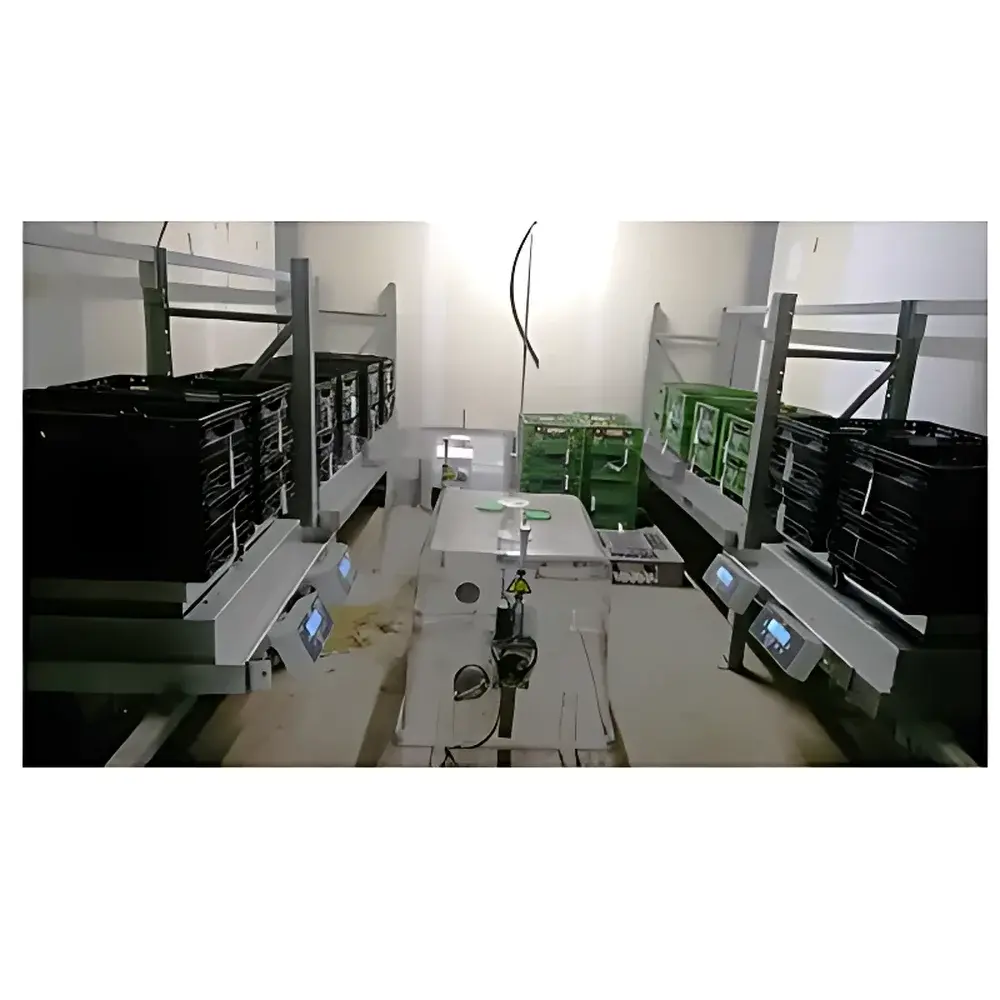
SCS p-Pod Post-Harvest Potato Monitoring System
| Brand | SCS |
|---|---|
| Origin | USA |
| Manufacturer Type | Authorized Distributor |
| Import Status | Imported |
| Model | p-Pod |
| Pricing | Available Upon Request |
Overview
The SCS p-Pod Post-Harvest Potato Monitoring System is a purpose-built, non-destructive respiration monitoring platform engineered for precision assessment of potato tuber physiological status during long-term controlled atmosphere (CA) storage. Operating on the fundamental principle of closed-chamber gas exchange kinetics, the p-Pod quantifies real-time O2 consumption and CO2 evolution rates—key metabolic indicators of tuber vitality, dormancy progression, and pre-sprouting stress. Unlike conventional spot-checking methods, the p-Pod provides continuous, high-temporal-resolution respiration indices derived from representative samples housed in standardized RPC trays. Its modular architecture enables deployment either as an isolated monitoring unit or integrated into existing CA storage infrastructure, delivering actionable insights without disrupting ambient storage conditions.
Key Features
- Automated, programmable isolation cycles via motorized solenoid valves—timed to cultivar-specific dormancy profiles
- Hermetically sealed sample chamber with integrated high-accuracy electrochemical O2 and NDIR CO2 sensors (±0.02% FS), coupled with calibrated capacitive humidity and PT100 temperature probes
- Respiration Index (RI) calculation engine compliant with ASTM D4715-22 methodology for post-harvest respiratory activity quantification
- SCS6000 remote control module enabling bidirectional communication, firmware updates, and parameter reconfiguration over LTE or Ethernet
- Cloud-native dashboard supporting multi-site comparison, historical trend analysis, and automated alert thresholds for RI deviation, CO2 accumulation, or thermal drift
- Web-based interface accessible via any modern browser (Chrome, Safari, Edge) and native iOS/Android applications—no proprietary client software required
Sample Compatibility & Compliance
The p-Pod accommodates four standard RPC (Reusable Plastic Container) trays—each holding 15–20 kg of commercially graded potato tubers—ensuring statistically representative sampling per USDA-AMS and EU Commission Regulation (EC) No 543/2011 guidelines. Chamber geometry and airflow dynamics are validated to minimize boundary-layer effects and ensure uniform gas diffusion across heterogeneous tuber surfaces. The system meets IEC 61000-6-3 (EMC emissions) and IEC 61000-6-2 (immunity) standards. Data integrity protocols align with FDA 21 CFR Part 11 requirements for electronic records and signatures, including full audit trails, user-level access controls, and immutable timestamped logs—supporting GLP/GMP-compliant storage operations.
Software & Data Management
Data acquisition, processing, and visualization are managed through the SCS Cloud Analytics Platform—a secure, ISO 27001-certified infrastructure hosted on AWS GovCloud. Raw sensor streams undergo real-time filtering, baseline correction, and stoichiometric respiration rate derivation using the Laisant equation (RQ = CO2/O2). Processed metrics—including hourly RI, cumulative respiration load, and dormancy decay slope—are stored with versioned metadata (sample ID, harvest date, variety, storage duration). APIs support integration with enterprise ERP (e.g., SAP S/4HANA) and CA controller systems (e.g., Priva, GEA). All reports comply with ISO 22000 traceability requirements and can be exported in CSV, PDF, or XLSX formats for regulatory submission.
Applications
- Optimizing timing and dosage of chlorpropham (CIPC) or alternative sprout suppressants based on quantitative RI thresholds—not calendar-based schedules
- Early detection of physiological stress preceding visible sprouting, enabling preemptive CA parameter adjustment (O2, CO2, temperature)
- Comparative evaluation of storage performance across cultivars, harvest batches, or pre-storage treatments (e.g., curing, fungicide application)
- Supporting third-party certification audits (e.g., GlobalG.A.P., SQF) with auditable, timestamped respiration data
- Feeding predictive models for shelf-life estimation and logistics planning in cold chain distribution networks
FAQ
How frequently does the p-Pod perform respiration measurements?
The isolation interval is fully programmable—from 2-hour cycles for high-risk early-season lots to 72-hour intervals during stable mid-season dormancy. Default configuration follows the industry-standard 24-hour cycle aligned with diurnal metabolic rhythms.
Can the p-Pod operate in ultra-low O2 (<1.5%) CA environments?
Yes. Its sensor stack is calibrated for operation across 0.5–21% O2 and 0–15% CO2, with pressure-compensated algorithms ensuring accuracy under sub-atmospheric storage conditions.
Is calibration required by the end user?
Zero-point calibration is automatic using internal reference gases; span calibration is performed annually by SCS-certified service engineers using NIST-traceable standards—documented per ISO/IEC 17025.
What happens if network connectivity is lost?
The p-Pod buffers up to 30 days of high-resolution sensor data locally on encrypted industrial-grade microSD storage, syncing automatically upon connection restoration without data loss.
Does the system support multi-variety simultaneous monitoring?
Each p-Pod unit monitors one homogeneous lot. For multi-variety sites, multiple p-Pod units are deployed per storage zone, with unified visualization in the cloud dashboard.




