
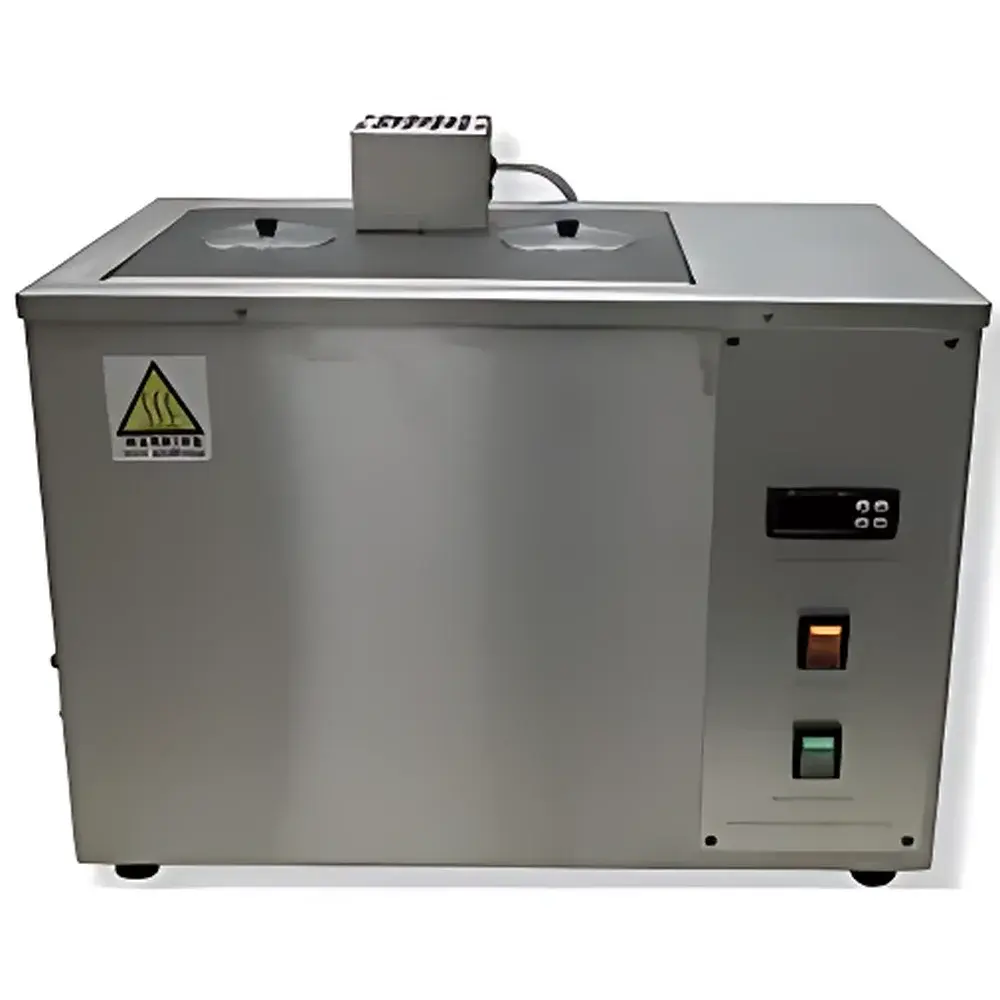
SDM 2020 Lubricating Grease Oxidation Stability Tester
| Brand | SDM |
|---|---|
| Origin | Italy |
| Model | 2020 |
| Temperature Range | Ambient to 120 °C (±0.1 °C stability) |
| Power Supply | 220 V, 50/60 Hz |
| Heating Power | 1200 W |
| Dimensions | 55 × 36 × 45 cm |
| Weight | 26 kg |
| Compliance | ASTM D942, IP 142, DIN 51808 |
| Construction | Double-walled insulated stainless steel housing |
| Safety Features | Low-level liquid alarm, over-temperature alarm, PT100A PID temperature controller, electric stirrer, dual-port lid for oxidation pressure vessels |
Overview
The SDM 2020 Lubricating Grease Oxidation Stability Tester is a precision-engineered benchtop instrument designed to evaluate the oxidative resistance of lubricating greases under accelerated, controlled atmospheric conditions. It operates on the principle of pressurized oxygen exposure at elevated temperatures—mimicking long-term aging in service environments—to quantify time-to-pressure-drop as a measure of oxidation onset. This gravimetric and manometric method aligns with internationally recognized test protocols that define oxidation stability as the elapsed time until a specified pressure decrease (typically 25.4 kPa or 3.7 psi) occurs in a sealed, oxygen-filled reaction vessel containing grease and a copper catalyst coil. The instrument’s core function is to provide reproducible, traceable data for formulation development, quality control, and regulatory compliance in lubricant manufacturing, OEM technical centers, and independent testing laboratories.
Key Features
- Double-walled, fully insulated stainless steel chamber ensures uniform thermal distribution and minimizes ambient interference—critical for maintaining ±0.1 °C temperature stability across the full operating range (ambient to 120 °C).
- PID-controlled temperature regulation using a calibrated PT100A platinum resistance thermometer enables precise setpoint tracking and automatic over-temperature cutoff to protect samples and hardware.
- Dual-port aluminum alloy lid accommodates two standard ASTM D942 oxidation pressure vessels (115 mL capacity), allowing parallel testing or reference/control comparison within a single run.
- Integrated electric stirring mechanism maintains consistent grease homogeneity during heating, preventing localized degradation and ensuring representative oxidation kinetics.
- Stainless steel immersion heater provides rapid thermal response and corrosion resistance in humid or condensate-prone operational environments.
- Redundant safety systems include audible/visual low-level liquid alarm (monitors bath fluid volume) and independent over-temperature alarm—both compliant with IEC 61000-6-2 electromagnetic compatibility requirements.
Sample Compatibility & Compliance
The SDM 2020 is validated for use with NLGI classes 000 through 3 greases, including lithium-, calcium-, aluminum-, and polyurea-thickened formulations. It supports both virgin and service-aged samples, provided they meet viscosity and volatility limits defined in ASTM D942 Annex A1. Instrument design and procedural execution conform strictly to three principal standards: ASTM D942 (Standard Test Method for Oxidation Stability of Lubricating Greases by Oxygen Pressure Drop), IP 142 (Institute of Petroleum Method 142), and DIN 51808 (German standard for grease oxidation testing). These protocols are routinely referenced in OEM specifications (e.g., SKF, FAG, Timken), ISO 6743-9 lubricant classification, and regional regulatory frameworks governing industrial lubricant registration. The system architecture supports GLP-compliant operation when paired with documented calibration records, maintenance logs, and operator training verification.
Software & Data Management
The SDM 2020 operates as a standalone hardware platform without embedded microprocessor control or digital data logging. All measurements—including pressure decay curves, temperature profiles, and alarm timestamps—are recorded manually or via external chart recorders compatible with 4–20 mA or 0–10 V analog outputs (optional interface module available upon request). Users maintain full traceability through standardized laboratory notebooks aligned with ISO/IEC 17025 documentation requirements. For laboratories requiring electronic data capture, the instrument integrates seamlessly with LIMS platforms via RS-232 or USB-to-serial adapters; raw pressure and temperature signals can be acquired using third-party DAQ systems compliant with FDA 21 CFR Part 11 audit-trail configurations when configured with appropriate software validation packages.
Applications
- Formulation screening of antioxidant packages (e.g., hindered phenols, amines, sulfur-containing compounds) in grease development labs.
- Batch release testing for industrial grease manufacturers supplying automotive, wind turbine, and mining equipment sectors.
- Comparative evaluation of base oil–thickener interactions under oxidative stress, supporting NLGI grade consistency studies.
- Failure analysis investigations where premature grease hardening or acid number rise correlates with field performance issues.
- Supporting ISO 5272 and ASTM D4950 classification reporting for multipurpose automotive greases (e.g., GC-LB certified products).
FAQ
What pressure vessel specifications does the SDM 2020 support?
It accepts standard ASTM D942-compliant 115 mL stainless steel oxidation vessels with copper catalyst coils, manufactured to ASTM F2134 dimensional tolerances.
Is calibration certification included with delivery?
Yes—each unit ships with a factory-issued calibration certificate for the PT100A sensor, traceable to NIST or EU-accredited national metrology institutes (e.g., INRIM, PTB).
Can the instrument operate continuously for extended test durations?
Yes—the robust thermal architecture and redundant safety interlocks permit unattended 100+ hour runs, provided bath fluid level and ambient ventilation meet manufacturer-specified thresholds.
Does it meet requirements for ISO/IEC 17025 accredited testing?
When operated within documented procedures, maintained per SDM’s service schedule, and verified with annual third-party calibration, the system satisfies Clause 6.4 (Equipment) and Clause 7.7 (Ensuring Validity of Results) of ISO/IEC 17025:2017.
Are replacement parts and consumables readily available?
SDM supplies OEM-certified pressure vessels, copper catalyst coils, silicone oil bath fluid, and PID controller modules with lead times under 4 weeks for EEA and North American distribution hubs.







