
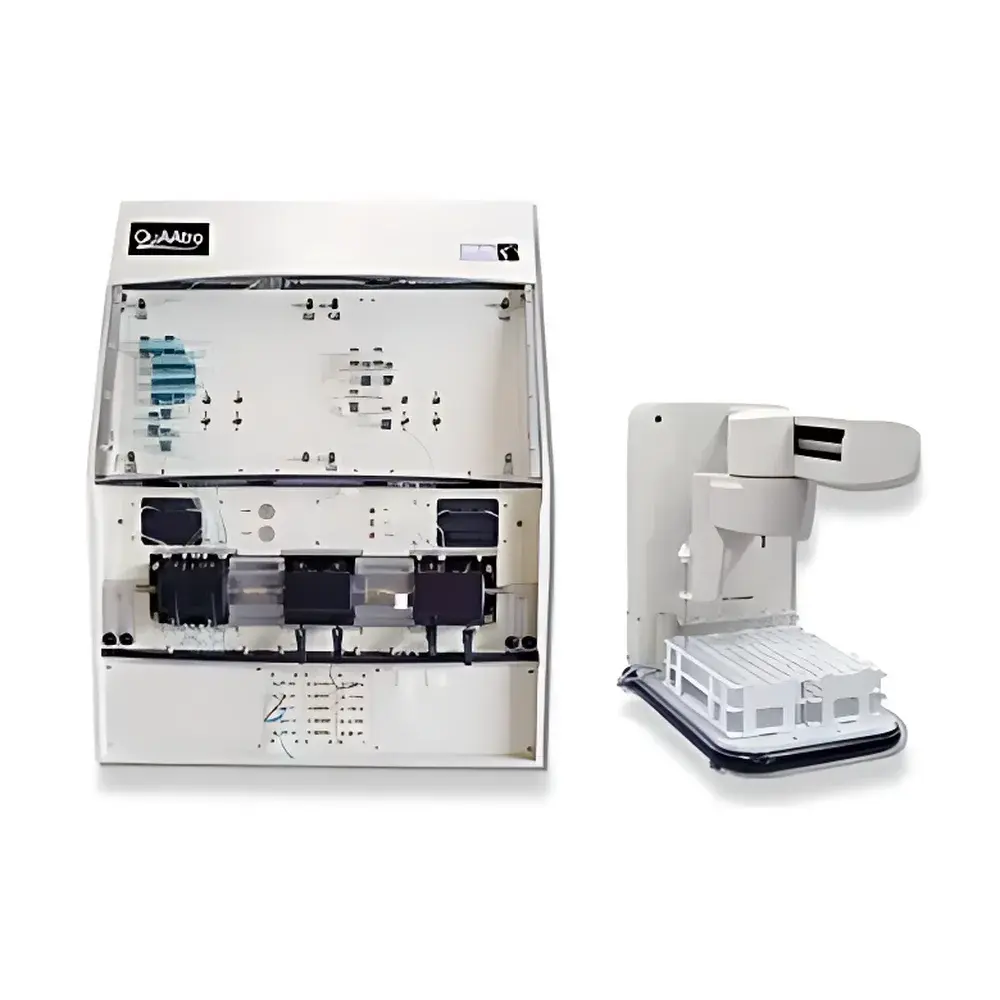
SEAL QuAAtro Continuous Flow Analyzer
| Brand | SEAL |
|---|---|
| Origin | Germany |
| Model | QuAAtro |
| Product Type | Continuous Flow Analyzer |
| Wavelength Range | 340–900 nm |
| Sample Capacity | 120 / 360 / 540 positions |
| Reagent Positions | 39 |
| Cuvette Path Length | 10 mm |
| Light Source | LED |
Overview
The SEAL QuAAtro Continuous Flow Analyzer is a vertically configured, high-precision wet-chemistry platform engineered for fully automated, high-throughput colorimetric and enzymatic analyses in environmental, industrial, food & beverage, pharmaceutical, and clinical laboratories. It operates on the principle of Segmented Flow Analysis (SFA), a well-established variant of continuous flow analysis (CFA) standardized under ISO 15681 and EPA methods. In SFA, discrete sample segments are separated by precisely injected air bubbles within a continuously flowing carrier stream. This segmentation prevents cross-contamination between samples, ensures reproducible reaction residence times, and enables robust, interference-resistant mixing and incubation in dedicated chemical modules (e.g., dialysis, digestion, distillation, or heating zones). Each reacted segment passes through a fixed-pathlength (10 mm) optical cell where absorbance is measured across a broad spectral range (340–900 nm) using stable, low-heat LED light sources—eliminating lamp drift and extending maintenance intervals. The system’s real-time peak-height detection and calibration against multi-point standard curves deliver quantitative results with high inter-run reproducibility and traceable accuracy.
Key Features
- Modular vertical architecture minimizing footprint while maximizing accessibility to fluidic paths, valves, and optical components
- Three configurable sample rack options (120-, 360-, or 540-position) supporting unattended overnight operation
- 39 independent reagent positions with integrated cooling (optional) and level sensing for critical reagents
- LED-based photometer with dual-beam compensation, delivering stable baseline performance over extended runs
- Integrated air-segmentation pump with programmable bubble frequency and volume control for precise segment definition
- Chemical modules compatible with on-line digestion (e.g., persulfate oxidation for total phosphorus), gas-diffusion (for ammonia), dialysis (for turbid or particulate-laden matrices), and temperature-controlled incubation (up to 100 °C)
- Robust fluidic design using chemically resistant tubing (PTFE, FEP, silicone) and corrosion-resistant manifold materials (e.g., PEEK, glass, quartz)
Sample Compatibility & Compliance
The QuAAtro accommodates diverse liquid matrices without manual pretreatment in most cases—including raw wastewater, seawater, soil leachates, wine musts, milk homogenates, pharmaceutical suspensions, and cosmetic emulsions. Its segmented flow architecture inherently handles moderate particulate load and variable viscosity better than flow injection systems. Method validation aligns with internationally recognized regulatory frameworks: over 300 validated chemistries are available, including EPA Methods 353.2 (nitrate/nitrite), 365.4 (phosphorus), 420.1 (cyanide), and 4500-NH3 F (ammonia); ISO standards 15681-1/2 (nutrients in water); and pharmacopoeial procedures compliant with USP , EP 2.2.45, and ICH Q2(R2) for method verification. The instrument supports full audit trails, electronic signatures, and data integrity features required for GLP and GMP environments under FDA 21 CFR Part 11.
Software & Data Management
QuAAtro is controlled via SEAL’s proprietary Quantra software—a Windows-based application designed for method development, sequence programming, real-time monitoring, and regulatory-compliant reporting. The software provides intuitive drag-and-drop method builder for configuring pumps, valves, heaters, and detectors; automatic peak integration with baseline correction algorithms; and dynamic calibration curve generation (linear, quadratic, or cubic fits with weighting). All raw absorbance traces, method parameters, user actions, and audit logs are timestamped and stored in an encrypted SQL database. Export formats include CSV, PDF analytical reports (with embedded chromatograms), and LIMS-ready XML. Optional 21 CFR Part 11 compliance package includes role-based access control, electronic signature workflows, and immutable archive export.
Applications
Validated applications span multiple sectors: environmental labs use QuAAtro for routine monitoring of NH3-N, NO2−, NO3−, PO43−, TN, TP, COD, phenols, cyanide, sulfide, and surfactants in drinking water, wastewater, and marine samples per HJ 665–667, SL/T 788, and HY-T 147.1. Food & beverage laboratories apply it to SO2, volatile acidity, reducing sugars, citric acid, and preservatives (sorbic/benzoic acid) in wines per SN/T 4675.23; and to lactose, urea, alkaline phosphatase, and nitrate in dairy products. Pharmaceutical QC labs deploy it for assay of antibiotics (ampicillin, amoxicillin), vitamins (B12, C), amino acids (lysine, phenylalanine), and excipients (glucose, sodium) in accordance with USP monographs. Industrial hygiene and cosmetics testing leverages its capacity for surfactant quantification (LAS, AES), total phosphorus, and enzyme activity (protease, amylase).
FAQ
What distinguishes Segmented Flow Analysis (SFA) from Flow Injection Analysis (FIA)?
SFA uses air segmentation to isolate discrete sample-reagent zones within a continuous carrier stream, ensuring consistent reaction time and minimizing dispersion. FIA injects discrete plugs into a flowing stream without segmentation, resulting in greater band broadening and lower precision for complex chemistries requiring precise timing or multi-step reactions.
Can QuAAtro handle turbid or high-solids samples?
Yes—via optional inline filtration or dialysis modules. For heavily suspended matrices (e.g., sludge extracts), pre-filtration (0.45 µm) is recommended prior to analysis to prevent clogging of narrow-bore tubing and manifolds.
Is method transfer from older SEAL AutoAnalyzer systems possible?
Yes. QuAAtro maintains full backward compatibility with legacy AutoAnalyzer III and QuikChem methods, including hardware pinout mapping and protocol syntax, enabling seamless migration without re-validation of existing SOPs.
How is wavelength selection managed during analysis?
The LED photometer operates at fixed, factory-calibrated wavelengths optimized per chemistry (e.g., 540 nm for phenol-hypochlorite, 660 nm for molybdenum blue). Multi-wavelength methods require sequential analysis using interchangeable optical filters or optional dual-LED configurations.
Does the system support remote diagnostics and service?
Yes. Quantra software includes secure remote access capability (with user permission) for SEAL Field Application Scientists to perform real-time troubleshooting, firmware updates, and preventive maintenance scheduling.
Related Products





