
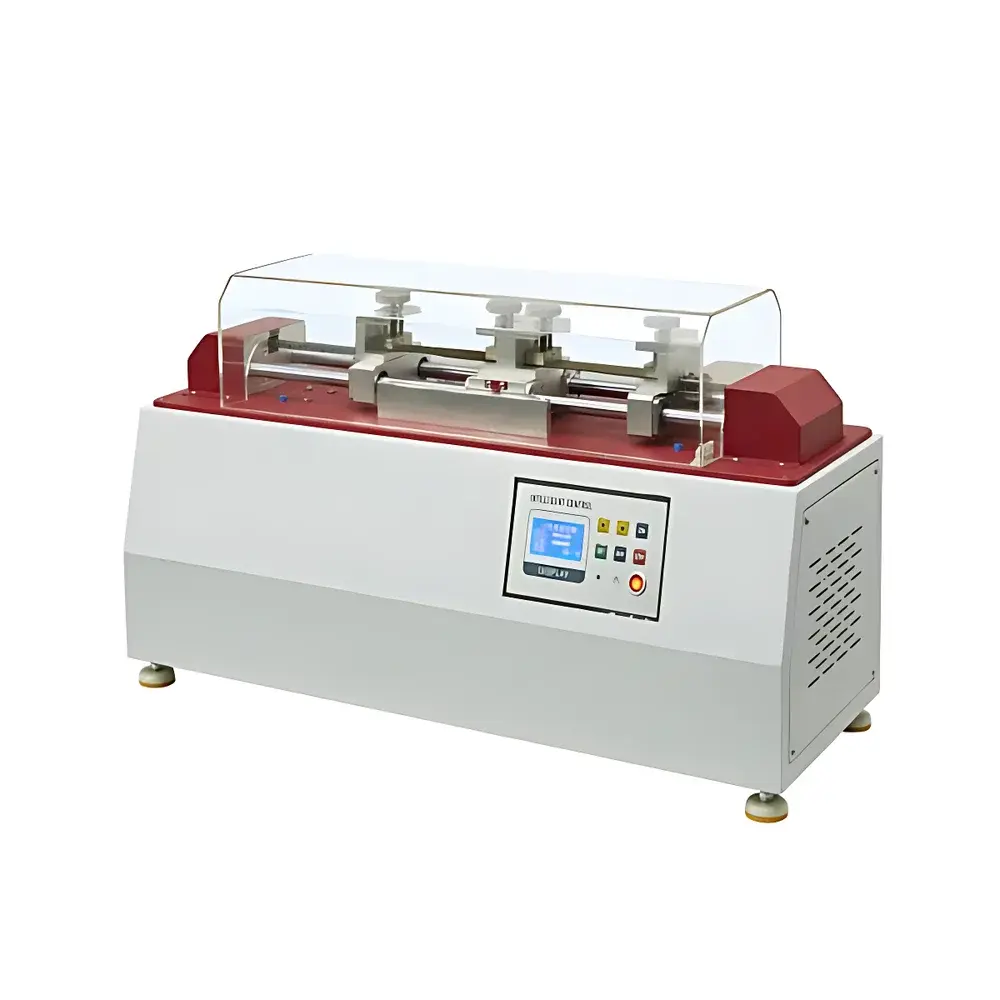
Seam Fatigue Tester ATD-200 / TTD–100 by NYX
| Brand | NYX |
|---|---|
| Origin | Tianjin, China |
| Manufacturer Type | Direct Manufacturer |
| Country of Origin | China |
| Model | ATD-200 / TTD–100 |
| Quotation | Upon Request |
| Dimensions (L×W×H) | 150 × 40 × 58 cm |
| Weight | 60 kg |
| Power Supply | AC 220 V, 50 Hz, 500 W |
| Operating Environment | 20 °C, 65 %RH |
| Installation Requirement | Bench-mounted |
Overview
The NYX ATD-200 / TTD–100 Seam Fatigue Tester is an electromechanical benchtop instrument engineered for standardized cyclic mechanical evaluation of seam integrity in automotive seating materials. It operates on the principle of controlled reciprocating motion applied to stitched or bonded fabric assemblies—simulating real-world flexing, shearing, and tensile stress conditions experienced during vehicle occupancy and long-term use. The system delivers repeatable, programmable displacement amplitude and frequency profiles to induce progressive degradation at stitch lines, enabling quantification of fatigue life (cycles to failure), seam slippage onset, and structural delamination thresholds. Designed specifically for compliance-driven R&D and quality assurance laboratories, this tester supports deterministic pass/fail assessment and comparative benchmarking against internationally recognized automotive material specifications.
Key Features
- Dual-mode operation: Configurable for both ATD (Abrasion & Tension Dynamic) and TTD (Tensile-Torsion Dynamic) test protocols per model designation, accommodating divergent fixture geometries and loading vectors.
- Programmable actuation: Stepper motor–driven crosshead with adjustable stroke range (±5–25 mm) and frequency control (0.1–5 Hz), ensuring precise replication of OEM-defined duty cycles.
- Integrated load monitoring: Optional high-resolution load cell (up to 500 N full scale) enables real-time force feedback and threshold-triggered termination upon predefined slippage or rupture criteria.
- Benchtop modular architecture: Compact footprint (150 × 40 × 58 cm) and 60 kg mass facilitate stable placement on ISO 554-compliant environmental test benches; no floor anchoring required.
- Compliance-ready calibration traceability: All mechanical and timing subsystems conform to internal QA procedures aligned with ISO/IEC 17025 requirements for testing equipment verification.
Sample Compatibility & Compliance
The ATD-200 / TTD–100 accommodates flat specimens up to 300 mm wide and 500 mm long, with clamping systems optimized for woven textiles, nonwovens, synthetic leathers, and laminated composites used in seat covers, headrests, and door trims. Fixture kits support standardized specimen mounting per JASO M 403 (seam peel), GMW 3405 (cyclic flex), BN 106-02 (tensile fatigue), SAE J 1531 (dynamic seam strength), and Chinese national standard GB/T 4043–2010 (determination of seam fatigue resistance). Test reports generated comply with GLP documentation standards, including operator ID, environmental log (temperature/humidity), calibration status, and raw cycle-count data—enabling audit readiness for Tier-1 supplier submissions and OEM PPAP packages.
Software & Data Management
The instrument operates via embedded firmware with USB interface for parameter upload and result export in CSV format. No proprietary runtime environment is required; exported datasets integrate natively with statistical process control (SPC) platforms such as Minitab or JMP. Cycle count, elapsed time, and optional load-channel timestamps are logged with millisecond resolution. Audit trail functionality records all user-initiated configuration changes and test start/stop events—supporting alignment with FDA 21 CFR Part 11 principles where electronic records are retained for regulatory review. Firmware updates are delivered via signed HEX files with version-controlled release notes.
Applications
- Validation of seam reinforcement strategies (e.g., double-stitching, thermobonding, ultrasonic welding) against OEM durability targets.
- Comparative evaluation of thread tensile modulus, needle penetration depth, and fabric weave density effects on fatigue initiation.
- Accelerated aging studies correlating seam performance with exposure to thermal cycling (per ISO 16750-4) and humidity preconditioning (per ISO 6270-2).
- Root cause analysis of field returns involving seam raveling, puckering, or catastrophic separation in driver/passenger seating zones.
- Supporting IATF 16949 clause 8.5.1.5 (process validation) through documented repeatability (n ≥ 10) and reproducibility (inter-operator) studies.
FAQ
What standards does the ATD-200 / TTD–100 directly support?
It is configured to execute test sequences defined in JASO M 403, GMW 3405, BN 106-02, SAE J 1531, TSL 5101G clauses 3.7 and 43.22, and GB/T 4043–2010 without hardware modification.
Is third-party calibration certification available?
Yes—NYX provides optional UKAS-accredited calibration certificates (traceable to NIM, China) for displacement, timing, and load channels upon request.
Can the system be integrated into a laboratory LIMS?
Raw CSV outputs are structured for automated ingestion via API or scheduled file polling; metadata fields include test ID, standard reference, specimen lot, and operator code.
What maintenance intervals are recommended?
Belt tension verification and linear guide lubrication every 500 operational hours; stepper motor encoder verification annually or after 10,000 cycles, whichever occurs first.
Does the tester meet CE or UKCA marking requirements?
As a benchtop industrial equipment unit intended for controlled laboratory environments (not general consumer use), it complies with EMC Directive 2014/30/EU and Low Voltage Directive 2014/35/EU per EN 61326-1 and EN 61000-6-3; CE documentation is supplied with shipment.
Related Products



